


Daily Dose Of Jazz…
Henry Butler was born September 21, 1949 in New Orleans, Louisiana and was blinded by glaucoma in infancy.His musical training began at the Louisiana State School for the Blind where he learned to play valve trombone, baritone horn and drums before focusing his talents on singing and piano. Mentored at Southern University by clarinetist and educator Alvin Batiste. He later earned a masters degree in music at Michigan State University in 1974, and received the MSU Distinguished Alumni Award in 2009.
He is known for his technique and his ability to play in many styles of music. He has been said to revel in fluency and facility, splashing chords all over the keyboard and streaking through solos with machine-gun articulation.Henry has recorded for Impulse, Windham Hill and Basin Street Records putting together a catalogue of eight albums to date.
With his home and vintage Mason & Hamlin piano destroyed by Hurricane Katrina’s floodwaters, Butler left New Orleans and briefly relocated to Boulder, and then Denver, Colorado before a final relocation to New York in 2009.
Butler’s pursuit of photography as a hobby since 1984, has culminated in his methods and photos being featured in an HBO2 documentary, Dark Light: The Art of Blind Photographers, airing in 2010 and has had his Butler’s photographs shown in galleries in New Orleans. The talented pianist and vocalist continues to perform, record and represent his generation of New Orleans pianists.
More Posts: piano
Daily Dose Of Jazz…
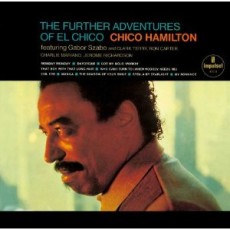
Chico Hamilton was born Foreststorn Hamilton on September 20, 1921 in Los Angeles, California and was on a drumming fast track musical education in a band with his schoolmates Charles Mingus, Illinois Jacquet, Ernie Royal, Dexter Gordon, Buddy Collette and Jack Kelso. Subsequent engagements with Lionel Hampton, Slim & Slam, T-Bone Walker, Lester Young, Count Basie, Duke Ellington, Charlie Barnet, Billy Eckstine, Nat King Cole, Sammy Davis Jr., Billie Holiday, Gerry Mulligan and six years with Lena Horne established this young West Coast prodigy as a jazz drummer on the rise, before striking out on his own as a bandleader in 1955.
He recorded his first LP as leader in 1955 on Pacific Jazz with George Duvivier and Howard Roberts and in the same year formed an unusual quintet in L.A. featuring cello, flute, guitar, bass and drums that has been described as one of the last important West Coast jazz bands. The original personnel: Buddy Collette, Jim Hall, Fred Katz and Jim Aton. Hamilton continued to tour using different personnel, from 1957 to 1960, Paul Horn and John Pisano that are featured in the film “Sweet Smell Of Success in 1957 and Jazz On A Summer’s Day with Nate Gershman and Eric Dolphy in 1960. Dolphy was enlisted to record on Hamilton’s first three albums, however by 1961 the group was revamped with Charles Lloyd, Gabor Szabo, George Bohannon and Albert Stinson.
Over the course of his career Chico changed personnel keeping his sound fresh and innovative. Subsequently he recorded for Columbia, Reprise and Impulse, scored for television, commercials and radio. He has worked with countless musicians and vocalists, received the New School Jazz and Contemporary Music Programs Beacons in Jazz Award and was awarded the WLIU-FM Radio Lifetime Achievement Award. He has been given a NEA Jazz Master Fellowship, was confirmed by Congress with the President’s nomination to the Presidents Council on the Arts, received a Living Legend Jazz Award as part of The Kennedy Center Jazz in Our Time Festival, as well as receiving a Doctor of Fine Arts from the New School where he currently teaches. Drummer Chico Hamilton continued to perform and record until his passing on November 25, 2013.
More Posts: drums
Daily Dose Of Jazz…
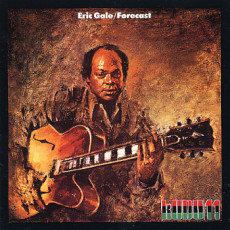
Eric J. Gale was born in Brooklyn, New York on September 20, 1938 and began playing the double bass when he was 12 years old, also playing tenor saxophone, trombone and tuba before settling on the guitar. The basis of his style was formed on the 50s and 60s R&B circuit.
He majored in chemistry at Niagara University but was determined to pursue a musical career, and began contributing to accompaniments for such stars as Maxine Brown, Jackie Wilson, The Flamingoes, The Drifters and Jesse Belvin in the 50s.
Eric began to attract rather quickly the attention of King Curtis and Jimmy Smith, who began recommending him for studio work. His reputation as a first call studio musician in the Sixties became widely recognized and he eventually appeared on an estimated 500 albums.
By the 70s he had teamed up with the AM/CTI label eventually working with Creed Taylor exclusively on CTI and its subsidiary label KUDU as a session musician. He finally got his break as a leader in 1973 with his well received “Forecast” LP that showcased his skill as a front man. He was a co-founder of the mid-70s funk band “Stuff” which garnered wide acclaim.
Among the list of Who’s Who musicians and vocalists he recorded with over the course of his career were David “Fathead Newman, Mongo Santamaria, Bob James, Paul Simon, Lena Horne, Johnny Hodges, Quincy Jones, Bob Marley, Nina Simone, Peter Tosh, Grover Washington Jr., Herbie Mann, Esther Phillips, Joe Cocker, Carly Simon, Van Morrison, Billy Joel and Aretha Franklin, along with a stint in her stage band.
Shortly after recording on Al Jarreau’s Tenderness album, guitarist Eric Gale died of lung cancer on May 25, 1994, at the age of 55 in Baja, California.
More Posts: guitar

Daily Dose Of Jazz…
Emily Remler was born September 18, 1957 in New York City and began playing the guitar when she was ten. Initially inspired by hard rock and other pop styles, she experienced a musical epiphany during her studies, from 1974 to 1976 while at the Berklee College of Music in Boston, Massachusetts. She began listening to Wes Montgomery, Miles Davis and John Coltrane taking up jazz with a ferocious intensity, practicing almost constantly, and never looked back.
After Berklee, she hit the New Orleans blues and jazz clubs working with FourPlay, and Little Queenie and the Percolators before beginning her recording career in 1981. Championed by guitar great Herb Ellis, he referred to her as “the new superstar of guitar”.
Emily recorded on the Concord label, quickly developing a distinctive style with her diverse influences through versions of standard tunes and genres. Her first album as a leader “Firefly” won immediate acclaim and her bop guitar on her follow up “Take Two” was equally well received. Her next two albums, “Transitions” and “Catwalk” traced the emergence of a more individual voice, with many striking original tunes, while her love of Wes Montgomery shone through on the stylish “East to Wes”.
In addition to her recording career as a leader and composer, Emily played in blues groups, on Broadway and with artists as diverse as Larry Coryell, Astrud Gilberto and Rosemary Clooney, produced two popular guitar instruction videos, won the “Guitarist Of The Year” award in Down Beat Jazz Magazine’s international poll, in 1988 she was “Artist in Residence” at Duquesne University and in 1989 received Berklee’s “Distinguished Alumni” award.
Guitarist, leader and composer Emily Remler died of heart failure at the age of 32 at the Connells Point home of musician Ed Gaston, while on tour in Australia on May 4, 1990.
More Posts: guitar
Daily Dose Of Jazz…
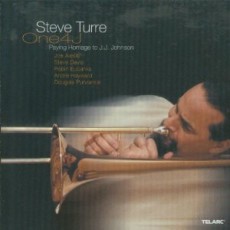
Steve Turre was born September 12, 1948 in Omaha, Nebraska but was raised in San Francisco, California to Mexican American parents. He began studying the violin but switched to trombone by age ten, later studying at the University of North Texas. By 1968 he was playing with Rahsaan Roland Kirk, went on to gig with Carlos Santana and toured with Ray Charles in 1972.
In 1970, encouraged by Kirk, Turre started playing conch and other seashells as musical lip-reed instrument. He has a collection of shells of various sizes, which he has picked up during his travels around the world. Turre leads “Sanctified Shells,” which is a “shell choir” made up of brass players who double on seashell releasing their first album in 1993.
Steve has had a long experience with Latin jazz he has become a skilled cowbell and Venezuelan maracas player. The internationally renowned trombonist, recording artist, arranger, and educator has won the Down Beat Reader’s poll for best trombonist in 1998, 1999, 2001, 2002 and 2006. He has been the trombonist for the Saturday Night Live band since 1985 and has taught jazz trombone at the Manhattan School of Music since 1988.
Turre has recorded 18 albums as a leader and has worked as a sideman on another 206 sessions with such luminaries as Monty Alexander, Carl Allen, Art Ensemble of Chicago, Frank Wess, Ray Barretto, Andy Bey, Art Blakey, Lester Bowie, Don Braden, Cecil Bridgewater, McCoy Tyner and Kenny Burrell among others. He continues to perform, record and tour.