

Daily Dose Of Jazz…
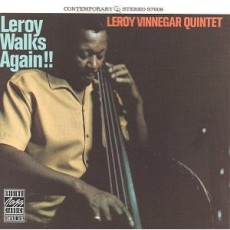
Leroy Vinnegar was born on July 13, 1928 in Indianapolis, Indiana and the self-taught bassist established his reputation in Los Angeles during the 50s and 60s. His trademark was the rhythmic “walking” bass line, a steady series of ascending or descending notes, and it brought him the nickname “The Walker”. Besides his jazz work, he also appeared on a number of soundtracks and pop albums, notably Van Morrison’s 1972 album, Saint Dominic’s Preview.
He recorded extensively as both a leader and sideman and came to public attention in the 1950s as a result of recording with Lee Konitz, Andre Previn, Stan Getz, Shorty Rogers, Chet Baker, Shelly Manne, Joe Castro and Serge Chaloff. He played bass on Previn and Manne’s My Fair Lady album, one of the most successful jazz records ever produced. He also performed on another of jazz’s biggest hit albums, Eddie Harris and Les McCann’s “Swiss Movement” released in 1969.
Moving to Portland, Oregon in 1986, the Oregon State Legislature honored him in 1995 by proclaiming May 1st as Leroy Vinnegar Day. The bassist died from a heart attack at the age of 71 in Portland on August 3, 1999.
More Posts: bass
Daily Dose Of Jazz…
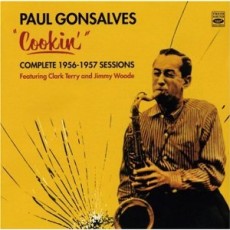
Paul Gonsalves was born July 12, 1920 in Brockton, Massachusetts to Cape Verdean parents. His first instrument was the guitar, and as a child he was regularly asked to play Portuguese folk songs for his family. Growing up in New Bedford, Massachusetts he was a member of the Sabby Lewis Orchestra.
His first professional engagement in Boston was with the same group on tenor saxophone, that he had learned to play prior to and during World War II military service. After the war he played in Count Basie and Dizzy Gillespie’s big bands before joining the Duke Ellington Orchestra in 1950.
At the 1956 Newport Jazz Festival, Gonsalves’ solo in Ellington’s song “Diminuendo and Crescendo in Blue” contained 27 choruses and the publicity from which is credited with reviving Ellington’s career. This performance is captured on the album Ellington at Newport. He was a featured soloist in numerous Ellingtonian settings and received the nickname “The Strolling Violins” from Ellington for playing solos while walking through the crowd.
Tenor saxophonist Paul Gonsalves died on May 15, 1974 in London just a few days before Duke Ellington’s death. Gonsalves and Ellington, along with trombonist Tyree Glenn, lay side-by-side in the same New York funeral home for a period of time.
More Posts: saxophone
Daily Dose Of Jazz…
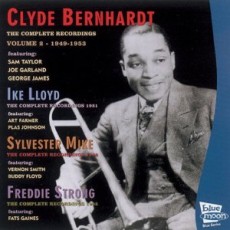
Clyde Bernhardt, born July 11, 1905 in Gold Hill, North Carolina, grew up in Harrisburg, Pennsylvania. He started playing trombone at 17 and in the Twenties performed in a series of lesser-known ensembles such as Bill Eady’s Ellwood Syncopators, Tillie Vennie, Odie Cromwell’s Wolverine Syncopators and The Whitman Sisters to name a few. In 1931 he worked with King Oliver and throughout the thirties played with Alex Hill, The Alabamians, Billy Fowler, Ira Coffey’s Walkathonians and Vernon Andrade.
In 1937 he joined the orchestra of Edgar Haye until 1942 then worked with Jay McShann, Cecil Scott, Luis Russell, Leonard Feather, Pete Johnson, Wynonie Harris, Claude Hopkins and the Bascomb brothers. He led his own ensemble, called the Blue Blazers, before returning to play with Russell from 1948-51. He recorded as a leader between 1946 and 1953, and on some of the recordings he sings under the pseudonym Ed Barron.
From 1952 to 1970 he played part-time with Joe Garland’s Society Orchestra followed with his leading the Harlem Blues and Jazz Band from 1972 and 1979 with sidemen Doc Cheatham, Charlie Holmes, Happy Caldwell, Tommy Benford and Miss Rhapsody. Shortly before his death he published his autobiography “I Remember” co-written with Sheldon Harris. As Bernhardt’s health began to fail in 1979, he gave up band leadership but played in Barry Martyn’s Legends of Jazz until his death on May 20, 1986 in Newark, New Jersey.
More Posts: trombone
Daily Dose Of Jazz…
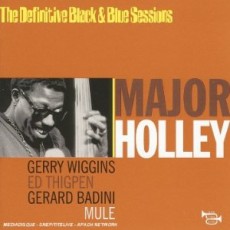
Major Holley was born on July 10, 1924 in Detroit, Michigan and started his music lessons playing violin and tuba at a young age. He started playing bass while serving in the Navy. In the latter half of the 1940s he played with Dexter Gordon, Charlie Parker, and Ella Fitzgerald. In 1950 he and Oscar Peterson recorded duets, and he also played with Peterson and Charlie Smith in a trio setting.
In the mid-1950s Major moved to England, working at the BBC. Upon returning to America he toured with Woody Herman in 1958 and with Al Cohn/Zoot Sims in 1959-60. A prolific studio musician, he played with Duke Ellington in 1964 and with the Kenny Burrell Trio, Coleman Hawkins, Lee Konitz, Roy Eldridge, Michel Legrand, Milt Buckner, Jay McShane and Quincy Jones during the Sixties and Seventies.
He was also noted for singing along with his arco (bowed) bass solos, a technique Slam Stewart also used. Holley and Stewart recorded together on two albums during the 1970s.
Never one far from the educational process, informal or formal, Holley was a professor and taught at the Berklee College of Music from 1967 to 1970. Upright jazz bassist Major Holley passed away on October 25, 1990 in Maplewood, New Jersey.
More Posts: bass

Daily Dose Of Jazz…
Colin James Bailey was born July 9, 1934 in Swindon, England and learned to play drums as a child, studying formally from age seven. Living in Australia from 1958 into the early 1960s, he played with Bryce Rohode and the Australian Jazz Quartet. While the AJQ toured the U.S., Bailey was hired by Vince Guaraldi to play alongside Jimmy Witherspoon and Ben Webster until 1963.
Settling in California, Bailey worked throughout the sixties with Claire Fischer, Victor Feldman, Joe Pass and Miles Davis; toured worldwide with Benny Goodman and George Shearing, played on a television program with Terry Gibbs and played with Chet Baker, Ray Brown, Joao Gilberto and Blossom Dearie in 1975.
In 1970, Bailey became an American citizen and spent six years as Ed Shaughnessy’s backup in the Tonight Show band, and starred in Fernwood Tonight in a drumming role in 1977-78. After a move to Texas in 1979, he became a faculty member at North Texas State University from 1981-84.
Drummer Colin Bailey’s later work includes time with Richie Cole, Jimmy Rowles, Red Mitchell, Stefan Scaggliari, Ron Affif, John Pisano, Weslia Whitfield, George H. Russell, Shelly Manne, Victor Feldman and re-teaming with Joe Pass.
More Posts: drums