


Daily Dose Of Jazz…
Harry Dial was born on February 17, 1907 in Birmingham, Alabama who became one of the classic drummers of the early jazz world. His specialty was keeping time behind artists known for their fun and pep. In fact, a glance at Dial’s discography is something like a partial scan of the most entertaining albums of all time, because such a list would surely include sides by two guys named Louis, Armstrong and Jordan, as well as Fats Waller and Ella Fitzgerald.
Harry was a solid, energetic drummer who pushed the beat forward without cluttering the airspace. His use of the sock cymbal and his fat, marching band snare drum sound are often imitated. He was also one of the rare breeds of singing drummers, the vocal side of his talents usually only exposed when he was in charge of the band. He was allowed to make comments on records with Fats Waller, the best example of which is the introduction to the upbeat Don’t Let It Bother You.
Dial’s career as a bandleader included a series of sides for Vocalion beginning in 1930. The group, whose recordings included the deadly “Poison,” was known as Harry Dial’s Blusicians, and included players such as banjoist Eursten Woodfork, trumpeter Shirley Clay, and the fine alto saxophonist Lester Boone. Some of this material has been reissued on the compilation Chicago 1929-1930: That’s My Stuff.
He was already recording with Armstrong around this time and began cutting tracks with Waller as a member of Fats Waller’s Rhythm before the middle of that decade. It might have taken him an additional ten years to master the art of playing the maracas since he seemed to find a way to include the delicate shakers on just about every funny style of music he played with Jordan beginning in the mid-’40s when he joined the Tympany Five.
In the late ’40s, he took another crack at recording under his own name, producing “Prince’s Boogie” for Decca with one of the earliest versions of the catchy “Diddy Wah Diddy” on the flipside. Dial liked to write as well, beginning with a song entitled “Don’t Play Me Cheap,” recorded by the famous Armstrong. His songs were also recorded by the merely infamous, a category that would not exist if it didn’t include a singer named Bea Booze, who cut Dial’s “Catchin’ as Catch Can” for Decca in 1942.
Many years later, the drummer published his All This Jazz About Jazz: The Autobiography of Harry Dial. The dapper, suave musician would have felt it important that he is most certainly not the Harry Dial who made it into the Guinness Book of World Records by claiming to have gone 78 years without bathing. Drummer Harry Dial passed away on January 25, 1987 in New York City.
More Posts: author,bandleader,drums,history,instrumental,jazz,music
Daily Dose Of Jazz…
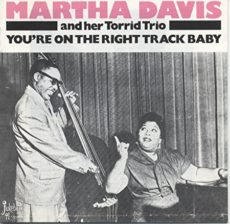
Martha Davis was born on December 14, 1917 in Wichita, Kansas, and was raised in Chicago, Illinois. By the mid-1930s, she had met and been influenced by Fats Waller, and performed regularly as a singer and pianist in Chicago clubs. In 1939, she met, and later married, bassist Calvin Ponder, who went on to play in Earl Hines’ band.
In 1948, Davis moved to California, and developed her recording career on Jewel Records in Hollywood with a trio including Ponder, guitarist Ralph Williams and drummer Lee Young. Their cover of Dick Haymes’ pop hit Little White Lies followed by a duet with Louis Jordan, Daddy-O in 1948, reached # 11 and #7, respectively, on the Billboard charts.
Davis and Ponder also began performing together on stage, developing a musical and comedy routine as “Martha Davis & Spouse” which played on their physical characteristics, she was large, he was smaller. The act became hugely popular, touring and having a residency at the Blue Angel in New York City. They appeared together in movies including Smart Politics with Gene Krupa, and in the mid-Fifties, variety films Rhythm & Blues Revue, Rock ‘n’ Roll Revue and Basin Street Revue. Several of their performances were filmed by Snader Telescriptions for video jukeboxes, and they also broadcast on network TV, particularly Garry Moore’s CBS show.
In 1957, after a break of several years, they resumed recording for the ABC Paramount label, with whom they cut two LPs. Singer and pianist Martha Davis passed away from cancer in New York on April 6, 1960 at age 42.
Daily Dose Of Jazz…
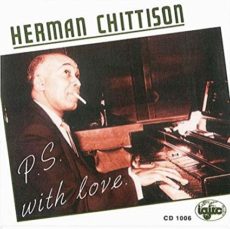
Herman Chittison was born on October 15, 1908 in Flemingsburg, Kentucky. Known as Ivory in the jazz world he began his career in Zack Whyte’s territory band in Ohio in 1928. In the early Thirties he moved to New York City and found work as an accompanist to Ethel Waters, Adelaide Hall, and Clarence Williams. It was during these years that he visited Boston for the first time with a traveling show headlined by comic actor Stepin Fetchit.
In late 1933 he went to Europe with the Willie Lewis Orchestra and toured Europe and the following year he recorded with Louis Armstrong in Paris, France. Chittison and trumpeter Bill Coleman left Lewis in 1938 and formed a band that worked extensively in Cairo, Egypt and traveled as far east as India. The two musicians would later lead the Harlem Rhythm Makers.
By 1959 Ivory arrived in Boston for a stay of two years and took up residence as the house pianist at the Red Garter bar in the Lenox Hotel. He then moved to the Mayfair Lounge, in Bay Village. He was one of the earliest and most important ambassadors of American jazz in Europe.
Stride pianist, accompanist and virtuoso Herman Chittison, whose style and technique were very similar to Art Tatum, passed away on March 8, 1967 in Cleveland, Ohio.

More Posts: piano

Daily Dose Of Jazz…
Teddy Weatherford was born on October 11, 1903 in Pocahontas, Virginia and was raised in neighboring Bluefield, West Virginia where he learned to play the piano. But it was while living in New Orleans, Louisiana from 1915 through 1920, that he learned to play jazz piano.
Moving to Chicago, Illinois he worked with the bands of Erskine Tate through the 1920s and with such jazz notables as Louis Armstrong and Johnny Dodds and impressed the young Earl Hines. Restless to experience the world, Weatherford then traveled, first to Amsterdam and then around Asia playing professionally. In the early 1930s, he led a band at the Taj Mahal Hotel in Bombay, now Mumbai, India. He joined Crickett Smith’s band in Jakarta, Indonesia and took over leadership of Smith’s band in Ceylon, now Sri Lanka, in 1937.
During World War II, Teddy led a band in Calcutta, where he made radio broadcasts for the U. S. Armed Forces Radio Service. Performers with in his band included Bridget Althea Moe, Jimmy Witherspoon, Roy Butler and Gery Scott.
Pianist and bandleader Teddy Weatherford, who was also an accomplished stride pianist, passed away of cholera in Calcutta, aged 41, on April 25, 1945.

More Posts: piano
Daily Dose Of Jazz…
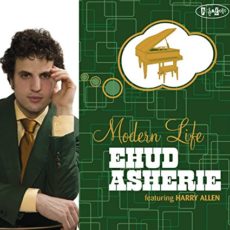
Ehud Asherie was born on December 20, 1979 in Israel and with his family moved to Italy at the age of three. He started playing piano at the age of seven and attended the Sir James Henderson School, now The British School of Milan, before they moved to the United States when he was nine. As a New York City teenager he visited Smalls Jazz Club, taking private lessons from Frank Hewitt, a pianist who often played there and attending the New School University.
Asherie first played at Smalls when he was a high school sophomore. In 2010 he recorded his debut solo piano album, Welcome to New York with a focus on stride and standards. The same year he played Hammond organ on his quartet release, Organic, mixing bop and swing with standards.
He has recorded seven albums as a leader ranging from duo to quintet group configurations on the Arbor and Posi-Tone labels. He has been a sideman recording with Bryan Shaw, Hilary Gardner and Harry Allen. He has performed with Peter Bernstrin, Joe Cohn, Billy Drummond, Bobby Durham, Frank Gant, Paul Gill, Jimmy Green, Dennis Irwin, Jimmy Lovelace, Joe Magnarelli, Bob Mover, Tim Pleasant, Ben Street and Mark Taylor.
Pianist and organist Ehud Asherie has for two years been playing regularly at Smalls with his own trio, the Grant Stewart Quartet and the Neil Miner Quintet. He has also served as a rehearsal pianist for the Village Vanguard Orchestra and Since January 2000 he’s part of Trio65 at New York City’s Rainbow Grill with bassist Joseph Lepore and drummer Tommaso Cappellato. He continues to perform, record and tour.
Sponsored By

Voices From The Community

More Posts: piano