

Daily Dose Of Jazz…
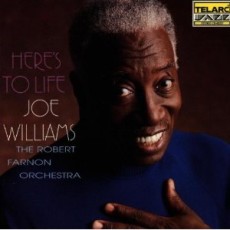
Joe Williams was born Joseph Goreed on December 12, 1918 in Cordele, Georgia but was raised in Chicago from the age of four by his mother, grandmother and aunt. As a child he was greatly influenced by the rebellious sound of jazz from Louis Armstrong, Duke Ellington, Ethel Waters, Cab Calloway, Big Joe Turner and many others of the 1920’s he would hear on the radio. By his early teens, he had already taught himself to play piano and had formed his own gospel vocal quartet, known as “The Jubilee Boys”, that sang at church functions.
During his mid-teens Williams began performing as a vocalist, singing solo at formal events with local bands. The most that he ever took home was five dollars a night, but that was enough to convince his family that he could make a living with his voice. So, at 16, he dropped out of school, created his stage name to “Williams” and began earnestly marketing himself to Chicago clubs and bands. His first job was singing with the band at Kitty Davis’s club during the evening for tips that would sometimes amount to $20.
Williams first real break came in 1938 when clarinetist Jimmy Noone invited him to sing with his band. Less than a year later, the young singer was earning a reputation at Chicago dance halls and on a national radio station that broadcast his voice across the nation. Soon he was touring the Midwest by 1939 and accompanying Louis Armstrong and Fats Waller, a year later toured with Coleman Hawkins. In 1942 Lionel Hampton hired Joe to fill-in for the regular vocalist for the orchestra, the Tic Toc Club in Boston and cross-country tours. By the time the relationship ended Williams was in great demand. Through the 40s he toured and made his first recording with Andy Kirk, which led to working with Red Saunders and recording for Okeh and Blue Lake Records.
He went on to sing with the Count Basie Orchestra from ’54 to 61 with his first recording “Count Basie Swings, Joe Williams Sings” that hit #2 on the charts and sparked another LP, he won Down Beat magazine’s New Star Award and international critic’s Best New Male Singer and reader’s poll Best Male Band Singer. Through the end of the 50s the band was consistently touring Europe.
By the Sixties he was working a solo career with top-flight jazz musicians like Harry “Sweets” Edison, Clark Terry, George Shearing and Cannonball Adderley. He did all the variety shows from The Tonight Show to Joey Bishop, Merv Griffin, Steve Allen and Mike Douglas. He gained further notoriety as the father-in-law on The Cosby Show.
Baritone Joe Williams continued to perform regularly at jazz festivals in the U.S. and aboard, as well as on the nightclub circuit. He received a star on the Hollywood Walk Of Fame in 1983 next to Count Basie, sang Ellington’s Come Sunday at Basie’s funeral, performed the title track All of Me in the Steve Martin/Lily Tomlin vehicle, won two Grammy Awards and enjoyed a successful career, working regularly until his death of natural causes at age 80. He collapsed on the street a few blocks from his home on March 29, 1999 in Las Vegas, Nevada.
More Posts: vocal
From Broadway To 52nd Street
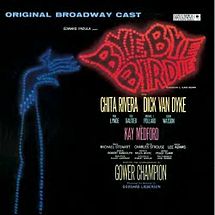
Bye-Bye Birdie opened at the Martin Beck Theatre on April 14, 1960 with Lee Adams and Charles Strouse composing the music. Running 607 performances the musical starred Dick Van Dyke, Chita Rivera, Dick Gautier, Kay Medford, Susan Watson and Paul Lynde. Two actors, Van Dyke and Lynde would go on to star in the film version. A Lot Of Livin’ To Do and Put On A Happy Face are two compositions that would go on to become jazz standards.
The Story: A popular rock star, Conrad Birdie, is about to be drafted and his agent, Albert, arranges a coup he hopes will keep revenues coming in during Conrad’s stint and allow him to marry Rosie. They pick a girl in a small American town to represent girls across the country to be sung to one last time before Conrad enters the service. Albert’s mother is against the marriage and breaks it up. Conrad goes off to have a wild night, Albert wins back Rosie but everything is turned upside down in the small town.
Broadway History: An Off-Off-Broadway production that features members of Actors Equity is called an Equity Showcase production, however, not all Off-Off-Broadway shows are Equity Showcases. The union maintains very strict rules about working in such productions, including restrictions on price, the length of the run and rehearsal times. Professional actors’ participation in showcase productions is frequent and comprises the bulk of stage work for the majority of New York actors. There has been an ongoing movement to revise the Equity Showcase rules, which many in the community find overly restrictive and detrimental to the creation of New York theatre.
The term indie theatre, or independent theatre, coined by playwright Kirk Bromley, has been adopted by many as a replacement for the term Off-Off-Broadway, and is used by groups such as The League of Independent Theater and the website nytheatre.com.
Sponsored By

www.whatissuitetabu.com

Daily Dose Of Jazz…
Cassandra Wilson was born December 4, 1955 in Jackson, Mississippi, the youngest child of guitarist, bassist and educator Herman Fowlkes, Jr. and between her parent’s love of Motown and jazz, her early interest in music was ignited.
Wilson’s earliest formal musical education consisted of classical lessons, studying piano from age of six to thirteen and playing clarinet in the middle school concert and marching bands. She then took what she calls an “intuitive” approach to learning to play the guitar and began writing songs and adopting a folk style. While in college she spent nights working with R&B, funk and pop cover bands and singing in local coffeehouses. But it wasn’t until her association with The Black Arts Music Society that she got her first opportunity to sing bebop.
By 1981 Cassandra was working television public affairs in New Orleans but the pull towards jazz was strong and began working with mentors Earl Turbinton, Alvin Batiste and Ellis Marsalis. With their encouragement she moved to New York to seriously pursue jazz singing the following year. There her focus turned towards improvisation, heavily influenced by Abbey Lincoln and Betty Carter. She fine-tuned her vocal phrasing and scat while studying ear training with trombonist Grachan Moncur III and frequenting jam sessions under the tutelage of pianist Sadik Hakim.
A meet with altoist Steve Coleman reinforced Wilson to look beyond the jazz repertoire in favor of composing original music. This led her to become the vocalist and one of the founding members of the M-Base Collective in which Coleman was the leading figure, a stylistic outgrowth of the early-formed Association for the Advancement of Creative Musicians and Black Artists Group.
Cassandra recorded her first project as a leader “Point of View” in 1986 utilizing M-Base members Coleman, Jean-Paul Bourelly and James Weidman. As subsequent albums followed she would develop a remarkable ability to stretch and bend pitches, elongate syllables, manipulate tone and timbre from dusky to hollow. She would receive broad critical acclaim for “Blue Skies” that would eventually lead to her signing with Blue Note.
She has effectively reconnected vocal jazz with its blues roots, but is arguably the first to convincingly fashion post-British Invasion pop into jazz, trailblazing a path that many have since followed. Wilson was a featured vocalist with Wynton Marsalis’ Pulitzer Prize winning composition “Blood On The Fields”, paid tribute to her greatest influence Miles Davis with “Traveling Miles”.
Cassandra has been a side- woman and guest vocalist on numerous recordings of such jazz luminaries as Terence Blanchard, Regina Carter, Don Byron, Jacky Terrasson, Charlie Haden, David Murray and Teri Lynne Carrington among others. She has performed on 13 soundtracks, featured singer in two movies, has received an honorary doctorate from Millsaps College, been named America’s Best Singer by Time Magazine and has won two Grammy Awards.
Contralto Cassandra Wilson has an unmistakable timbre and approach as she is expanding the playing field by incorporating country, blues and folk with jazz while continuing to perform, tour and record.
More Posts: vocal

From Broadway To 52nd Street
West Side Story opened at the Winter Garden Theatre on September 26, 1957. Stephen Sondheim and Leonard Bernstein composed and wrote the score for the musical that ran 732 performances. Larry Kert, Carol Lawrence, Chita Rivera, Mickey Cain and Ken Leroy were the stars of the show that gave the jazz world such classics as Somewhere, I Feel Pretty, Tonight, Maria and Cool.
The Story: On the streets of West Side Manhattan in the late summer of 1957, there is mounting racial tension between rival white American and Puerto Rican gangs to maintain control of the neighborhood – the Jets and the Sharks. An interracial relationship blossoms between Tony and Maria who see past their ethnic differences. However, Maria’s brother Bernardo and leader of the Sharks does not want this love-match to succeed. Destined to be short-lived, a rumble between the two gangs ensues, Maria begs Tony to stop it, the fight escalates from lists to knives and Tony ultimately kills Bernardo.
When Bernardo’s girlfriend Anita learns of his death she is overcome with emotion and seeking out Maria, who already knows, discovers Tony is with her. Tony leaves for refuge at Doc’s drugstore after which they learn that Chino was seeking revenge for Bernardo by shooting Tony. Maria begs Anita to go tell Tony but after a mock rape at the hands of the Jets, Anita delivers a different message – that Maria is dead. In shock Tony runs out screaming for Chino to come kill him. On the playground Tony and Maria see each other but before they can embrace Chino shoots and kills Tony.
Broadway History: The Off-Off-Broadway movement began in 1958 as a reaction to Off-Broadway, and a “complete rejection of commercial theatre”.[2] Among the first venues for what would soon be called “Off-Off-Broadway” were coffeehouses in Greenwich Village, particularly the Caffe Cino at 31 Cornelia Street, operated by the eccentric Joe Cino, who early on took a liking to actors and playwrights and agreed to let them stage plays there without bothering to read the plays first, or to even find out much about the content. Also integral to the rise of Off-Off-Broadway were Ella Stewart at La MaMa and Al Carmines at the Judson Poets’ Theater, located at Judson Memorial Church, Playbox Studio, New York Theatre Ensemble, The Old Reliable, The Dove Company and the Nuyorican Poets Cafe.
Sponsored By
www.whatissuitetabu.com
Daily Dose Of Jazz…
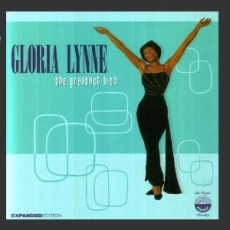
Gloria Lynne was born Gloria Wilson on November 23, 1931 in New York City and grew up in Harlem. Her professional career began in 1951 after winning first prize at the “Amateur Night” at the Apollo Theater. She shared the stage with contemporary nightclub vocal ensembles as well as with Ella Fitzgerald. During the Fifties she recorded as part of such groups as The Enchanters, The Del Tones and recording as a soloist under her birth name. However, most of her work was released under her stage name on both Everest and Fontana record labels.
Gloria showed much promise early on, especially after TV appearances, including the Harry Belafonte Spectacular, but her development suffered through poor management, some unscrupulous recording executives who profited while she was left virtually penniless, saved only by the fact that she was able to work steadily and earn her money from performance.
Throughout the 1960s she had several hits including “June Night”, “Love I Found You,” and “I Wish You Love” in 1964 that became a big hit and her signature song, “I’m Glad There Is You” and a pop tune “(You don’t have to be a) Tower Of Strength” that proved her versatility. Lynne went on to record such albums as “Soul Serenade”, “Love And A Woman”, “Where It’s At”, and “Here, There And Everywhere” all of which showcased her versatility in jazz, R&B, soul and melodic “pop”.
During her earlier years on-the-road she shared bills with Ray Charles, Billy Eckstine, Johnny Mathis, Ella Fitzgerald and Harry Belafonte. As Lynne moved into jazz in her later career she worked with top-flight musicians and arrangers and performed with many of the jazz greats, including Quincy Jones, Bobby Timmons, Philly Joe Jones and Harry “Sweets” Edison. She penned lyrics with Herbie Hancock for his “Watermelon Man” and “All Day Long” with Kenny Burrell.
She has been inducted into the National Black Sports and Entertainment Hall of Fame, honored with a Pioneer Award by the Rhythm & Blues Foundation, with Gloria Lynne Day in New York City, received the National Heritage Award, the Prestigious Eagle Award and Outstanding Achievement In Jazz at the New York MAC Awards.
Vocalist Gloria Lynne continued to record, perform and write until passing away on October 15, 2013 at age 83 in Newark, New Jersey.
More Posts: vocal