

Daily Dose Of Jazz…
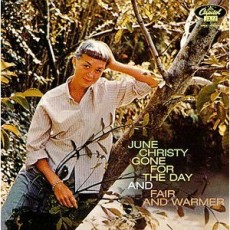
June Christy, born Shirley Luster on November 20, 1925 in Springfield, Illinois but grew up in Decatur, Illinois from the age of three. She began singing at 13 with the Decatur-based Bill Oetzel Orchestra continuing through high school and adding appearances with the Ben Bradley Band, and Bill Madden’s Band. Graduating she moved to Chicago, changed her name to Sharon Leslie, sang with the Boyd Raeburn group, then joined Benny Strong’s band and in 1944, with Strong’s band moved to New York.
In 1945, after hearing that Anita O’Day had left Stan Kenton’s Orchestra, she auditioned and got the role as a vocalist and her success was on the rise. She actually bore a heavy vocal and physical resemblance to Anita O’Day and it was during this time, she changed her name once again, finally becoming June Christy. I
n 1947 June started working on her own records with arranger and bandleader Pete Rugolo that produced her debut “Something Cool” in 1954 with husband Bob Cooper and Bud Shank. This album was instrumental in launching the vocal cool movement of the fifties. Throughout the decade she had a string of hits like Something Cool, Midnight Sun and I Should Care as she continued to release records, such as, “The Misty Miss Christy” that would set new standards for the music and influence future jazz vocalists.
During the 50s and 60s, Christy appeared on the top television programs of the day including Eddie Condon’s Floor Show, The Alan Young Show, The Jack Carter Show, The Jackie Gleason Show, The Tonight Show, The Nat King Cole Show, The Steve Allen Show, Playboy’s Penthouse, The Mike Douglas Show and The Joey Bishop Show. She embarked on dozens of concert tours throughout the U.S. and in Europe, South Africa and Japan.
June retired from the music business in 1969, only to take the stage again in financial crisis. In 1972, June sang at the Newport Jazz Festival in New York and reunited on stage with the Stan Kenton Orchestra. She recorded her final album “Impromptu” in 1977 but continued to perform at a few festivals over the next two decades with her final performance sharing the stage with Chet Baker in 1988. After struggling with illness for many years, vocalist June Christy passed away at her home in Sherman Oaks, California of kidney failure on June 21, 1990. She was 64.
More Posts: vocal
From Broadway To 52nd Street
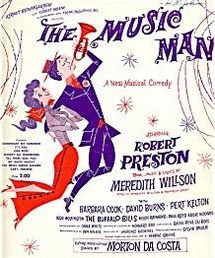
The Music Man opened at the Majestic Theatre on December 19,1957 and entered the ranks of “Blockbuster” with one thousand three hundred and seventy-five performances. The book, music and lyrics were written and composed by Meredith Wilson for Robert Preston and Barbara Cook, who held the starring roles. The cast album won five Grammy Awards for “Best Original Cast Album”, was on the Billboard charts for 245 weeks and spawned a 1962 film version in which Preston reprised his role with Shirley Jones as the lead love interest. The song “Till There Was You” remains a jazz standard today.
The Story: This is the tale of smooth talking con man Harold Hill who poses as a boys band organizer and leader and sells band instruments and uniforms to naive townsfolk before skipping town with the cash. In River City, Iowa the prim librarian and piano teacher Marian Paroo sees through him, but when Hill helps her younger brother overcome his fear of social interactions due to his lisp, Marian begins to fall in love with Harold. Harold, in turn falling for Marian, risks being caught to win her.
Jazz History: Swing music or simply “Swing” is a form of American music that developed in the early 1930s and became a distinctive style by 1940. Swing uses a strong rhythm section of double bass and drums as the anchor for a lead section of brass instruments such as trumpets and trombones, woodwinds including saxophones and clarinets and sometimes stringed instruments such as violin and guitar, medium to fast tempos, and a “lilting” swing time rhythm. The name swing came from the phrase “swing feel” where the emphasis is on the off–beat or weaker pulse in the music, unlike classical music. Swing bands usually featured soloists who would improvise on the melody over the arrangement.
The danceable swing style of big bands and bandleaders were the dominant form of American popular music from 1935 to 1946, a period known as the Swing Era.
Sponsored By

www.whatissuitetabu.com

Daily Dose Of Jazz…
Ernestine Anderson was born November 11, 1928 in Houston, Texas. By age three she was singing along with the raw tunes of the legendary Bessie Smith and soon moved on to the more refined environs of her local church, singing solos in its gospel choir. She grew up listening to John Lee Hooker, Muddy Waters and other blues greats while listening to the live performances of the Jimmy Lunceford, Billy Eckstine, Erskine Hawkins and Count Basie big bands. At twelve she entered into a local talent contest and singing around the melody in the wrong key was told she was a jazz singer.
Moving to Seattle with her family when she was sixteen, Ernestine graduated from Garfield High and at eighteen went on the road with the Johnny Otis band. By 1952 she was with Lionel Hampton, then settled in New York working with Gigi Gryce, touring Europe with Rolf Ericson. She recorded her debut album “Hot Cargo” in Sweden and released by Mercury Records. She won Down Beat’s “New Star” award in ’59, continued to record for Mercury to sensational acclaim, splitting her time between the States and Europe.
Anderson stepped out of the limelight as the Sixties ushered in rock and roll but re-emerged in the mid 1970’s with Ray Brown as her manager. Her appearance at the Concord Jazz Festival led to a string of albums for the label working into the ‘90s with the Clayton-Hamilton Jazz Orchestra among others.
In 2008 she fell on hard times and her family home facing foreclosure, was saved by an outpouring of donations by friends and colleagues like Quincy Jones and Dianne Schuur. Ernestine Anderson, a jazz and blues singer has enjoyed a career that has spanned over half a century has recorded over 30 albums, been nominated four times for a Grammy Award, has performed at Carnegie Hall, the Kennedy Center and the Monterey Jazz Festival six times during her prolific career as well as jazz festivals and clubs all over the world.
More Posts: vocal
From Broadway To 52nd Street
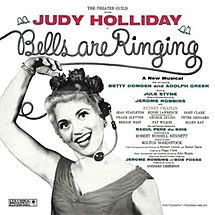
Bells Are Ringing opened on November 29, 1956 at the Shubert Theatre, starring Judy Holliday, Jean Stapleton, Sydney Chaplin, Jack Weston and John Cleese, running 924 performances. The music and lyrics were composed and written by Jule Styne, Betty Comden and Adolph Green. The original production was directed by Jerome Robbins, choreographed by Robbins and Bob Fosse and ran for 924 total performances after transferring to the Alvin Theatre. The Party’s Over and Just In Time rose to prominence as jazz standards.
The Story: Ella Peterson works in the basement office of “Susanswerphone”, her boss, Sue, telephone answering service. Listening in on others’ lives, adds some interest to her own humdrum existence by adopting different identities and voices for her clients. They include Blake Barton, an out-of-work method actor, Dr. Kitchell, a dentist with musical yearnings but lacking talent, and playwright Jeff Moss, who is suffering from writer’s block and desperately needs a muse. Ella considers the relationships with these clients “perfect” because she can’t see them and they can’t see her.
When Jeff Moss pleads with Ella for help in writing, she responds, and a romance ensues. Complications arise when Ella thinks that she does not fit in with Jeff’s wealthy friends. Adding complications are the police, who are certain the business is a front for an “escort service,” and Sandor, the owner’s shady boyfriend, who unbeknownst to Sue is using the agency as a bookmaking operation.
Broadway History: Off-Off-Broadway theatrical productions in New York City are those in theatres that are smaller than Broadway and Off-Off Broadway theatres. Off-Off-Broadway theatres are often defined as theatres that have fewer than 100 seats,though the term can be used for any show in the New York City area that employs union actors but not under an Off-Broadway, Broadway or Lort contract. It is often used as a term relating to any show with non-union actors. The shows range from professional productions by established artists to small amateur performances.
Sponsored By
www.whatissuitetabu.com
From Broadway To 52nd Street
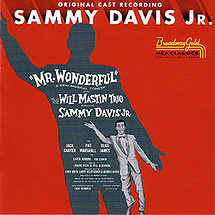
Mr. Wonderful opened at the Broadway Theatre on March 22, 1956 and ran for 383 performances. Jerry Bock, Larry Holofcener and George David Weiss composed the music and lyrics for the musical from which emerged Too Close For Comfort to become a jazz standard.
The Story: Written specifically to showcase the talents of Sammy Davis Jr. the thin plot, focusing on entertainer Charlie Welch’s show business struggles, primarily served as a springboard for an extended version of Davis’s Las Vegas nightclub act. The cast was comprised of Sammy Davis Sr., Will Mastin, Jack Carter, Chita Rivera, Malcolm Lee Beggs and Marilyn Cooper.
Jazz History: The 1930s belonged to popular swing big bands, in which some virtuoso soloists became as famous as the bandleaders. Key figures in developing the “big” jazz band included bandleaders and arrangers Count Basie, Cab Calloway, Jimmy and Tommy Dorsey, Duke Ellington, Benny Goodman, Fletcher Henderson, Earl Hines, Glenn Miller and Artie Shaw.
Swing was also dance music. It was broadcast on the radio ‘live’ nightly across America for many years especially by Hines and his Grand Terrace Cafe Orchestra broadcasting coast-to-coast from Chicago, well placed for ‘live’ time-zones. Although it was a collective sound, swing also offered individual musicians a chance to ‘solo’ and improvise melodic, thematic solos, which could at times be very complex and important music.
Over time, social strictures regarding racial segregation began to relax in America: white bandleaders began to recruit black musicians and black arrangers.
Sponsored By
www.whatissuitetabu.com