

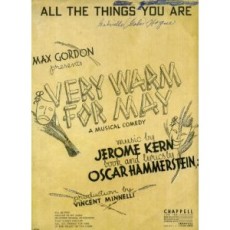
From Broadway To 52nd Street
Very Warm For May opened at the Alvin Theatre on November 17, 1939. Vincente Minnelli directed the play and the music was scored by Jerome Kern and Oscar Hammerstein, producing such favorites at the time as “All In Fun” and “In The Heart Of The Dark” but it was “All The Things You Are” that went on to become a jazz standard. However, the musical that starred June Allyson, Eve Arden and Vera-Ellen ran on Broadway for only two months, received mixed reviews and closed after only 59 performances.
The Story: The plot that had Long Island society girl May Graham fleeing threatening gangsters and hiding out with an avant-garde summer stock troupe in Connecticut. The first version of the show, which opened out of town, received rave reviews and played to sold-out houses. However, producer Max Gordon had been away when the show opened out of town and when he saw it, he hated the gangster subplot and had it removed. This could have been a contributing factor to the mixed reviews and the audience enjoyment.
Broadway History: Broadway was originally the Wickquasgeck Trail, carved into the brush destination of Manhattan by its indigenous Native American inhabitants.This trail originally snaked through swamps and rocks along the length of Manhattan Island.
Upon the arrival of the Dutch, the trail soon became the main road through the island from Nieuw Amsterdam at the southern tip. The Dutch explorer and entrepreneur David de Vries gives the first mention of the trail in his journal for the year 1642, “the Wickquasgeck Road over which the Indians passed daily”. Although current street signs are simply labeled as “Broadway”, in a 1776 map of New York City, Broadway is explicitly labeled “Broadway Street”.In the mid-eighteenth century, part of Broadway in what is now lower Manhattan was known as Great George Street.
Sponsored By

www.whatissuitetabu.com
More Posts: broadway
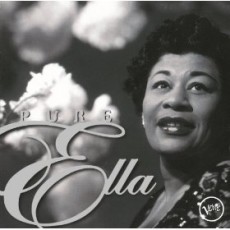
Daily Dose Of Jazz…
Ella Jane Fitzgerald was born on April 25, 1917 in Newport News, Virginia, the child of common law parents who separated shortly after her birth. Her mother moved her to Yonkers, New York and as a child she wanted to be a dancer but loved listening to the jazz of Louis Armstrong, Bing Crosby and The Boswell Sisters.
However, losing her mother to a heart attack in 1932 and the subsequent trauma caused her grades to drop, skip school, become a bordello lookout, and become involved with a Mafia affiliated numbers runner. This trouble led to reform school, ultimate escape, homelessness, and apprehension and sent to the Colored Orphan Asylum in the Bronx.
Ella made her singing debut at age 17 on November 21, 1934 at the Apollo Theatre. Pulling in a weekly audience won her the opportunity to compete in the Amateur Nights where she won first prize. Her winning spirit led her to perform with the Tiny Bradshaw band at the Harlem Opera House in 1935, and then to meet Chick Webb who offered her an opportunity to test with the band at a Yale University dance. This led to a regular gig with Webb at the Savoy Ballroom and in 1938 her rendition of the nursery rhyme A-Tisket, A-Tasket that she co-wrote, brought her wide public acclaim. When Webb died in 1939, Ella became the bandleader renaming it Ella Fitzgerald and Her Famous Orchestra, and went on to record nearly 150 songs during this tenure.
Pursuing a solo career she left the band, signed with Decca Records, began working with Norman Granz’s Jazz At The Philharmonic, and saw the demise of swing and the big touring bands. With Granz as her manager creating Verve Records around her and the advent of bebop, Fitzgerald changed her style of singing evident in her work with Dizzy Gillespie. She included scat in her repertoire and her rendition of Flying Home became one of the most influential vocal jazz records. Other songs like Oh, Lady Be Good would enhance her reputation as an important jazz vocalist.
Over the course of a career spanning nearly 60 years she recorded her now famous songbooks, recorded for a host of labels, performed all over the world. Fitzgerald appeared on film in Pete Kelly’s Blues, St. Louis Blues, and Let No Man Write My Epitaph. On television her most famous commercial was with Memorex in which her singing of a note and the subsequent playback shatters a glass – “Is it live or is it Memorex?”
Ella Fitzgerald, the three-octave vocalist noted for her purity of tone, impeccable diction, phrasing, intonation and horn-like improvisation ability is considered one of the supreme interpreters of the Great American Songbook. She has been photographed by Annie Liebovitz, won 14 Grammy awards, received the National Medal of Art by President Ronald Reagan and the Presidential Medal Of Freedom from George H.W. Bush.
After a long battle with diabetes Ella Fitzgerald passed away on June 15, 1996 at the age of 79 in Beverly Hills, California. So important was her contribution to the genre that her career history and archival material are housed at the Archives Center at the Smithsonian’s National Museum of American History; her personal music arrangements are at The Library of Congress; her extensive cookbook collection was donated to the Schlesinger Library at Harvard University; and her published sheet music collection is at the Schoenberg Library at UCLA.

More Posts: vocal
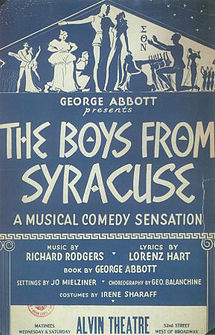
From Broadway To 52nd Street
The Boys From Syracuse came to Broadway with music and lyrics by Richard Rodgers and Lorenz Hart and opened on November 23, 1938 at the Alvin Theatre. The musical ran for two hundred and thirty-five performances, giving the world and jazz the songs “Falling In Love With Love” and “This Can’t Be Love”. The show starred Eddie Albert, Ronal Graham, Teddy Hart and Jimmy Salvo.
The Story: This is the tale of separated twins when young, Antipholus of Ephesus and Antipholus of Syracuse, who have taken on twin servants both named Dromio. It is when the pair from Syracuse come to Ephesus, that a comedy of errors ensues.
Jazz History: As the country becomes though over-commercialized with swing, the necessity of change hovers in the air. By the end of the Thirties, Coleman Hawkins would open the door that whet the appetites and influence aspiring jazz improvisers seeking a new mode of expression in small group settings and after-hour jam sessions. His rendition of Body and Soul was a landmark recording that sparked the emergence of bebop.
Sponsored By
www.whatissuitetabu.com
More Posts: broadway

From Broadway To 52nd Street
On October 19, 1938 the musical Knickerbocker Holiday opened at the Ethel Barrymore Theatre starring Walter Huston, Ray Middleton, Richard Kollmer and Jeanne Madden. The play ran for 168 performances with music composed by Kurt Weill and Maxwell Anderson. From the musical came the jazz standard September Song.
The Story: As he is writing the history of New York, Washington Irving seems to wander back to the 17th century just as New Amsterdam is awaiting the arrival of Peter Stuyvesant. The town council seeks to divert the new governor from its corruption and ineptitude by staging a hanging of a rebellious young man named Brom.
Brom has brashly asked for the hand in marriage of Tina, one of the councilor’s daughters. Stuyvesant pardons Brom but refuses him marriage to Tina. Stuyvesant decides to marry Tina, prompting Brom to rouse the citizens against the governor. Sensing the way the political winds are blowing, the governor backs down, his decision aided by Irving’s warning for him to consider his place in history.
Broadway History: While Broadway is experiencing both success and failure, Hitler takes control of the army and marches into Austria; Joe Louis takes the heavyweight championship title from Nathan Mann followed by a first round KO of Max Schmeling; the first play is telecast with the original cast of Susan and God; the Yankee Clipper completes its first cross Atlantic flight; Howard Hughes flies around the world in 91 hours; and instant coffee is invented.
Sponsored By
www.whatissuitetabu.com
More Posts: vocal
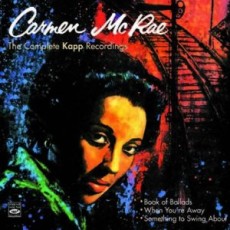
Daily Dose Of Jazz…
Carmen Mercedes McRae was born on April 8, 1920 in Harlem, New York City to Jamaican immigrant parents. She began studying piano at eight and the music of Louis Armstrong and Duke Ellington filled her home. Drawing inspiration from Billie Holiday, whom she met at 17, she developed and established her own distinctive voice. As a teenager she came to the attention of longtime Holiday collaborator Teddy Wilson and his composer wife, Irene Kitchings Wilson and through their influence Billie recorded her early composition “Dream of Life”.
In her late teens and early twenties, McRae worked as a secretary, sang as a chorus girl, played piano at Harlem’s famous Minton’s Playhouse where she met Dizzy Gillespie, Oscar Pettiford and Kenny Clarke. By 1944 she was playing piano with Benny Carter, working with Count Basie and made her first recording as a pianist with Mercer Ellington between 1946-47. But it was her meeting of Milt Gabler that got her signed to Decca and over the next five years she produced twelve albums.
A four-year stint in Chicago from 1948 to 1952 gave her, in her own words, “Those years in Chicago gave me whatever I have now… That’s the most prominent schooling I ever had.” Upon her return to New York she landed the record contract that launched her career and got her voted best new female vocalist by Down Beat magazine.
Carmen McRae enjoyed an opulent career that would span fifty years producing memorable albums with composer Noel Coward, Sammy Davis Jr., Dave Brubeck, George Shearing, Louis Armstrong, Cal Tjader and Betty Carter. She never performed without singing at least one song associated with Lady Day and recorded tribute albums to Billie Holiday, Thelonious Monk and Sarah Vaughan. She sang in jazz clubs throughout the U.S. and around the world, performed at the North Sea and Montreux Jazz Festivals and was a seven-time invitee to the Monterey’s Jazz Festival. She recorded over 60 albums and it was her behind-the-beat phrasing and ironic interpretations of lyrics that made her memorable.
Refusing to quit smoking, she was forced to retire in 1991 due to emphysema and on November 10, 1994 Carmen McRae, singer, composer, pianist and actress died in Beverly Hills, California from a stroke following complications from respiratory illness. She was 74.
