

Daily Dose Of Jazz…
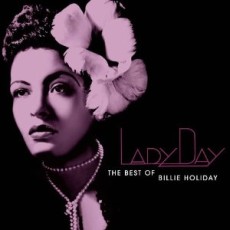
Billie Holiday was born Elinore Harris on April 7, 1915 in Philadelphia, Pennsylvania to a single mother who often left her to be raised by relatives. Surviving a tumultuous childhood in and out of reform schools, it was while working in a brothel at fourteen that she first heard the songs of Louis Armstrong and Bessie Smith. She soon teamed up with tenor saxophonist Kenneth Hollan and changing her name to Billie Holiday, her first taken from an actress she admired and taking her father Clarence last name. For the next two years played clubs like Grey Dawn, Pod’s and Jerry’s and the Brooklyn Elks Club. Replacing Monette Moore in 1933 at Govan’s gave producer John Hammond his first opportunity to hear her and he quickly set up a recording session with Benny Goodman who had heard her two years earlier.
By 1935 she was recording with Teddy Wilson which produced “What A Little Moonlight Can Do” and Miss Brown To You” and established Billie as a major vocalist. Under the Brunswick label during the 1930’s and 40’s, Wilson and Holiday revolutionized improvising melodies to fit the emotion of the lyric and these recordings caught singers attention nationwide who began imitating Billie’s light, rhythmic style.
Among the musicians who accompanied her frequently was her friend tenor saxophonist Lester Young, who dubbed her “Lady Day” and she in turn nicknamed him “Prez”. She also worked with Count Basie and Artie Shaw during this period; the latter arrangement of working with an all-white band went against the tenor of the times. Throughout her career she co-wrote notable jazz standards “God Bless The Child”, Don’t Explain”, Fine and Mellow”, “Lady Sings The Blues” and made “Easy Living” and “Strange Fruit” her signatures. Turbulence followed her from her childhood into adulthood with failed marriages, drug addiction, incarceration and the revocation of her cabaret card prohibiting her from working in New York City.
Arrested for drug possession while she lay dying of cirrhosis of the liver in New York City’s Metropolitan Hospital, she passed away on July 17, 1959. Billie Holiday’s well-trained ear, distinct delivery, masterful improvisation and infallible technique left a profoundly essential impressive catalogue of music that has influenced countless generations of jazz singers.

More Posts: vocal
From Broadway To 52nd Street
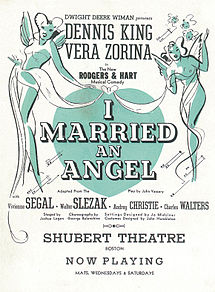
I Married An Angel opened on Broadway at the Shubert Theater on May 11, 1938. Running for three hundred and thirty-eight performances, the musical starred Dennis King, Audrie Christie, Vera Zorina and Vivienne Segal. Richard Rodgers and Lorenz Hart composed the score from which emerged Spring Is Here as another jazz standard.
The Story: The musical tells the story of a banker and ladies man who breaks off his engagement, swearing he will marry an angel. A real angel promptly flies into his life and he marries her. But her angelic honesty causes no end to problems for him until his sister teaches the angel the way of the cynical world. His sister also bribes a cab driver to delay creditors until a way is found to save her brother’s bank.
Jazz History: On the Street of Jazz musicians, jazz lovers, college students and big businessmen—everybody knew that this was “The Street that Never Slept,” the street where every night was New Year’s Eve. Here, for the price of a drink or two, you could walk through the whole history of jazz. Hot jazz was born and raised on The Street, as were the big swing bands of the thirties and the modern “cool” jazz combos of the forties. Comics like Alan King and Joey Adams got their start here, as did musicians like Erroll Garner, Jack Teagarden, and Coleman Hawkins.
Bessie Smith performed on the Street, as did Count Basie, Charlie “Bird” Parker, Dizzy Gillespie, Billie Holiday, Art Tatum, Sarah Vaughn, the Dorsey Brothers, Artie Shaw, and other jazz greats. The Street gave birth in Prohibition-era speakeasies, where musicians jammed for gin or just for the fun of it and its post-Repeal blossoming as the center of the jazz universe. The Street lined up and down on both sides with tiny, smoke-filled rooms where black and white musicians played to capacity crowds long before its postwar decline to become a tawdry tenderloin of strip and clip joints.
Sponsored By

www.whatissuitetabu.com
More Posts: broadway
From Broadway To 52nd Street
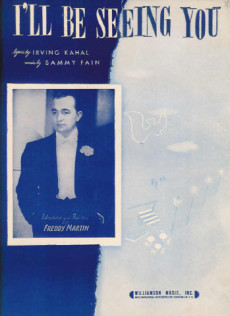
Right This Way came to fruition on January 5, 1938 as the production opened at the 46th Street Theatre. Brad Greene and Fabian Storey composed the music with Marianne Brown Waters writing the lyrics for the majority of the musical that was categorized as an original musical comedy set in Paris and Boston. The show starred Henry Arthur, Nelson Barcliff, Christine Bromley and Maude Carroll. Though the show only ran for 15 performances, the one song written by Irving Kahal and Sammy Fain, “I’ll Be Seeing You” was featured and became destined to be a jazz classic.
Broadway History: While Broadway prospered with a variety of shows being produced on The Great White Way not realizing that just some eight months away the city would be struck by what would be labeled as the “Long Island Express” or “The Great New England Hurricane of 1938”. The storm claimed 700 lives, injured another 700 more, destroyed 4500 homes, cottages and farms, damaged another 15,000 along with 26,000 cars, wiping out power above 59th Street, flooding subways and causing the East River to overflow to an estimated tune of three hundred million dollars. Despite the destruction, one unexpected positive outcome did emerge from the storm. The devastation reportedly helped solve the unemployment crisis that had been lingering since the Great Depression, as thousands of people were able to find work on Long Island helping to clean up and repair the damage.
Sponsored By
www.whatissuitetabu.com
More Posts: broadway

Daily Dose Of Jazz…
Pearl Mae Bailey, born March 29, 1918 in Southampton County, Virginia was raised in the Newport News, Virginia. She began singing at the age of three, making her stage debut at 15 when prompted by her brother Bill she entered an amateur contest winning first prize at Philadelphia’s Pearl Theatre. She went on to do the same at The Apollo, which cemented her decision to pursue an entertainment career.
Singing and dancing in Philly’s black nightclubs and other east coast cities in the thirties, by WWII she was touring the country with the USO and then settling in New York. Her success as a solo nightclub performer brought her work with Noble Sissle, Cootie Williams, Cab Calloway and Duke Ellington.
In 1946 she made her debut on Broadway in St. Louis Woman, which was later followed by House Of Flowers. Broadway led to the silver screen and in 1954 she took the role of Frankie in Carmen Jones, Maria in Porgy and Bess in ’59, both starring Dorothy Dandridge and Aunt Hagar in the film version of St. Louis Blues. In between demanding stage and screen commitments she continued to tour and record.
Returning to Broadway with Cab Calloway in David Merrick’s 1967 production of Hello Dolly won her a Tony award a year later. Throughout the next two decades she would sing the national anthem at the World Series, have her own television show, continue to perform on Broadway, be the voice for several animated film characters, earn a B.A. in theology from Georgetown University, become a spokesperson for Duncan Hines, win a Daytime Emmy, be appointed Ambassador of Love by President Nixon, be awarded the Bronze Medallion from New York City and a Presidential Medal of Freedom.
Pearl Bailey, an uninhibited vaudevillian, singer and actress passed away on August 17, 1990 in Philadelphia of arteriosclerotic coronary artery disease. The sultry voice was best known for her signature songs “Takes Two To Tango”, “Baby It’s Cold Outside” and “Won’t You Come Home Bill Bailey”.

More Posts: vocal
From Broadway To 52nd Street
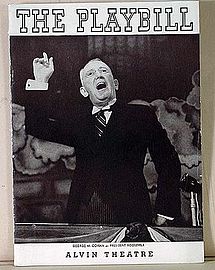
I’d Rather Be Right opened at the Alvin Theatre on November 2, 1937 and ran two hundred and ninety performances. The play starred Joy Hodges, Austin Marshall and George M. Cohen. The composers of the play’s music were Richard Rodgers and Lorenz Hart and one of their songs emerge to become a jazz standard – Have You Met Miss Jones.
The Story: As the story goes, a couple, Phil & Peggy, who wish to marry cannot do so until he receives a raise in pay. This raise was contingent on President Roosevelt balancing the budget. Falling asleep in Central Park, Phil dreams that he and Peggy meet the President. The President, in turn, summons the Cabinet, goes to battle with the Supreme Court, all to help the youngsters. Seemingly stymied, the President then suggests the young lovers marry anyway. When Phil awakens, that’s what they do.
Jazz History: Swing was dance music. It was a “live” broadcast nightly on the radio across America for many years especially by Earl “Fatha” Hines and his Grand Terrace Cafe Orchestra broadcasting coast-to-coast from Chicago. Although it was a collective sound, swing also offered individual musicians a chance to “solo” and “improvise” melodic, thematic solos, which could at times be very complex and “important” music. Over time, social strictures regarding racial segregation began to relax in America: white bandleaders began to recruit black musicians and black bandleaders. In the mid-1930s, Benny Goodman hired pianist Teddy Wilson, vibraphonist Lionel Hampton and guitarist Charlie Christian to join small groups.
More Posts: vocal