

Daily Dose Of Jazz…
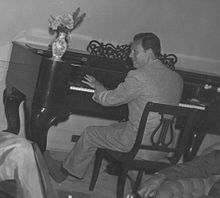
Irving Gordon was born in Brooklyn, New York on February 14, 1915 and as a child, studied violin. After attending public schools in New York City, he went to work in the Catskill Mountains at some of the resort hotels in the area. While working the resorts, he took to writing parody lyrics to some of the popular songs of the day. He has been credited with writing “Who’s On First” made famous by Abbott and Costello, according to his son William.
In the 1930s, he took a job with the music-publishing firm headed by talent agent Irving Mills, at first writing only lyrics but subsequently writing music as well. Together they wrote two songs for Duke Ellington, Please Forgive Me and Prelude To A Kiss and co-wrote Blue Prelude with Ellington.
After writing Mister and Mississippi, a Patti Page hit, Irving decided he enjoyed puns on state names, and some years later wrote Delaware, a Perry Como hit. He also went on to write for Bing Crosby, Eddy Arnold and Billie Holiday. But he is perhaps best known for his song, “Unforgettable” recorded by Nat King Cole in 1951 and then three Grammys in 1992 by his daughter Natalie Cole, in which Gordon himself received a Grammy. Nat’s version was inducted into the Grammy Hall of Fame in 2000.
In the 1940’s he moved to Los Angeles where he spent the rest of his life continually writing and composing and is noted for his contribution in music and lyrics of the Americana genre. Songwriter Irving Gordon passed away in his home of cancer on December 1, 1996.
More Posts: songwriter
From Broadway To 52nd Street
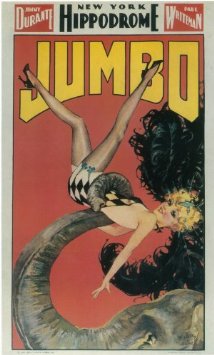
The Richard Rodgers and Lorenz Hart music written for Jumbo was first heard on November 16, 1935 on the stage of the Hippodrome. Rodgers and Hart wrote three timeless classics that became jazz standards: My Romance, Little Girl Blue and The Most Beautiful Girl In The World. The musical ran for 233 performances and starred Jimmy Durante, Donald Novis, Gloria Grafton and a number of circus specialty acts.
The Story: It’s a Circus tale about two feuding circus magnates, Mulligan & Considine, who are dismayed to learn their children have fallen in love. Considine’s problems compound by his drinking and imminent bankruptcy. His money difficulties are solved when his agent burns down his house allowing him to collect his insurance. When the kids reconcile the fathers, Considine puts the bottle on the shelf.
Jazz History: Jazz standards are musical compositions that are widely known, performed and recorded by jazz artists as part of the genre’s musical repertoire. This list includes compositions written in the 1930s that are considered standards by at least one major fake book publication or reference work. Some of the tunes like Summertime, All The things You Are, My Funny Valentine and Body and Soul were already well known standards by the 1940s, while others were popularized later.
Sponsored By

www.whatissuitetabu.com
More Posts: broadway
From Broadway To 52nd Street
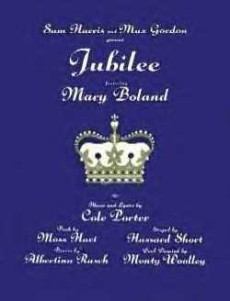
The Imperial Theatre aptly opened Jubilee on October 25, 1935 with music composed by Cole Porter and starring Melville Cooper, Mary Boland, Charles Walter and Margaret Adams. Running for 169 performances, entering into the jazz lexicon are two songs from the musical, Begin The Beguine and Just One Of Those Things.
The Story: Set approaching the anniversary of the coronation and the King and Queen admit they have become jaded with their luxurious but constrained life and Prince James & Princess Diana agree. When a royal nephew leads an insurrection, the royal family rushes into seclusion and emerges incognito. The queen flirts with a movie star, the princess has an affair with a writer and the prince takes a celebrated dancer out on the town. The king is happy to remain at home playing his beloved parlor games. Inevitably they are recognized, so when the insurrection dies, the royal family returns to its comfortable restricted world.
Broadway History: The first decade of the century witnessed the creation of numerous theatres in the new Longacre Square area, and, in 1902 when the Hotel Pabst was razed to allow the Times Building to be built on that spot, Longacre Square became Times Square. New theatres in the area included the Victoria at 42nd & 7th built in 1899; the Republic on 42nd built in 1900;; The Lyric and The New Amsterdam both a few doors down built in 1903. The following year the Lew Fields Theatre was built on the same block. There were several others built in the area from 39th to 45th streets, and some enterprising individuals were progressing even further uptown to Columbus Circle and Central Park West.
In 1900, Broadway (the Broadway we’re interested in) extended from The Star Theatre on 13th Street to the New York Theatre on 45th Street and patrons were paying $1.50 to $2.00 each for the best seats to see their favorite stars.
Sponsored By
www.whatissuitetabu.com
More Posts: broadway

Daily Dose Of Jazz…
Jeanne Lee was born on January 29, 1939 in New York City. Attending Bard College for dance, she began singing while still a student, formed a duo with classmate Ran Blake and recorded her first album, The Newest Sound Around. Jeanne was to become one of the foremost exponents of free vocal jazz extending her style to include moods that were sensual, somber, and sensitive while expressing standard lyrics as well as scatting.
During the 60’s and 70’s she recorded her distinctively independent and creative style either as a lead artist or a sidewoman for major performers of the jazz avant-garde, Archie Shepp, Anthony Brown, Rahsaan Roland Kirk, Enrico Rava, Carla Bley, Cecil Taylor and Mal Waldron to name a few, on independent labels in America and Europe. In 1967, she toured and recorded with her husband and vibraphonist Gunter Hampel.
In 1976 she sang in the spiritual tradition in John Cage’s “Apartment House 1776”, composed for the U.S. Bicentennial. By the 80’s Jeanne was concentrating on composing and performing/recording her original works that often included poetic and dance components.
Jeanne Lee combines acrobatic vocal maneuvers with a deeply moving sound and quality that allows her to alternate between soaring, upper register flights and piercing, emotive interpretations. The extremely precise and flexible Jeanne Lee who easily moved from a song or solo’s top end to its middle and bottom accompanying an instrument, passed away due to complications from cancer on October 25, 2000 in Tijuana, Mexico.
More Posts: vocal
From Broadway To 52nd Street
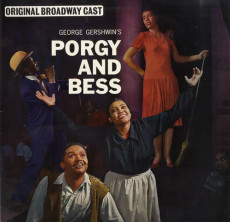
Porgy & Bess took the stage at the Alvin Theatre on October 10, 1935, running for only 124 performances. Written by Dubose Hayward with music composed by the Gershwins, and starred Todd Duncan, Anne Wiggins Brown, Warren Coleman and John W. Bubbles. The initial production was treated as such a major event that the larger dailies sent both their drama and music critics to cover the opening. Though not a commercial success from the ashes rose a score that has been performed by countless musicians but a few songs separated themselves to become individual classics and jazz standards such as Summertime, I Loves You Porgy, My Man’s Gone Now, It Ain’t Necessarily So, and There’s A Boat That Leaving Soon.
The Story: Set in Charleston, South Carolina in the tenements of Catfish Row, this opera follows the lives of Porgy, a crippled beggar, his love interest – the seductive Bess, her abusive man Crown and the slinky cocaine dealer Sportin’ Life who woos her away to New York City. The star-crossed lovers, Porgy and Bess, are doomed to struggle but triumph with dreams of life outside their community.
Broadway History: But while New Yorkers were enjoying the distraction of Broadway, the country remained engulfed in The Great Depression and in year five of the Dust Bowl’s “Dirty Thirties” in which the year hosted on April 14th the worst “black blizzard” causing such extensive soil erosion that would come to be known as Black Sunday. Some 5.3 million acres of the Southern Plains were damaged and the dust would blow all the way to east coast.
However, while part of the country was experiencing disaster Ella Fitzgerald was winning a one week performance at the Harlem Opera House, the “Swing Era” was in its infancy, Benny Goodman has secured a recording contract with Victor Records and snagged a spot on the Let’s Dance radio program and a live broadcast of his Palomar Ballroom performance in Los Angeles garnered him national following and a first-ever jazz concert at Carnegie Hall in New York. Tommy Dorsey would follow with a million-seller record with Irving Berlin’s Marie along with Artie Shaw’s version of Cole Porter’s Begin The Beguine.
Sponsored By
www.whatissuitetabu.com
More Posts: broadway