

Daily Dose Of Jazz…
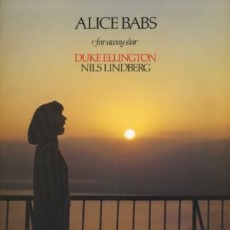
Alice Babs was born Hildur Alice Nilsson on January 26, 1924 in Kalmar, Sweden. The singer and actress has worked in a wide number of genres including Swedish folklore, Elizabethan songs and opera however, she is best known internationally as a jazz singer.
Alice made her recording debut in 1939 at the age of 15, her yodeling making her initially popular but it was her acting breakthrough in “Swing It, Teacher!” in 1940 and subsequent hit song that brought her more acclaim for her appealing voice and lightly swinging style. She appeared in more than a dozen Swedish language films and despite playing the well- behaved, good-hearted and cheerful girl; the youth culture made Alice its icon causing outrage among members of the older generation. A vicar called the Alice Babs cult the “foot and mouth disease to cultural life”.
In 1958, she was the first artist to represent Sweden in the Eurovision Song Contest finishing in 4th place. The same year, she formed “Swe-Danes”, touring the U.S. before dissolving in 1961. Fortune smiled and Alice began a long and productive collaboration with Duke Ellington in 1963, performing among other works his 2nd and 3rd Sacred Concerts. Because her voice had a range of more than three octaves, Duke Ellington said that when she did not sing the parts that he wrote for her, he had to use three different singers.
Ellington once remarked to the visitors of an Alice Babs recording session: “This voice, ladies and gentlemen, embodies all the warmth, joy of life, rhythm and tragedy that, for me, is the innermost secret of jazz”. She passed away from complications of Alzheimer’s disease on February 11, 2014 at age 90 in Stockholm, Sweden.

More Posts: vocal
Daily Dose Of Jazz…
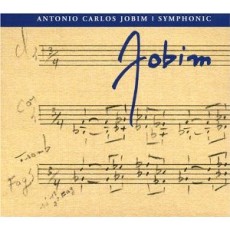
It has been said that Antonio Carlos Jobim was the George Gershwin of Brazil, and there is a solid ring of truth in that, for both contributed large bodies of songs to the jazz repertoire, both expanded their reach into the concert hall, and both tend to symbolize their countries in the eyes of the rest of the world.
Born Antônio Carlos Brasileiro de Almeida Jobim on January 25, 1927 in Tijuca neighborhood of Rio de Janiero studied to become an architect but the lure of music was too strong being firmly rooted in the music of Pixinguinha, who began modern Brazilian music in the 1930’s. By twenty he started playing piano in nightclubs and working recording sessions. He cut his first record in 1954 leader his group Tom and His Band, backing singer Bill Farr.
Tom, a nickname he affectionately carried throughout his life, was firmly planted in jazz having been impacted by Gerry Mulligan, Chet Baker, Barney Kessel and other West Coast musicians. He also gleaned influence upon his harmonies from Claude Debussy and Samba gave his music an exotic rhythmic underpinning. His piano is simple and melodic, his guitar gentle and his singing hauntingly emotional. Among his many themes his lyrics talked of love, political repression, betrayal, the natural beauties of Brazil and his home city of Rio.
Jobim first found fame in 1956 when he teamed with poet and diplomat Vinicius de Moraes to score part of the play Orfeo do Carnival, which would later gain them worldwide acclaim at Cannes when Black Orpheus debut in 1959.
In 1958, an unknown Brazilian singer João Gilberto recorded some of Jobim’s songs, which effectively launched bossa nova. Yet, Jobim’s breakthrough outside Brazil occurred in 1962 when Stan Getz and Charlie Byrd scored a surprise hit with his tune “Desafinado” – and later Getz teamed with Joao Gilberto and his wife Astrud resulting in Getz/Gilberto in 1963 and Getz/Gilberto 2 in 1964. The ’63 album became one of the best selling jazz albums of all time and grabbed 4 Grammy Awards. With their gracefully urbane, sensuously aching melodies and harmonies, Jobim’s songs gave jazz musicians in the 1960s a quiet, strikingly original alternative to their traditional Tin Pan Alley source.
Grammy award winning songwriter, composer, arranger, singer, pianist and guitarist while driving home after finishing recording for his next album Tom Jobim, collapsed and passed away of heart failure in New York City on December 8, 1994.

From Broadway To 52nd Street
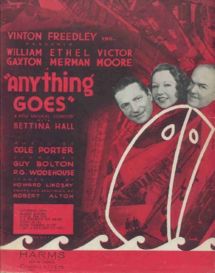
Anything Goes opened at the Alvin Theater on November 21, 1934 and had a run of 420 performances. Cole Porter wrote the music for the show and it featured such stars as Ethel Merman, William Gaxton and Bettina Hall. From the musical I Get A Kick Out Of You is singled out for fame and applause as a jazz standard.
The Story: Reno Sweeney, an evangelist turned bar hostess gets such a kick out of Billy Crocker that she boards a Europe bound liner to dissuade him from pursuing Hope Harcourt. Crocker, aboard without a ticket must adopt several disguises. Hope loves an Englishman of her peer. Rev. Dr. Moon is on J. Edgar Hoover’s public enemy list at #13 and attempting to rise to #1. Reno holds a revival; Hope becomes an heiress, drops her Englishman and consents to marry Crocker. Moon gets dropped from Hoover’s list.
Broadway History: In the 1900-01 season there were seventy plays or musicals being produced on Broadway. It was the beginning of the boom and the decades that followed saw the number of plays produced quadruple. In addition, there were seven vaudeville houses and six burlesque theaters presenting their shows to a theatre thirsty population of just over three and a half million inhabitants.
The first decade of the 20th century was both boring and transformational in the history of Broadway. The seeds of that transformation go back to 1882 with the construction of The Madison Square Theatre at 24th Street. At the time, the theatre district was concentrated between Union Square and 24th Street.
More Posts: broadway
Daily Dose Of Jazz…
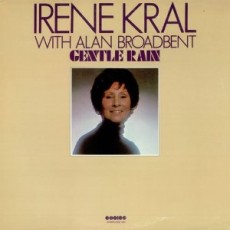
Vocalist Irene Kral was born in Chicago, Illinois on January 18, 1932. The younger sister of Roy Kral, an already a successful musician, she started singing professionally as a teenager making her debut with the Jay Burkhardt Big Band. She went on to work with Woody Herman and Chubby Jackson.
Freelancing around Chicago, Irene gigged with a vocal group called Tattle-Tales, spent nine months singing with Maynard Ferguson’s big band and also performed with groups led by Stan Kenton and Shelly Manne, After an association with the Herb Pomeroy Orchestra, she got married, moved to Los Angeles and stopped performing.
Fortunately for the jazz world by the late 50’s Irene embarked upon a solo career recording two sessions for United Artists, a ’65 date for Mainstream and from 1974 to 1977 recorded three great albums, “Kral Space” and two projects with pianist Alan Broadbent “Where Is Love” and “Gentle Rain”. Her rendition of Spring Can Really Hang You Up The Most is not only considered classic but also definitive.
Irene Kral died at the age of 46 of breast cancer in Encino, California on August 15, 1978. She attributed Carmen McRae as one of her inspirations and was brought back to the attention of the world posthumously by director Clint Eastwood when he used her recording in the Bridges of Madison County.
More Posts: vocal
From Broadway To 52nd Street
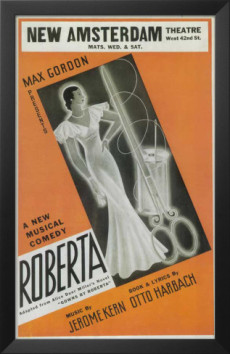
Roberta opened at the New Amsterdam Theater on November 11, 1933. It ran 295 performances with music by Jerome Kern, and lyrics and book by Otto Harbach. The show starred Tamara Drasin, Bob Hope, George Murphy, Ray Middleton, Fay Templeton and Fred MacMurray. The musical comedy was based on the novel Gowns by Roberta by Alice Duer Miller and is set in a fraternity house at Haverhill College. From the play came songs like Yesterdays, Smoke Gets In Your Eyes and The Touch Of Your Hand that have become jazz standards.
The Story: Set in a fraternity house at Haverhill College: A deposed Russian princess has become a famed Parisian couturier. Her partner passes away leaving her half of the business to American football player Randolph Scott–who of course knows next to nothing about the gown business, and couldn’t care less anyway. The former girlfriend of the bandleader poses as a phony Polish countess. Men are chasing women who are chasing men as flirtations involved all.
Jazz History: By the time Roberta premiered on Broadway, the nation was buckling under the devastation of The Great Depression. Twenty-five percent of the workforce was jobless, and up to 60 percent of African American men had no work. Cities became crowded with people searching for work after farms began to whither and rot. Black musicians were not allowed to do studio or radio work. However, jazz music was resilient. While businesses, including the record industry, were failing, dance halls were packed with people dancing the jitterbug to the music of big bands, which would come to be called swing music.
Swing bands attracted throngs with their intensity, playing fast and loud blues riffs and featuring virtuosic soloists. All of a sudden, thanks to musicians such as Coleman Hawkins, Lester Young and Ben Webster, the tenor saxophone became the instrument most strongly identified with jazz.
In Kansas City, pianist Count Basie began building an all-star big band after Benny Moten, a well-known bandleader died in 1935. Basie featured Lester Young, giving rise to the saxophonist’ career as an innovator, and also bringing exposure to an aggressive and bluesy vein of jazz that filled the clubs of the Midwest.
Sponsored By

www.whatissuitetabu.com
More Posts: broadway