

Daily Dose Of Jazz…
Zenzile Miriam Makeba was born on March 4, 1932 in the Prospect Township of Johannesburg, South Africa. Known to her many fans as simply Miriam Makeba or Mama Afrika, her career spanned more than 50 years.
As a child, she sang at the Kilmerton Training Institute in Pretoria, while attending for eight years followed by touring with an amateur group. Her professional career began in the 1950s with the Manhattan Brothers prior to her forming her own group, The Skylarks, singing a blend of jazz and traditional melodies of South Africa.
By 1959 she was performing in the musical King Kong with her future husband Hugh Masekela and though she became a successful recording artist, she received a pittance for her work without residual royalties. However in the same year her big break arrived when she was given a short guest appearance in the indie anti-apartheid documentary “Come Back, Africa” and she made such an impression that the director managed a visa for her to leave the country for the Venice Film Festival.
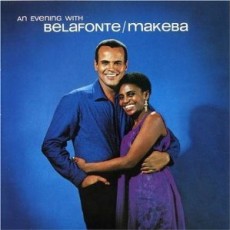
Traveling to London she met Harry Belafonte who assisted her in gaining entry to and fame in the United States. She released many of her most famous hits there including “Pata Pata”, “The Click Song” and “Malaika”. In 1966, Makeba, in collaboration with Belafonte received a Grammy for Best Folk recording “An Evening With Belafonte/Makeba” that dealt South African apartheid.
Miriam went on to perform at the 1974 Rumble In The Jungle between George Foreman and Muhammad Ali, on Paul Simon’s Graceland, authored an autobiography, starred in Sarafina, guest appeared on the Cosby Show, took part in Amandla: A Revolution in Four Part Harmony and returned to South Africa under the persuasion of Nelson Mandela.
She was awarded the Dag Hammarskjöld Peace Prize, was named Goodwill Ambassador for the UN Food and Agriculture Organization, was awarded the UN Gold Otto Hahn Peace Medal and voted 38th in the top 100 Great South Africans. While on a concert stage taking a stand against injustice against humanity singing her hit song “Pata Pata”, she succumbed to a heart attack on November 9, 2008.

More Posts: vocal
From Broadway To 52nd Street
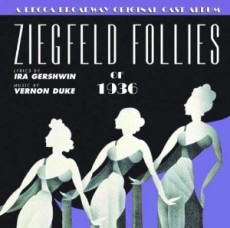
The Ziegfeld Follies of 1936 premiered on Broadway at the Winter Garden Theatre on January 30, 1936 and closed on May 9, 1936 after 115 performances due to Fanny Brice’s illness. The musical had a return engagement on Broadway at the Winter Garden Theatre on September 14, 1936, and closed on December 19, 1936 after 112 performances. Brice reprised her role, with the additional cast that included Gypsy Rose Lee.
The musical was produced by Billie Burke Ziegfeld, Lee Shubert and J. J. Shubert; directed by John Murray Anderson and Edward Clarke Lilley; choreographed by Robert Alton; sketches directed by Edward D. Dowling; ballets directed by George Balanchine and scenic design and costumes were by Vincente Minnelli.
Vernon Duke composed the music with lyrics by Ira Gershwin and a cast starring Fanny Brice, Bob Hope, Eve Arden, Josephine Baker and the Nicholas Brothers.
The Story: In the opening number Brice mocks her famous song (“My Man”) in “He Hasn’t a Thing Except Me”, standing against a lamp-post. In “The Sweepstakes Taker” Brice portrays a Jewish Bronx housewife who wins the Irish sweepstakes. In “Fancy Free’ she becomes the affected and bored British “Zuleika” as she exchanges witty remarks with her husband Sir Robert, and, leaving behind elegance, burps in his face and utters a trade-mark “Denk you.” As Baby Snooks, Brice stars with popular stars of the day such as Clark Gable. The only song to become popular from the musical was “I Can’t Get Started” sung by Bob Hope to Eve Arden.
Broadway History: The musical was not all that was spawned from within the hallowed walls of the Broadway theatre. A new age of American playwright with the emergence of Eugene O’Neill, whose successful plays such as Beyond the Horizon, Anna Christie and The Hairy Ape proved that there was an audience for serious drama on Broadway, thus ushering major dramatists like Elmer Rice, Maxwell Anderson, Robert E. Sherwood, Tennessee Williams and Arthur Miller. Comedy and classical revivals became the norm on Broadway and opened the doors for dramas addressing the rise of Nazism and America’s non-intervention in the approaching world war. The most successful was Lillian Hellman’s “Watch on the Rhine” that would open in April 1941.
Daily Dose Of Jazz…
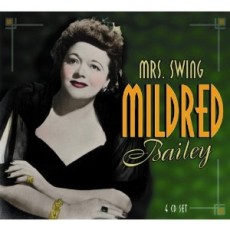
Mildred Bailey was born Mildred Rinker on February 27, 1907 in Tekoa, Washington. She began performing at an early age, playing piano and singing in movie theatres by 1920. Moving to Seattle to bolster her career, she retained the name of her first husband Ted Bailey, but it was her second husband Benny Stafford that helped establish her on the West Coast.
By 1925 she was headlining a Hollywood club performing pop, early jazz and vaudeville standards. Due to her success Mildred was able to secure work for her brother Al Riker and his partner Bing Crosby, who in turn, introduced Mildred to Paul Whiteman via singing at a party so he could “discover” her. Whiteman had a very successful radio show and big band and Mildred became the first woman to join a band as a full time singer.
An early jazz singer with a sweet voice that belied her plump figure, Mildred Bailey influences were Ethel Waters, Bessie Smith and Connie Boswell. She balanced popular success with a hot jazz slanted career as the better half of her third husband Red Norvo, who together were known and Mr. and Mrs. Swing.
Bailey’s debut recording was with Eddie Lang in 1929 and by ’32 her fame exploded with her signature hit “Rockin’ Chair” written especially for her by Hoagy Carmichael. Throughout the 30’s and into the 40’s she continued to record with the Whiteman orchestra, her husband Red, and recording arrangements written by Eddie Sauter that proved perfect for her voice.
She appeared on Benny Goodman’s Camel Caravan radio program, and gained her own series again during the mid-’40s. Hampered by health problems by the end of the decade suffering from diabetes and Mildred Bailey died of a heart attack on December 12, 1951 in Poughkeepsie, New York.
Jazz and blues vocalist Mildred Bailey, a major jazz vocalist and innovator who influenced Billie Holiday, Ella Fitzgerald and Rosemary Clooney was inducted into the Big Band and Jazz Hall of Fame in 1989.

More Posts: vocal
From Broadway To 52nd Street
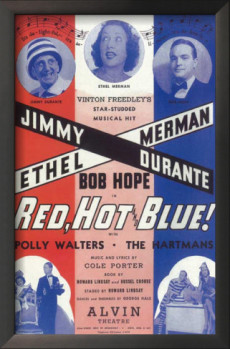
Red, Hot And Blue! opened the Alvin Theater stage on October 29, 1936. The music and lyrics, composed by Cole Porter, rendered the tune “It’s De-Lovely” sung by Ethel Merman. Though the show only ran for one hundred and eighty-three performances, the song became an enduring jazz standard. The story taken from the book by Howard Lindsay and Russell Crouse goes as follows:
The Story: Loud and brassy manicurist Nails O’Reilly Duquesne is a newly wealthy young widow. Organizing a benefit for her favorite cause, the rehabilitation of ex-convicts, she teams with her ex-con sidekick Policy Pinkle and her “square” boyfriend, lawyer Bob Hale. Soon she embarks on a nationwide search for Bob’s old girlfriend, which is really the reason for the enterprise. However, the national lottery that Nails starts gets the attention of the Finance Committee, winding up in Washington DC in an even more complicated situation, with the Supreme Court declaring the lottery unconstitutional, because it would benefit the people.
Jazz History: The blocks of 52nd Street between Fifth and Seventh Avenue were renowned in the mid-20th century for the abundance of jazz clubs and lively street life. The street was convenient to musicians playing on Broadway and the “legitimate” nightclubs and in the CBS studio. Musicians who played for others in the early evening played for themselves on 52nd Street.
In its heyday from 1930 through the early 1950s, 52nd Street clubs hosted such jazz legends as Miles Davis, Harry Gibson, Dizzy Gillespie, Billie Hoiday, Nat Jaffe, Marian McPartland, Thelonious Monk, Charlie Parker, Louis Prima, Art Tatum, Fats Waller and numerous more. Although musicians from all schools performed there, after Minton’s Playhouse in Harlem, 52nd Street was the second most important place for the dissemination of bebop. In fact, a tune called “52nd Street Theme” by Thelonious Monk became a bebop anthem and jazz standard.
Sponsored By

www.whatissuitetabu.com
More Posts: broadway
From Broadway To 52nd Street
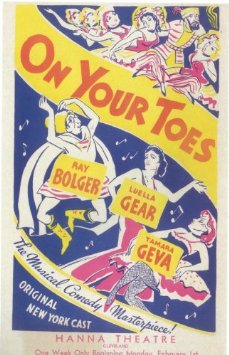
On Your Toes opened at the Imperial Theater on April 11, 1936. The show ran three hundred and fifteen performances and the music and lyrics were once again composed by Richard Rodgers and Lorenz Hart. The production starred Ray Bolger, Tamara Geva and Doris Carson.
the Story: Junior Dolan, son of an old vaudevillian, becomes a music professor. He takes on the task of helping a struggling Russian ballet company. When complications arise, Junior is forced to take the place of the lead dancer and perform opposite Vera Barnova. Gangsters try to shoot him during the ballet but they are apprehended in time for a happy ending that included his proposal of marriage to sweet Frankie Frayne. From this musical came two songs that have endured as jazz classics – Glad To Be Unhappy and There’s A Small Hotel.
Broadway History: Broadway and 39th Street became the site where Aronson built The Casino with the procurement of financing from some of the wealthiest finance wizards of the day – the Goulds, Roosevelts, Vanderbilts and Morgans. When it opened I n 1882, The Casino was considered the finest example of Moorish architecture outside of Spain.
While Aronson was building his theatre, Charles Frohman had begun his separate career as the manager of theatrical professionals and in 1893 opened his own theatre. The Empire was one block up from The Casino. In November of that year Abbey’s Theatre opened next door to The Casino and the uptown migration of the theatre district continued. The Casino led the way for a number of entrepreneurs to build in the vicinity of Longacre Square, a long open promenade where Broadway crossed 7th Avenue. Following Aronson’s lead, the likes of Charles Frohman, Henry Abbey, Oscar Hammerstein and the Shuberts were among the investors and creators of the new theatre district.
Sponsored By
www.whatissuitetabu.com
More Posts: broadway