

Hollywood On 52nd Street
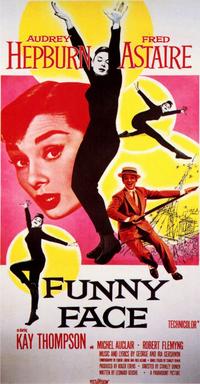
George and Ira Gershwin composed S’Wonderful and How Long Has This Been Going On were composed for the 1927 Broadway musical Funny Face by George and Ira Gershwin. S’Wonderful was used in the 1951 musical movie An American In Paris before making its appearance in this film. How Long Has this Been Going On was dropped from the Broadway musical and makes its introduction when Audrey Hepburn sing it in this 1957 movie musical of Funny Face that also starred Fred Astaire in a reprisal of his Broadway role. Although having the same title as the Broadway musical, the plot is totally different and only four of the songs in the stage musical are included. Kay Thompson also stars in a supporting role as Astaire portrays still photographer Dick Avery, loosely based on photographer Richard Avedon.
The Story: Maggie Prescott (Thompson) is a fashion magazine publisher and editor for Quality magazine, looking for the next big fashion trend. She wants a new look to be both “beautiful” and “intellectual”. She and famous fashion photographer Dick Avery want models that can “think as well as they look.” The two brainstorm and come up with the idea to find a “sinister-looking” bookstore in Greenwich Village and discover “Embryo Concepts.”
They put Jo Stockton (Hepburn) in the first shot and toss her out of the store until the shoot ends. Jo wants to go to Paris to hear famed philosopher Emile Flostre speak on empathicalism. Dispatched on an assignment, New York City-based fashion photographer Avery is struck by Jo’s beauty, a shy bookstore employee he’s photographed and he believes has the potential to become a successful model. He gets Jo to go with him to France, where he snaps more pictures of her against iconic Parisian backdrops. In the process, they fall for one another, only to find hurdles in their way.
Joao Gilberto & Lonette McKee/Dexter Gordon
Sponsored By

www.whatissuitetabu.com
Hollywood On 52nd Street
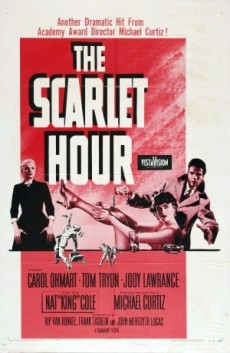
The song Never Let Me Go was composed by Jay Livingston (music) and Ray Evans (lyrics) and introduced by Nat King Cole in the 1956 crime drama film titled The Scarlet Hour.
The movie was a relatively bold experiment for a mid-1950s Paramount release. The studio expended a great deal of money on the project and enlisted the services of top-flight director Michael Curtiz and populated with a cast of young unknowns. Carol Ohmart and Tom Tryon (future novelist) star with supporting cast including Jody Lawrence, Elaine Stritch, James Gregory and Edward Binns.
The Story: Ohmart and Tryon portray Paulie and Marsh, respectively the film’s villainess and protagonist. Knowing that Marsh is hopelessly in love with her, Paulie uses him as a dupe in an upcoming jewelry heist. Only after a killing has occurred does Marsh come to his senses. Lawrence is good girl to whom Marsh eventually retreats.
Sponsored By
www.whatissuitetabu.com
Daily Dose Of Jazz…
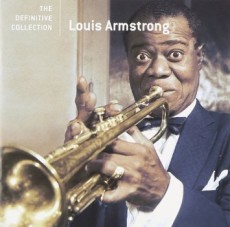
Louis Armstrong was born on August 4, 1901 in New Orleans, Louisiana and grew up in the poverty-stricken, rough neighborhood known as “The Battlefield”, which was part of the Storyville legal prostitution district. Abandoned by his father while still an infant, he and his sister lived with relatives for a period of years. He attended the Fisk School for Boys, getting his early exposure to music, worked as a paperboy, discarded food reseller, and hauled coal to the brothels and clubs and worked for a Jewish junk haulers who treated him like family.
Dropping out of school at age eleven, Louis joined a quartet of boys singing on the corner for money, and listened to the bands in Storyville. He developed his cornet playing skills by playing in the band of the New Orleans Home for Colored Waifs under the tutelage of Professor Peter Davis who instilled discipline in and provided musical training to the otherwise self-taught Armstrong. He eventually became the bandleader, they played around New Orleans and by thirteen-year-old he began drawing attention by his cornet playing, starting him on a musical career. At fourteen he got his first dance hall job at Henry Ponce’s where Black Benny became his protector and guide. He hauled coal by day and played his cornet at night.
Over the next years he played in the city’s frequent brass band parades and listened to older musicians every chance he got, learning from Bunk Johnson, Buddy Petit, Kid Ory and Joe “King” Oliver, who acted as a mentor and father figure to the young musician. He toured with Fate Marable, replaced King Oliver in Kid Ory’s band, and was second trumpet in the Tuxedo Brass Band.
1922 saw Armstrong in Chicago joining King Oliver’s Creole Jazz Band when the city was the center of the jazz universe. He was challenged to “cutting contests” by hornmen trying to displace the new phenomenon, which could blow two hundred high Cs in a row. He made his first recordings on the Gennett and Okeh labels, he met Hoagy Carmichael through his friend Bix Beiderbecke. Taking the advice of second wife Lil Harden Armstrong, he left Oliver and went to work with Fletcher Henderson in New York and developing his own style. By 1924 he switched to trumpet and his influence upon Henderson’s tenor sax soloist Coleman Hawkins, can be judged by listening to the records made by the band during this period.
During this time, Armstrong made many recordings on the side, arranged by Clarence Williams, with the Williams Blue Five pairing him with Sidney Bechet and backing Bessie Smith, Ma Rainey and Alberta Hunter. He began recording under his own name for Okeh with his famous Hot Five and Hot Seven groups Hot Five and Hot Seven groups, producing hits Potato Head Blues, Muggles and West End Blues, the music of which set the standard and the agenda for jazz for many years to come. His recording of Heebie Jeebies turned on both black and white young musicians to his new type of jazz, including a young Bing Crosby.
Over the course of his career he appeared in musical, played clubs, added vocals to his repertoire covering most famously Carmichael’s Stardust that became one of the most successful renditions. His approach to melody and phrasing was radical and evolved into scat singing. As with his trumpet playing, Armstrong’s vocal innovations served as a foundation stone for the art of jazz vocal interpretation. The uniquely gritty coloration of his voice became a musical archetype that was much imitated and endlessly impersonated.
After spending many years on the road, in 1943 Louis settled permanently in Queens, New York in 1943 in contentment with his fourth wife, Lucille. During the subsequent thirty years, he played more than three hundred gigs a year, toured Africa, Europe, and Asia under sponsorship of the US State Department earning the nickname “Ambassador Satch” and inspiring Dave Brubeck to compose his jazz musical The Real Ambassadors.
He has been honored posthumously with a Grammy Lifetime Achievement Award, won a Male Vocal Performance Grammy for Hello Dolly, has 11 recordings inducted into the Grammy Hall of Fame, the Rock and Roll Hall of Fame list his West End Blues as one of the 500 songs that shaped Rock and Roll, had a commemorative U.S. postage stamp issued, and has been inducted into six Halls of Fame, has a star on the Hollywood Walk of Fame, as well as the Louis Armstrong New Orleans International Airport, the US Open main stadium was renamed Louis Armstrong Stadium, and his Hot Five and Hot Seven recordings are now a part of the National Recording Registry in the Library of Congress.
Trumpeter and vocalist Louis Armstrong, also known as Satchmo, Dipper, Pops and the King of Jazz, passed away in his sleep of a heart attack on July 6, 1971. His honorary pallbearers included Bing Crosby, Ella Fitzgerald, Dizzy Gillespie, Pearl Bailey, Count Basie, Harry James, Frank Sinatra, Ed Sullivan, Earl Wilson, Alan King, Johnny Carson and David Frost. Peggy Lee sand The Lords Prayer, Al Hibbler sang Nobody Knows The Trouble I’ve Seen and his long-time friend Fred Robbins gave the eulogy.

Dose A Day – Blues Away
Hollywood On 52nd Street
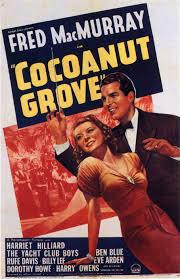
You Leave Me Breathless is the Frederick Hollander and Ralph Freed vehicle that Fred MacMurray introduced in the 1938 film Cocoanut Grove. Harriet Hilliard, Eve Arden, Billy Lee, Harriet Nelson and Rufe Davis are part of the supporting cast.
The Story: MacMurray plays a bandleader who is trying to get from Chicago to Hollywood so he can audition for the Cocoanut Grove nightclub. The band is a disparate group of musicians as well as the Yacht Club Boys and Eve Arden and Ben Blue are a dance “speciality” act. MacMurray also has a kid who isn’t his and a tutor. With no money, they go on a road trip in a jalopy pulling a trailer. They also pick up a bizarre singer because he has a tow truck.
Sponsored By
www.whatissuitetabu.com

Daily Dose OF Jazz…
Claudia Acuña was born July 31, 1971 in Santiago, Chile and raised in Concepcion. She was inspired as a child to perform a variety of music, including folk, pop and opera by Victor Jara and Violetta Parra. Her attention turned to American popular music and jazz at the age of 15 when she first heard Erroll Garner, Sarah Vaughan and Frank Sinatra. Upon returning to her birthplace in 1991, she quickly gained prominence on the local jazz scene through live performances and radio broadcasts with visiting artists.
By 1995, Acuña had decided to move to New York City and she began performing at jam sessions and clubs including the Zinc Bar, Smalls and with her own band at the Jazz Gallery. During this period she met pianist/composer Jason Lindner, who remains her musical director. She released her debut album, Wind from the South in 1999 for Verve Records followed by Rhythm of Life in 2001 and Luna in 2004.
In 2009 she moved to the Marsalis Music label and recorded her first session En Este Momento. Claudia has been featured on various recordings with Peck Almond, George Benson, Joey Calderazzo, Avishai Cohen, Mark Elf, Tom Harrell, Antonio Hart, Arturo O’Farrill and Guillermo Klein. She has been the co-curator of a Chilean music festival, the spokesperson for World Vision Chile, her cover of the Antonio Carlos Jobim tune “Suddenly” was featured on the soundtrack for the movie Bossa Nova.
Venturing outside the jazz medium the vocalist garnered substantial exposure by recording a single with House producers MKL and Soy Sos of 3 Generations Walking titled Slavery Days. Vocalist Claudia Acuña continues to perform, tour and record for her Cambridge, Massachusetts based record label, Marsalis Music.
Inspire A Young Mind
More Posts: vocal