

Hollywood On 52nd Street
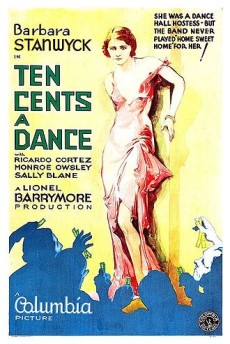
10 Cents A Dance is a song originally written by Richard Rodgers and Lorenz Hart for the Broadway play Simple Simon, which became the inspiration for the 1931 romance-drama film of the same name. The film starred Barbara Stanwyck as a married taxi dancer who falls in love with one of her customers.
The Story: A beautiful streetwise taxi dancer named Barbara O’Neill works at a New York City dance hall called Palais de Dance. One of the dance hall’s wealthy patrons, Bradley Carlton comes to the hall and gives Barbara $100. Concerned about her unemployed friend and neighbor Eddie Miller, Barbara asks Bradley to give him a job, and he agrees. They fall in love, get married, Eddie philanders, they get divorced, they remarry, and then he wanders off to South America. Realizing their love is not strong enough she tries to get another divorce but gets denied by the judge. But after a fight and his gambling she packs her bags, goes to the dance hall and leaves with Bradley for France.
Sponsored By

www.whatissuitetabu.com
Daily Dose Of Jazz…
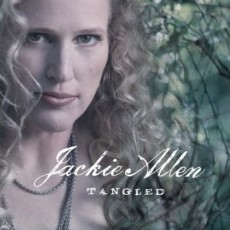
Jackie Allen was born on February 19, 1959 in Brown Deer, Wisconsin and raised in McFarland. She first became interested in music through her father, Louis (Gene) Allen, an accomplished tuba player.[3] Growing up she sang in choirs and played French horn, but was not exposed to modern jazz until she attended the University of Wisconsin in Madison. Limited by the available majors offered at the time, she moved to Milwaukee where she performed five nights a week for four years in a duo with Mel Rhyne at the Wyndham Hotel.
Moving to Chicago in 1990 she began to compose and self-produced her first release, Never Let Me Go, for the short-lived Lake Shore Jazz label. Hitting the top twenty of the Gavin Jazz Charts where it drew the attention of Grammy winning producer Ralph Jungheim who brought her to Naxos Records. out to Los Angeles to record Which with Red Holloway, Gary Foster and Bill Cunliffe. Success sent Jackie on an Asian tour and made her the first jazz artist to perform at the Beijing Music Festival.
By the late 90’s Allen again began enjoying the interactive possibilities in duo settings. She began a collaboration with pianist Judy Roberts, started a series of successful holiday duet concerts, released “Autumn Leaves” the following year. In 1999 she began performing in a voice-bass duo with Hans Sturm and record for the Red Mark label.
Since 2002 Jackie Allen has performed and recorded primarily with the same core rhythm section of bass, guitar and percussion and adding piano, trumpet or woodwinds. She produced The Men in My Life, was picked up by the Chicago label A440, and followed with Love Is Blue. Again success brought her to Michael Cuscuna, Bruce Lundvall, John Clayton Frank Proto, Bill Cunliffe, Mark Buselli and Matt Harris. In 2008 Allen was approached by the Muncie Symphony Orchestra to create a project for their 60th Anniversary Season that resulted in the 2009 live release Starry Night.
Jackie has taught at the Wisconsin Conservatory of Music, the Old Town School of Folk Music, Elmhurst College, Roosevelt University, Ball State University, The Cornerstone Center for the Arts, E.B. Ball Center, Doane College, and the University of Nebraska-Lincoln. She has taught privately, conducted master classes and community outreach projects teaching small groups of adult students learn to sing in public. She continues to record, perform and tour.

Dose A Day – Blues Away
More Posts: vocal
Daily Dose Of jazz…
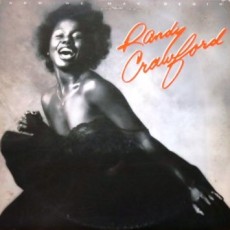
Veronica “Randy” Crawford was born on February 18, 1952 in Macon, Georgia. She first performed at club gigs from Cincinnati to Saint-Tropez but made her name in mid 1970s in New York, where she sang with jazzmen George Benson and Cannonball Adderley. She signed with Columbia Records and released her first single, “Knock On Wood” / “If You Say the Word” in 1972. Adderley invited her to sing on his album Big Man: The Legend Of John Henry in 1975. During her brief tenure at Columbia, she recorded “Don’t Get Caught in Love’s Triangle”. In 1977 she was one of the vocalists on Fred Wesley & The Horny Horns – A Blow For Me, A Toot To You album.
1978 saw Crawford performing on the second solo album of former Genesis guitarist Steve Hackett, singing vocals on “Hoping Love Will Last”, the opening song on side two of Please Don’t Touch. The following year she led R&B veterans The Crusaders on the transatlantic hit “Street Life” that ended up on the soundtracks of Sharkey’s Machine and Jackie Brown. and appeared in commercials in the early 2000s. She later recorded for Warner Bros. Records.
Randy follow-up solo efforts included “One Day I’ll Fly Away”, You Might Need Somebody, and “Rainy Night In Georgia” which became soul standards. By the mid ‘80s her star lost its luster and though she continued to record for Warner Bros. she was unable to score crossover success. In 1995 her recording of Naked And True brought Crawford back to her roots: it included George Benson’s “Give Me The Night and confirmed her soul heritage.
She enjoyed her highest profile of the decade when rising starlet, Shola Ama had a worldwide hit with her 1997 cover of “You Might Need Somebody”. She recorded a live session with Joe Sample in 2007 at Abbey Road Studios for Live From Abbey Road. She would record with Quincy Jones, Al Jarreau, Bootsy Collins, Johnny Bristol, and the Yellowjackets among others. Vocalist Randy Crawford has been more successful in Europe than in the United States, where she has not entered the Billboard Hot 100 as a solo artist. She has had multiple top five hits in the UK, including her 1980 number 2 hit, “One Day I’ll Fly Away”. She continues to perform, record and tour.
Inspire A Young Mind
More Posts: vocal
Hollywood On 52nd Street
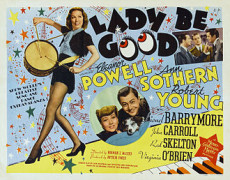
Lady Be Good was performed in the 1941 film Lady Be Good, taking its title and theme song “Oh Lady Be Good” from the 1924 George and Ira Gershwin Broadway musical, but otherwise is unrelated to the musical play. The film starred dancer Eleanor Powell, Ann Sothern, Robert Young, Lionel Barrymore and Red Skelton.
The Story: Eddie Crane, a young composer, is struggling with a tune he has just written. When his girlfriend, Dixie Donegan, provides words almost by accident, the song is published and is a great success.
A few years later, now married and successful songwriters with a hit Broadway show behind them, Dixie realizes that Eddie is spending more time in rich New York society than composing. They divorce, but quickly realize they are still in love and cannot do without each other. They remarry and write more successful songs, but then Eddie goes off to South America, ostensibly to get inspiration to write a symphony. Dixie again seeks a divorce, but the astute judge denies it. Eddie returns and they realize that despite all, they are still in love.
Sponsored By
www.whatissuitetabu.com
Daily Dose Of Jazz…
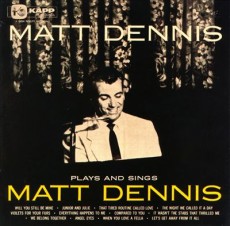
Matt Dennis was born on February 11, 1914 in Seattle, Washington. His early exposure to music came from the family business of vaudeville, his mother who was a violinist and his father a singer. In 1933 he joined Horace Heidt’s orchestra as a vocalist and pianist. Later he would form his own band, with Dick Haymes as vocalist.
Dennis became a vocal coach, arranger, and accompanist for Martha Tilton and then worked with a new vocal group, The Stafford Sisters. Jo Stafford, one of the sisters, joined the Tommy Dorsey band in 1940 and persuaded Dorsey to hire him as arranger and composer. He would go on to wrote prolifically, with 14 of his songs recorded by the Dorsey band in one year alone, including “Everything Happens To Me”, an early hit for Frank Sinatra.
With four years in the U.S. Air Force in World War II behind him, Matt returned to music writing and arranging. He got a boost from his old friend Dick Haymes, who hired him to be the music director for his radio program, and with lyricist Tom Adair wrote songs for Haymes’ program.
Dennis made six albums, most of which are out of print; however, his 1953 song Angel Eyes that he composed with lyricist Earl Brent has become a frequently recorded jazz standard. Added to that list of standards are Will You Still Be Mine, The Night We Called It A Day and Violets For Your Furs.
Composer, pianist, arranger, singer and bandleader Matt Dennis passed away on June 21, 2002 in Riverside, California at the age of 88.
Dose A Day – Blues Away