

Daily Dose Of Jazz…
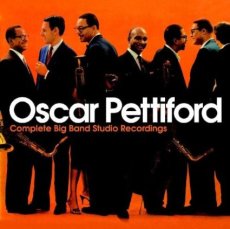
Oscar Pettiford was born September 30, 1922 in Okmulgee, Oklahoma to a Choctaw mother and Cherokee/African American father. Growing up playing in the family band in which he sang and danced, he switched to piano at the age of 12 then to double bass when he was at the age of 14. Despite being admired by the likes of Milt Hinton, he stopped playing in 1941, feeling he couldn’t make a living. Five months later, he once again met Milt, who persuaded him to return to music.
In 1942 he joined the Charlie Barnet band and 1943 saw him gaining wider public attention after recording with Coleman Hawkins on his “The Man I Love.” He also recorded with Earl Hines, Ben Webster, led a group with Dizzy Gillespie and went to California with Hawkins to play in the film The Crimson Canary and on the soundtrack.
Following this he joined Duke Ellington, then Woody Herman but by the 50s mainly became a leader. It was in this role he inadvertently discovered Cannonball Adderley after one of his musicians tricked him into letting Adderley, an unknown music teacher, onto the stand, he had Adderley solo on a demanding piece, on which Adderley performed impressively.
Pettiford is considered the pioneer of the cello as a solo instrument in jazz music, first played the cello as a practical joke on Woody Herman. However, in 1949, after breaking his arm and finding it impossible to play his bass, he started playing the cello allowing him to perform during his rehabilitation. He made his first recordings with the instrument in 1950. The cello thus became his secondary instrument, and he continued to perform and record with it throughout the remainder of his career.
He recorded extensively during the 1950s for the Debut, Bethlehem and ABC Paramount labels among others, and for European companies after his move to Copenhagen, Denmark in 1958. Oscar Pettiford passed away from a virus associated with polio on September 8, 1960 in Copenhagen and along with his contemporary, Charles Mingus, he stands out as one of the most-recorded bassist and bandleader/composers in jazz

Dose A Day – Blues Away
Daily Dose Of Jazz…
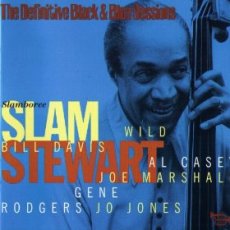
Slam Stewart was born Leroy Eliot Stewart on September 21, 1914 in Englewood, New Jersey. He originally played violin before switching to bass at the age of 20. While attending the Boston Conservancy he heard Ray Perry singing along with his violin giving him the inspiration to follow suit with his bass.
In 1937 Stewart teamed with Slim Gaillard forming the novelty jazz act Slim and Slam. The duo’s biggest hit was in 1938 with Flat Foot Floogie (With A Floy Floy).
Stewart found regular session work throughout the 1940s with Lester Young, Fats Waller, Coleman Hawkins, Erroll Garner, Art Tatum, Johnny Guarnieri, Red Norvo, Don Byas, Benny Goodman Sextet and Beryl Booker among others.
One of the most famous sessions he played on took place in 1945, when Stewart played with Dizzy Gillespie’s group during Charlie Parker’s tenure. Out of those sessions came some of the classic bebop tunes such as “Groovin’ High” and “Dizzy Atmosphere”.
Throughout the rest of his career, Stewart worked regularly and employed his unique and enjoyable bass-playing style trademark of bowing the bass (arco) while simultaneously humming or singing an octave higher until his death on December 10, 1987 in Binghamton, New York.
Inspire A Young Mind
More Posts: bass
Daily Dose Of Jazz…
Tatsu Aoki was born on September 19, 1957 in Tokyo, Japan into an artisan family that was a booking and training agent for Geisha ladies. He received at age 4 the important essence of traditional Tokyo Geisha cultural training and studies and became a part of the performing crew in early childhood. After his grandmother died, he had kept the Tokyo music training until early teen, and shifted his musical focus to American pop music and experimental music.
With his movie producer father he began working in small gage films and started to produce experimental films, was active performer during the early 70’s in the mist of Tokyo Underground Arts movement, became a member of Japanese Experimental Music ensemble, Gintenaki, presenting mixture of traditional music and new western music.
After coming to U.S. in 1977, Aoki studied experimental filmmaking at the School of the Art Institute of Chicago. During the late 80’s, Aoki has become a leading advocate for Chicago’s Asian American community and one of Chicago’s most in-demand musicians on contrabass, taiko (Japanese drums) and shamisen (Japanese lute) and working in both film and music.
An active musician in the field of Asian American jazz, he is the founder and artistic director of Asian Improv ARTS Midwest, The Annual Chicago Asian American Jazz Festival and The JASC Tsukasa Taiko Legacy arts residency program. Double bassist Tatsu Aoki currently teaches at the School of the Art Institute in Chicago.
Jazz Is Global – Share
Daily Dose Of Jazz…
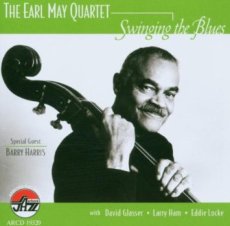
Earl May was born on September 17, 1927 in New York City first gravitated to drums, but at 14 acquired an acoustic bass, later making his professional debut at the Bronx’s 845 Club. While working an insurance job by day, 1949 saw May moonlighting across the New York club circuit, eventually catching the attention of drummer Connie Kay, who invited him to sit in behind Lester Young at Harlem’s now-legendary Minton’s Playhouse. He continued honing his craft in clubs like Minton’s Playhouse with musicians such as Lester Young and Mercer Ellington. A protégé of the legendary Charles Mingus, in 1951 Earl joined the Billy Taylor Trio, appearing regularly in such clubs as the Hickory House, Birdland and the Downbeat Club.
During the Fifties Earl also worked with Charlie Parker, Miles Davis, Quincy Jones, Gene Ammons, Sonny Stitt, Chet Baker, and Lorez Alexandria, Webster Young among others and recorded the classic “Lush Life” with John Coltrane. He left the Billy Taylor Trio in 1959 to form his own group and act as musical director and arranger for Gloria Lynne.
By the mid-sixties May took up the electric bass and led the Earl May Quartet at The New York Playboy Club and the group rapidly became the epitome of great music in the New York club scene.
Over the years Earl has performed or recorded with Dizzy Gillespie, Frank Foster, Cab Calloway, Tommy Flanagan, Barry Harris, Junior Mance, Benny Powell, Carmen Bradford, Frank Foster, Dizzy Gillespie, Linda Hopkins, Doc Cheatham, Charles Brown, Claude Williams, Jon Hendricks, Charles McPherson, Marlena Shaw, Ruth Brown, Winard Harper and Phyllis Hyman to name a few more.
Jazz bassist Earl May, one of the most prodigious and prolific bassists of the postwar era, lent his rich, round sound to every session and performance, was the only bassist to play with his left hand but kept the strings in their normal order and was a member of Local 802 since 1947, passed away on January 5, 2008. He was 80 years old.
Give The Gift Of Knowledge
More Posts: bass
Daily Dose OF Jazz…
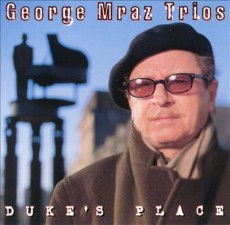
George Mraz was born Jiří Mráz on September 9, 1944 in Pisek Protectorate of Bohemia and Moravia, now the Czech Republic. He began his musical studies on violin at age seven and started playing jazz in high school on alto saxophone. He attended the Prague Conservatory in 1961 studying bass violin and graduating in 1966. During that time he was performing with the top jazz groups in Prague.
His first introduction to jazz was through the Voice Of America radio and Louis Armstrong which opened him to a vast new world of possibilities across the ocean. After finishing his studies George moved to Munich and played clubs and concerts throughout Germany and Middle Europe with Benny Bailey, Carmel Jones, Leo Wright, Mal Waldron, Hampton Hawes, Jan Hammer and others.
Mraz was greatly influenced by Ray Brown, Scott LaFaro, Paul Chambers, and Ron Carter. In 1968 he ventured to Boston on a scholarship to the Berklee School of Music and played at Lennie’s on the Turnpike and the Jazz Workshop with such artists as Clark Terry, Herbie Hancock, Joe Williams and Carmen McRae. By ’69 he was playing with Dizzy Gillespie and then on the road with Oscar Peterson for two years followed by a six- year residency with the Thad Jones/Mel Lewis Orchestra.
From the late seventies on he worked with Stan Getz, New York Jazz Quartet, Chet Baker, Hank Jones, Paul Motian, Zoot Sims, Bill Evans, John Abercrombie, Joe Lovano, Carmen McRae, Joe Henderson, Tommy Flanagan and the list of jazz luminaries is to long to elaborate. He was a member of the New York Jazz Quartet and Quest. Bassist and alto saxophonist George Mraz continues to perform, record and tour.
Take A Dose On The Road