

Daily Dose Of Jazz…
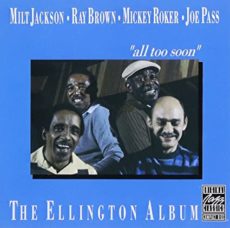
Mickey Roker was born Granville William Roker on September 3, 1932 in Miami, Florida into extreme poverty. After his mother died when he was ten, he was taken by his grandmother to live in Philadelphia, Pennsylvania with his uncle Walter. He gave the young boy his first drum kit, communicated his love of jazz, and introduced him to the Philadelphia jazz scene, where drummer Philly Joe Jones became his idol.
In the early 1950s, he started gaining recognition as a sensitive yet hard-driving big-band drummer. Favored by Dizzy Gillespie, he was soon in demand for his supportive skills in both big-band and small-group settings. While in Philadelphia he played with Jimmy Oliver, Jimmy Heath, Jimmy Divine, King James, and Sam Reed before moving to New York in 1959. Once there his first gigs were with Gigi Gryce, Ray Bryant, Joe Williams, Junior Mance, Nancy Wilson, and the Duke Pearson big band. In 1992, he replaced Connie Kay in the Modern Jazz Quartet.
He recorded with Dizzy Gillespie, Sonny Rollins, Duke Pearson, Tommy Flanagan, Ella Fitzgerald, Zoot Sims, Horace Silver, Junior Mance, Sarah Vaughan, Milt Jackson, Herbie Hancock, Phil Woods, Oscar Peterson, Ray Brown, Bucky Pizzarelli, Stanley Turrentine, Lee Morgan, Roy Ayers, Toshiko Akiyoshi, Hank Jones, Bobby Hutcherson, Joe Locke, and numerousother jazz musicians.
Drummer Mickey Roker Roker, who remained active on the Philadelphia music scene well into the 21st century, passed away on May 22, 2017 at the age of 84.

More Posts: drums,history,instrumental,jazz,music
Daily Dose Of Jazz…
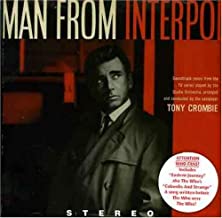
Tony Crombie was born Anthony John Kronenberg on August 27, 1925 in Bishopsgate, London, England. He was a self-taught musician who began playing the drums at the age of fourteen. He was one of a group of young men from the East End of London who ultimately formed the co-operative Club Eleven, bringing modern jazz to Britain.
In 1947 traveling to New York City with his friend Ronnie Scott, he witnessed the playing of Charlie Parker and Dizzy Gillespie, then took it back to the UK along with Scott, Johnny Dankworth, and Dennis Rose. 1948 saw Crombie touring Britain and Europe with Duke Ellington, who only brought Ray Nance and Kay Davis with him. Picking up a rhythm section in London, Ellington chose him on the recommendation of Lena Horne, with whom he had worked when she appeared at the Palladium.
Tony would go on to depart from jazz and set up a rock and roll band in 1956 he called The Rockets. Modelled after Bill Haley’s Comets and Freddie Bell & the Bellboys, he released several singles for Decca and Columbia record labels. By 1958 the Rockets had become a jazz group with Scott and Tubby Hayes. During the following year Crombie started Jazz Inc. with pianist Stan Tracey.
In 1960, he composed the score for the film The Tell-Tale Heart and established residency at a hotel in Monte Carlo. In May 1960 he toured the UK with Conway Twitty, Freddy Cannon, Johnny Preston, and Wee Willie Harris.
During the next thirty years he performed with Ben Webster, Coleman Hawkins, Illinois Jacquet, Joe Pass, Mark Murphy and Eddie “Lockjaw” Davis. In the mid-1990s, after breaking his arm in a fall, he stopped playing the drums but continued composing until his death in 1999. Drummer, pianist, vibraphonist bandleader, and composer Tony Crombie, who was an energizing influence on the British jazz scene for over six decades, passed away on October 18, 1999 in Hampsead, London at the age of 74.

More Posts: bandleader,composer,drums,history,instrumental,jazz,music
Daily Dose Of Jazz…
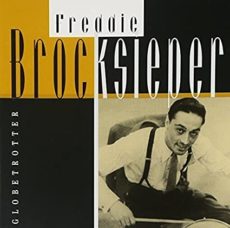
Fritz “Freddie” Brocksieper was born in Istanbul, Turkey on August 24, 1912, the son of a Greek-speaking Jewish woman and a German engineer, who was able to get through National-Socialism as an essential swing musician. His playing style on the drums was influenced above all by Gene Krupa and by 1930, he was playing professionally in Germany working in Nuremberg and Berlin throughout the decade. During World War II he played with the Golden Seven, Benny De Weille, Willy Berking, and the radio orchestra of Lutz Templin.
He recorded with his own ensembles, both large and small, in the later 1940s, and performed for American GIs in Stuttgart, Munich, and Berlin. An essential swing musician, Freddie was considered a leading figure of early European big-band jazz. With his bands, he made it to the front page of Stars and Stripes. Beginning in 1957 Bavarian radio regularly broadcast live concerts from his studio in Munich.
He continued performing in the 1960s and 1970s and was awarded a Deutscher Schallplattenpreis in 1980. From 1964 he played mainly in trios, and often with American soloists in Europe. Drummer Freddie Brocksieper passed away on January 17, 1990.
More Posts: bandleader,drums,history,instrumental,jazz,music
Daily Dose Of Jazz…
Max Abrams was born on August 11, 1907 in Glasgow, Scotland and began playing drums with dance bands in his teens, often in his hometown area. In the late Twenties, he headed to London, England and was soon active with a number of bands there.
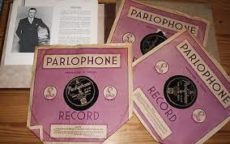
Touring South Africa before returning to London, in 1932, he joined Jack Hylton’s orchestra. During the next few years, Max played with several leading UK dance bands, including Sydney Lipton’s and Carroll Gibbons’ Savoy Orpheans. He was in demand for numerous recording sessions with many leaders as well as recording with his own band in 1935. He also made a series of tuition records for aspiring drummers.
In the early 40s, Abrams drummed with Ambrose, Jack Payne, and Stéphane Grappelli, then, in 1945, joined Sid Phillips for an engagement that lasted well into the next decade. During this period he often worked with small bands, including Humphrey Lyttelton’s, and appeared regularly on the radio. Technically gifted as a percussionist, he played several instruments including vibraphone, xylophone, and timpani.
As an educator, he was much sought after and founded his own School for Drum Tuition. His admired ability drew many eager and gifted drummers to him, among them Jack Parnell. Drummer Max Abrams, who actively performed from the 1930s through the 1950s, passed away on November 5, 1995.
More Posts: bandleader,drums,history,instrumental,jazz,music
Daily Dose Of Jazz…
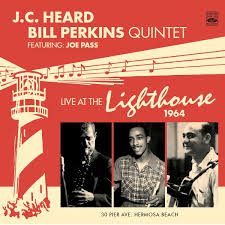
James Charles Heard, known as J. C. Heard was born on August 10, 1917 in Dayton, Ohio and grew up in Detroit, Michigan. As a young child, he performed as a tap dancer in amateur contests and vaudeville shows. He began to switch his focus to drumming around age 11 and started out teaching himself to play, then took lessons as a student at Cass Technical High School. Supporting his interest, his parents brought him to see major performers who toured to Detroit’s famous music venues, however, it was Chick Webb play in 1937 as a formative experience.
Becoming a protege of the drummer Jo Jones, through him he met and sat in with Count Basie. With Jones’s help, Heard got his first professional job with Teddy Wilson’s band in 1939. They played the Golden Gate Ballroom in Harlem and the Roseland Ballroom and recorded for Columbia Records. After the Wilson band’s breakup, he went on to perform in bands led by Benny Carter, Louis Jordan, Louis Armstrong, Benny Goodman, Duke Ellington, Woody Herman, and Dizzy Gillespie. He also performed at major jazz festivals and played alongside Roy Eldridge and Charlier Parker.
Heard’s style was a hybrid of swing and bop and was known for his innovative techniques and the hard swing he would bring to both large and small bands. He recorded with Charles Mingus, Ray Brown, Billie Holiday, Ray Charles, Nat King Cole, Dinah Washington, Lena Horne, and Sarah Vaughan. He also led his own bands, including a quintet that played at Cafe Society and a trio with Erroll Garner and Oscar Pettiford. Performing as a featured member of Cab Calloway’s band from 1942-1945, he appeared in several Hollywood films, including Stormy Weather.
During the Fifties Heard toured with Norman Granz’s Jazz at the Philharmonic in the 1950s and after a successful engagement in Japan in 1953, stayed for many years performing and teaching. Returning to New York in 1957, J.C. played with the Coleman Hawkins-Roy Eldridge Quintet and with Teddy Wilson’s trio. In 1966 he moved back to Detroit where he was influential as a bandleader and a mentor to younger musicians. In 1983, he again recorded an album as a leader, accompanied by saxophonist George Benson, pianist Claude Black, and Dave Young on bass. In 1981, Heard started a 13 piece big band which played around the state and at festivals, often featuring Dizzy Gillespie and other colleagues. This group recorded in 1986 and continued performing regularly until his death.
Drummer J. C. Heard passed away from a heart attack on September 27, 1988 at the age of 71 in Royal Oak, Michigan. His legacy is honored with a yearly jazz drumming competition held as part of the Detroit Jazz Festival.
More Posts: bandleader,drums,history,instrumental,jazz,music