

Hollywood On 52nd Street
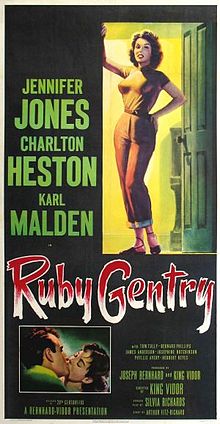
The song Ruby was composed by Heinz Eric Roemheld as the theme for the 1952 film Ruby Gentry. It subsequently became a jazz and pop standard, both as an instrumental and with lyrics by Mitchell Parish. The film was directed by King Vidor and starred Jennifer Jones as Ruby Corey/Gentry, Charlton Heston played Boake Tackman and Karl Malden held down the role of Jim Gentry. At the time of the film’s release the theme enjoyed much popularity in an orchestration by Les Baxter with harmonica solo by Danny Welton.
The Story: Ruby, a poor backwoods girl living in the small North Carolina town of Braddock, is still in love with Boake Tackman. During high school, Ruby had rebuffed his aggressive advances, and was taken in for a couple of years by kind wealthy businessman and his wife, who protected her and taught her the skills a lady would need. She moves back home when her father needed her help. Boake’s family used to be wealthy, but after generations of profligacy all he has left is the land he has had drained and farmed. He starts a relationship with her but plans to marry a local woman with a rich family. When Ruby hears the news, she marries her former benefactor, Mr. Jim Gentry, whose invalid wife recently died, despite not loving him.
Her background keeps her from being accepted by most of Jim’s peers, most of whom decline to attend their after-wedding party. Insecure, Jim becomes jealous of her relationship with Boake, has a fight, calls her a tramp and she leaves in tears. Apologies ensue and while sailing she admits her lack of loving him, while a loose rope results in Jim being knocked overboard by the boom, leaving Ruby widowed and distraught. Now she becomes the local gold-digger and murderess, the town rebuffs her and she gets harassing phone calls.
Retaliating, Ruby uses Jim’s money to begin a campaign against everyone who slighted her, calling in debts to close down people’s businesses as well as the newspaper that slandered her. Still holding a soft spot for Boake she returns his promissory note but again he rebuffs her kindness as a way to buy him and her out of the swamp. Once again, woman scorned and she floods Boake land, ruins his crop and once calm, apologizes. However, her estranged brother Jewel begins shooting at them, killing Boake and in turn Ruby kills her brother and then laments her decisions that have caused so much pain. Now alone, Ruby becomes the skipper of a fishing boat, forever looked down upon by the townspeople.
Sponsored By

www.whatissuitetabu.com

#preserving genius
Review: Allan Harris | Nobody’s Gonna Love You Better
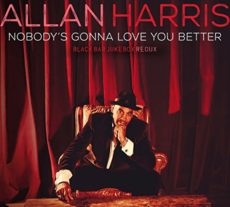
Choice, style and interpretation are the cornerstones of this vocalist who has an innate ability to proffer songs that allow him to eloquently emote. Having followed his career over the years there has been little he has been unable to do. Bringing four songs to the session that he penned, Allan deftly selected seven additional tunes composed by music’s elite that crosses all genres. Coupled with this, is his choice of musicians who pull off this roundhouse of songs that will definitely knock your socks off, if not off your feet. After numerous listening sessions and dancing around myself, I warn you now and it is my suggestion that you prepare to move about unabashedly through a variety of tempos. What is truly amazing is that Harris pulls this off without the use of any brass or wind instruments, producing not the sound but the feel of a Sixties rock and roll rhythm section.
This latest offering, Nobody’s Gonna Love You Better is evidence of that fact. An accomplished composer and lyricist, Allan kicks off this compendium of music with the uptempo wisdom of Mother’s Love, the formal name of the title track. Ever the griot, Harris plants thoughts worthy of rumination without being preachy but more of a gentle reminder for every son. He returns with Steely Dan’s brotherly advice by telling us Any Major Dude Will Tell You, giving the listener another lesson in keeping it real.
Covering a hit song is always a tribute to the original artist and requires it be performed just as well if not better. If you were around in 1969 then you remember a quintet called the Spiral Staircase who made More Today Than Yesterday popular for a couple of generations coming of age. Putting the right amount of swing in the mix he stays in the pocket with a big scoop of organ that will have you patting you foot and snapping your fingers, if not dancing around the house.
Giving us the opportunity to breathe a little lighter he drops down to ballad tempo to deliver a heartfelt rendition of the Johnny Mercer/Victor Schertzinger tune I Remember You. Love lost is not love forgotten and Mercer penned this song to Judy Garland, reminiscing over their short-lived romance when she was just 19. For those who may ask has Harris gone through this heartache himself given his superb delivery or like the bass keeping the heartbeat alive, does he just understand the emotional distress in the words, as does pianist Pascal Le Boeuf, who mirrors the sentiment throughout. Be comforted that he is just that good.
Rising up from the samba of Bahia, the bossa nova craze of Rio took the world by storm when the movie Orfeu Negro (Black Orpheus) hit the silver screen. Out of that explosion was birthed a host of composers, musicians and singers that included Dorival Caymmi and Antonio de Almeida who wrote Doralice. Fluently beautiful in the Portuguese language, Allan transports easily us to the side of her lover who is in strife because he loves her so but wants no wife, so he asks her what are they to do. For Brazil and bossa nova, it is nearly always about love. The rhythm is deceptive in its lightness for these star-crossed lovers.
Time has no meaning when one searches for the right song to add to their playlist and the Fields/McHugh tune I’m In The Mood For Love fit the bill perfectly. It was, however, refreshed with an improvised solo on the 1935 melody by James Moody and the lyrics by Eddie Jefferson, we add to the Great American Songbook the tune Moody’s Mood For Love. Harris stays away from the original rendition of performing the woman’s response in a high voice, delivering his version in ballad and taking the woman’s response to a mid-tempo beat and finishing his final words with brashness befitting someone who is smitten and confident and laying his emotions on the table.
Swing says it all in the title and having penned this one himself, Allan celebrate the big band era when teenagers and young adults all over America filled ballrooms like the Savoy, Palomar and Trianon and danced to jazz by Ellington, Goodman and Basie. A fitting tribute to the country’s most popular music between the Depression and a World War.
Hollywood is not off limits for this purveyor of song as he takes the theme song composed by Heinz Roemheld for the film Ruby Gentry. The lyrics by Mitchell Parish were added long after the tune had received wide acclaim. With a tempo suitable for dancing cheek to cheek, Harris speaks to the heart of the Ruby lyric and exposes the anguish, love and futility for this beauty that only the unloved would know. One will notice the bass line quietly captures the mood, with guitars in tow.
Your toes will tap once more as you are introduced to a swinging version of Jimi Hendrix’s Up From The Skies. This exemplifies Harris’ true talent in taking a rock song and giving it new life in jazz. The arrangement features the Hammond B3 gives it the punch need to get you on the floor or at the very least bopping in your seats and leaving you exhausted.
Blue Was Angry comes from the musical Cross That River that he wrote about the Black contributions, trials and accomplishments in the expansion of the West. Closing out this concert with a final ballad that he penned Secret Moments, he leaves us with a bit more wisdom about love and life.
I would be remiss if I didn’t pay my respects to the band that put in the hours to make this a winning project. Joining Allan Harris on Vocals, Acoustic Guitar, Resonator Guitar, D’Angelico Electric Guitar are Russell Hall – Acoustic Bass, Electric Bass; Pascal Le Boeuf – Piano, Fender Rhodes, Hammond B3; Shirazette Tinnin – Drums, Cajon; and Freddie Bryant playing Electric Guitar and Classical Guitar. Listening to them perform I can only surmise they truly had fun putting this one in the can and look forward to hearing them live. You chose well Mr. Harris.
What caught my eye at first glance were the classic songs that were chosen and the order in which they were placed. Introducing new songs, especially those you pen yourself, can often be a difficult task, but he does it well mixing them into the lineup. Next my ear was put to task to stay with a song to see developmental possibilities. As a deejay, I look for order and I will give any artist one opportunity to delight me. The song order in which Harris chose to present was pleasantly received having no inclination to skip a song or change the order. I was taken through all the emotions these composers and lyricists put into their compositions and felt buoyant and fully entertained. I heard versions of classics that were unexpected but fresh in their arrangements. If this is his brand, and I believe it is, he is not to be typecasted but embraced for the pioneering spirit that pushes his envelope to include all genres in this tapestry we call jazz.
For in this disposable world of short attention spans, where music is in your pocket, sold by the track, a click away from changing a song and one cannot listen longer than thirty seconds, there is no more getting up or walking across the room to the turntable, lifting the needle, moving to the next song or having to flip to the B side. I recognize the amount of thought that went into the order of his lineup and hopefully you will also. It may be a rollercoaster ride of emotions that begins on the downhill side of the first climb, winds around all the emotional twists and turns the music offers as it flows smoothly to a halt and we see just what has influenced his life and made him the superior musician and vocalist who has carved out his own niche in this world.
carl anthony | notorious jazz | january 3, 2017
Give A Gift Of Jazz ~ Share
#preserving genius
More Posts: bandleader,guitar,history,instrumental,jazz,music,review,vocal
Review: Niki Harris & EC3 | Time & Rhyme
Every now and then, if you’re lucky, you run across a bandleader who understands how to make a joyful noise. The days of the solo arranger and set configuration of players have been replaced with diversity bringing new ideas to eleven old songs. On his latest project Time & Rhyme, producer and drummer EC has collaborated with Niki Haris (Gene Harris’ daughter) and together have selected an incomparable set list that is no small feat to honor. Kicking off the set is a Tyrone Jackson arrangement with vocalist Niki Harris swinging an upbeat, straight-ahead version of the Hart/Rodgers tune Falling In Love With Love.
Traveling across the musical landscape Niki again takes center stage to present a poignant and tender rendition of another Jackson arrangement of the Bell/Creed composition Stop, Look, Listen. Not many vocalists have made me sit down and listen as intently as she did with the clarity and beauty of her interpretation. I could attempt to describe the emotional delivery Ms. Haris rendered on this song that five guys out of the Philly sound machine made famous, but the effort would be feeble at best and would be an injustice as you listen to her immense talent.
To challenge oneself to play a master is EC’s forte and he delivers with aplomb Dizzy’s Night In Tunisia opening with a strong bass line and sliding easily into an Afro-Cuban beat that can only be viewed as homage to a rhythm so dear to Mr. Gillespie’s heart. I was immediately transported to the backstreets of Havana and the raucous clubs full of flute, percussion and mambo.
Jackson steps in again with an easy bossa nova arrangement utilizing Frankie Quiñones percussive endowment to compliment Niki’s voice on Abbey Lincoln’s Throw It Away. Interestingly modal, they take it to a middle-eastern groove towards the end of the song, which gives Lincoln’s tune a refreshing outlook.
One can only think of the hapless scarecrow in the Wizard Of Oz when you see the words If I Only Had A Brain. Having heard this catchy Arlen/Yarburg tune many times, I was curious about the arrangement that would set this apart from the pack. Wade Beach set the tone for bassist Zack Pride’s conversation with EC’s drums. One can actually envision walking down the yellow brick road as they playfully execute the melody.
Billy Paul pulled the world’s heartstrings with Me & Mrs. Jones, however, Niki emotes a sense of fun and enjoyment in her relationship with Mr. Jones. One gets the sense that she is as comfortable with the relationship the way it is as she is relating it with an under beat of this collaborative mid-tempo bossa nova arrangement by EC and Jackson. Artia Lockett adds her enjoyment in the background like two girls having fun on a double date.
Not much more than the title needs to be said about Swinging At The Haven. EC puts his foot in the stew on this arrangement and the guys stir it up well. If you aren’t tapping a toe, shaking a hip or snapping your fingers, then you don’t know swing. Let this be your introduction.
Lionel Bart sits alongside the many resident masters of the Great American Songbook having penned the music and lyrics to Where Is Love for the 1960 Broadway musical Oliver. It’s a ballad of a young orphaned lad longing to find someone to love him and Niki quietly portrays the emotional depth of the lyric causing one to sympathize for the plight of this lost waif.
Changing tempos, EC, Dominique Patrick-Noel and A.T. take us back to our roots in the motherland as the trio drums and chants through Black Codes. One can visualize the movements of the dancers in a celebration of raising their ancestors. Nice & Easy is exactly what Niki and company do with this mid-tempo 7/8 meter of straight swing and Afro-Cuban undertones. If an encore was ever warranted on a recording then this Mandel/Mercer classic Emily would be a fitting adieu. The guys maintain the light and airy touch of the composers had in mind, leaving this listener with a vision of blue skies, sundresses, laughter and play in a field of wildflowers. Allow them to take you where your heart wants to go.
On this session drummer Ernest “EC” Coleman enlists vocalist Niki Harris, pianists Tyrone Jackson and Wade Beach, bassists Craig Shaw and Zack Pride, Sam Skelton on tenor saxophone and flute, saxophonist Teddy Baker, percussionists Frankie Quiñones, Dominique Patrick-Noel and Arch A.T. Thompson and Artia Locke holding down the background vocals.
For the uninitiated to EC’s genius, as you listen to this compendium of talent and music, I implore you to keep in mind, these are not shy schoolboys or coy girls on their first date. They are uncompromising professionals who know how to swing as well as be that gentle giant in the room with an equally tender touch. They may make it look easy but it is far from being that simple. Time, patience and the talent of eleven musicians committed to their craft have given birth to this seamlessly entrancing orchestration of sound.
carl anthony | notorious jazz | april 11, 2016
Give A Gift Of Jazz ~ Share
#preserving genius
More Posts: bandleader,drums,history,instrumental,jazz,music,review,vocal
Daily Dose Of Jazz…
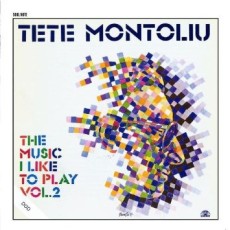
Tete Montoliu was born Vicenç Montoliu i Massana on March 28, 1933 in the Eixample district of Barcelona, Spain. Born blind, he was the only son of Vicenç Montoliu, a professional musician) and Àngela Massana, a jazz enthusiast, who encouraged her son to study piano. He first began piano lessons under Enric Mas at the private school for blind children that he attended from 1939 to 1944. By 1944, his mother arranged for Petri Palou to provide formal piano lessons.
From 1946 to 1953 Montoliu studied music at the Conservatori Superior de Música de Barcelona, where he also met jazz musicians and became familiar with the idiom in jam sessions. During the early stages of his career, Montoliu was particularly influenced by the music of pianist Art Tatum, although he soon developed a distinctive style.
He began playing professionally in Barcelona pubs where noticed by Lionel Hampton in 1956 he began touring with Hampton throughout Spain and France. After the tour Tete recorded Jazz Flamenco, setting off a prolific international career. In the 1960s, he played in various New York City concerts and established collaborations with drummer Elvin Jones and bassist Richard Davis.
The Seventies saw him traveling extensively throughout Europe, consolidating his reputation as a main referent in the hard bop movement. During the 1980s, he played numerous concerts, collaborating with Dexter Gordon, Johnny Griffin, Joe Henderson, Dizzy Gillespie, Chick Corea, Hank Jones, Roy Hargrove and Jess Davis, to name a few.
The man from Catalonia, pianist Tete Montoliu was given a public tribute by Spain in 1996 for his fifty-year career in jazz. He passed away the following year on August 24, 1997 in Barcelona. He left the jazz world an estimated catalogue of 52 albums as a leader and another 21 as a sideman with Anthony Braxton, Nuria Feliu, Dexter Gordon, Eddie Harris, Rahsaan Roland Kirk, Charlie Mariano, Jordi Sabates, Archie Shepp, Lars Gullin, Buddy Tate, and Ben Webster.

Inspire A Young Mind

More Posts: bandleader,composer,history,instrumental,jazz,music,piano
Daily Dose Of Jazz…
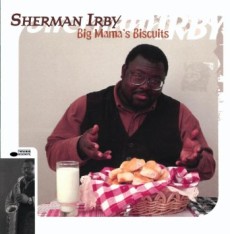
Sherman Irby was born and raised in Tuscaloosa, Alabama on March 24, 1968. He found his calling to music at age 12 and in high school he played saxophone and recorded with gospel immortal James Cleveland. Graduating from Clark Atlanta University with a B. A. in Music Education, in 1991, he joined Johnny O’Neal’s Atlanta-based quintet.
1994 saw Irby moving to New York City and immediately became a part of the jazz scene at Smalls jazz club. Catching the attention of Blue Note Records. He subsequently recorded his first two albums, Full Circle in 1996 and Big Mama’s Biscuits in 1998 on the label. He toured the U.S. and the Caribbean with the Boys Choir of Harlem in 1995, and was a member of the Jazz at Lincoln Center Orchestra from 1995 to 1997. During that tenure, he also recorded and toured with Marcus Roberts, Roy Hargrove and was part of Betty Carter’s Jazz Ahead Program.
After a four-year stint with Roy Hargrove, he focused on his own group, in addition to being a member of Elvin Jones’ ensemble and Papo Vazquez’s Pirates Troubadours. Since 2003, Irby has been the regional director for the Jazz Masters Workshop, mentoring young children, and a board member for the CubaNOLA Collective. Saxophonist and composer Sherman Irby formed Black Warrior Records and has released Black Warrior, Faith, Organ Starter and Live at the Otto Club under the new label. Post-bop alto saxophonist Sherman Irby has re-joined Jazz At Lincoln Center Orchestra with Wynton Marsalis and currently continues to perform with his quartet and his group Organomics.
Put A Dose In Your Pocket
More Posts: bandleader,composer,history,instrumental,jazz,music,saxophone