

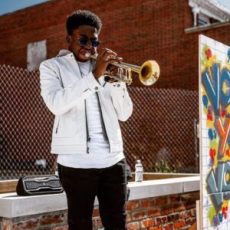
JAURON PERRY
Jauron Perry, is a rising Detroit-Native Jazz Trumpeter, Composer, and Bandleader, currently a first year undergraduate studying jazz performance at Michigan State University’s College of Music. Selected as the Next Generation of Talent award recipient, Jauron has quickly gained much experience performing and working with Detroit jazz masters such as Rodney Whitaker, Dwight Adams, James Carter, Dee Dee Bridgewater, Vincent Chandler, Kris Johnson, Diego Rivera, Sean Dobbins, Wendell Harrison, Marion Hayden, and Regina Carter, just to name a few. Other sensations outside of his hometown include Etienne Charles, Wynton Marsalis, Marcus Printup, Walter Blanding, Jerome Jennings, Tim Warfield, Helen Sung, and Jeff Hamilton.
Jauron has also been featured in popular events such as the Detroit Jazz Festival, Michigan Jazz Festival, African World Festival, East Lansing Summer Solstice Jazz Festival, and as of
recent, the Jack Rudin Jazz Championship at Jazz at Lincoln Center with MSU’s Jazz Orchestra 1. From his experience has come his reputation for being vastly knowledgeable, passionate, and mature about his craft for his age. He has been said, according to Kris Johnson, to be a “natural leader who searches for new ways to make personal connections with the music”. Having graduated from the acclaimed Detroit School of Arts High School, known for producing popular artists such as Aaliyah, and even the vibrant Endea Owens, a strong foundation and seriousness was established for Jauron early on through effective exposure and world-class mentorship. In addition to his performance endeavors, Jauron also works as a
youth mentor and advocate for young people matriculating into the arts and entertainment industry.
He is currently constructing his own original compositions and aspires to lead bands of varying styles and sizes from small group to big band and straight ahead jazz to funk and fusion to perform across numerous venues around the country and internationally. Jauron desires to spread a message of unity, diversity, and awareness through his music, honor the tradition by highlighting the great eras of jazz and pay tribute to legends and his mentors, and include relevant themes in how he approaches performing even jazz classics through the lens of today’s world.
Showtimes: 7:30p | 9:30p
More Posts: adventure,club,genius,jazz,music,preserving,travel,trumpet

JOHN PERRINE QUARTET
Composer, Saxophonist and Educator John Perrine returns to the BOP STOP! He will be presenting original music with his quartet.
CSU alums Jimmie Parker, piano | CSU faculty member Chris Vance, bass | Crystal Burks, drums
John Perrine, Professor, is Coordinator of Jazz Studies and Director of Jazz Ensembles at Cleveland State University. He has premiered works by Kari Juusela, Aaron Johnson and William Price. Perrine holds a doctorate from Louisiana State University, a masters from Northwestern University, and a BME from Stetson University. His teachers include James Bishop, Fred Hemke, Jonathon Helton and Griffin Campbell. He has studied jazz with Harold Blanchard, Don Owens, Tony Garcia and Michael Koucour.
Recently, Perrine has performed the Bolcom Concert Suite with the Volga Band (Saratov, Russia). Perrine also gave master classes at the Saratov Conservatory and the Rostov On-Don Conservatory and well as at Moscow State University for Culture and Arts where he has been invited back to perform the Ingolf Dahl Saxophone Concerto.
He is a founding member of the Red Stick Saxophone Quartet. The quartet has won national prizes in the MTNA and Fischoff chamber music competitions. Perrine’s composition “Vonnegut: Suite for Saxophone Quartet” was premiered at the North American Saxophone Alliance International Convention in Columbia, South Carolina by the Red Stick Saxophone Quartet.
His recordings “Dance of the Pampanzi” and “Here’s the Thing” are available on most streaming services.
More Posts: adventure,club,genius,jazz,music,preserving,saxophone,travel

ADAM HAWLEY
Ten #1 hits. 65+ dates per year. smooth jazz guitarist Adam Hawley has burst on to the scene as a celebrated and innovative artist, composer and band leader. Originally signed to Maurice White’s (founder of Earth, Wind, & Fire) label Kalimba Music, Adam’s first two albums “Double Vision” and “Just the Beginning” spawned an incredible Six #1 Hits, an unprecedented feat for a new artist.
He followed that up with “Escape” which included the 2020 Billboard Song Of The Year “To The Top.” In 2021 Adam set out with the exciting fourth album “Risin’ Up” which features Steve Cole, Vincent Ingala, Julian Vaughn, Riley Richard & Kat Hawley anchored by the thrilling first single “Risin’ Up.”
More Posts: adventure,club,genius,guitar,jazz,music,preserving,travel
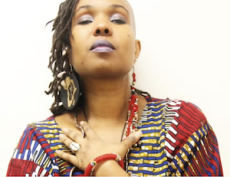
AKUA ALLRICH & THE TRIBE!
Jazz vocalist and DC-native Akua Allrich has proven herself to be a musician of extraordinary talent and crowd-moving passion. With finesse and charisma, this vocalist, composer and teacher, has successfully etched out a place for her unique musical expression, electrifying audiences in and around the nation’s capital with sold-out performances.
Allrich’s style is fluid and ever evolving. Her musical roots run deeply into blues, soul and rhythm and blues, with a clear grounding in jazz and pan-African music. She sings in many languages including Portuguese, French, Spanish, English, Xhosa, and Twi. Given her ability to capture the essence of a broad range of musical genres, Allrich is often likened to legendary artists such as Oscar Brown, Jr., Miriam Makeba, Bob Marley and Nina Simone. She has developed popular tribute programs involving the latter two women and other great African American women of jazz.
More Posts: adventure,club,festival,genius,jazz,music,preserving,travel,vocal
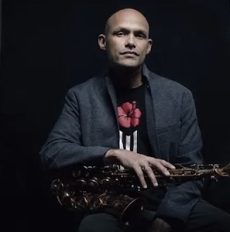
MIGUEL ZENÓN QUARTET
More Posts: adventure,club,genius,jazz,music,preserving,restaurant,saxophone,travel