

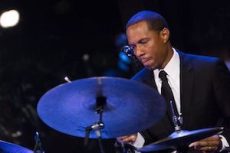
WILLIE JONES III QUINTET
Jazz drummer Willie Jones III has played, toured, and recorded with Horace Silver, Roy Hargrove, Hank Jones, Cedar Walton, and Herbie Hancock. He played on Arturo Sandoval’s Grammy-winning 1998 album Hot House.
Jones was one of the founding members of the band Black Note in 1990. Members of this ensemble included, at various times, Ark Sano, Eric Reed, Gilbert Castellanos, James Mahone, Kenneth Crouch, Mark Shelby, and Richard E. Grant. They released several albums.
In 1991, Jones began studying at the California Institute of the Arts, where he took drum lessons from Albert “Tootie” Heath. Jones played with Milt Jackson in 1994, and toured with trumpeter Arturo Sandoval from 1994 to 1998.
Jones was based in Los Angeles until he moved to New York in 1997. He played in trumpeter Roy Hargrove’s quintet from 1998 to 2006.
In 2000, Jones founded an independent jazz label, WJ3 Records. He has regularly played with pianist Eric Reed, as the drummer for Wynton Marsalis’ Jazz at Lincoln Center, and has several CDs released as a leader on his own label, playing hard bop and swing.
Jones has taught at Northwestern University since 2010.
Showtimes: 7:00pm | 9:30pm
More Posts: adventure,club,drums,genius,jazz,music,preserving,travel

BRIA SKONBERG
Skonberg was the leader of Bria’s Hot Five and The Big Bang Jazz Band. She also performed with Canadian jazz veteran Dal Richards and his Orchestra in concert and on recordings.
Skonberg has appeared as a band leader and guest artist at jazz festivals in North America, Europe, China and Japan. She moved to New York City in 2010. She was a co-founder of the New York Hot Jazz Festival.
Skonberg has performed with Bucky Pizzarelli, Howard Alden, and Wycliffe Gordon. Also with Shaye Cohn.
In 2017 Skonberg won the Juno Award for Vocal Jazz Album of the Year, for her crowd-funded album Bria.
Showtimes: 7:00pm | 9:30pm
More Posts: adventure,club,genius,jazz,music,preserving,travel,trumpet
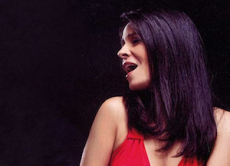
MAUCHA ADNET: BOSSA ALWAYS NOVA
Maucha Adnet was born in Rio de Janeiro, Brazil. She started her professional singing career at the age of 15, as a member of vocal group Céu da Boca. Maucha toured with Jobim throughout Brazil, United States, Japan, Israel and Europe and performed in Jazz Festivals and venues such as Carnegie Hall (NY), Avery Ficher Hall (NY), Hollywood Ball (LA), Bill Graham Wiltern Theatre (LA) and many others.
Maucha has also recorded with such artists as Dorival Caymmi, Chico Buarque, Dori Caymmi, Caetano Veloso, Toninho Horta, Mario Adnet, Joyce, Nara Leão, Cesar Camargo Mariano, Charlie Byrd, Gil Goldstein, Emily Remler, Rob Mounsey, Othelo Molineaux, Trio da Paz, Herry Allen, Duduka Da Fonseca, Slide Hampton and many others. She was the guest vocalist on Randy Brecker’s Grammy Winner CD ‘Into the Sun’.
Residing in New York for many years, Maucha has been performing regurlaly with her own band and has performed in shows with Claudio Roditi, Herbie Mann, Trio da Paz, Oscar Castro Neves, Eliane Elias, Mark Johnson, Slide Hampton, Randy Brecker, Carnegie Hall Jazz Band at various venues, notably; Carnegie Hall, Avery Fisher Hall, Blue Note and Birdland. Most recently she was the guest vocalist performing with Wynton Marsalis and the Lincoln Center Jazz Orchestra with Cyro Baptista at Alice Tully Hall (NY), may 2002. Maucha has a solo CD ‘Songs I Learned From Jobim’, released in Japan (Venus Records).
Showtimes: 7:00pm | 9:30pm
More Posts: adventure,club,genius,jazz,music,preserving,restaurant,travel,vocal
Daily Dose Of Jazz…
Edward Anderson was born on July 1, 1910 in Jacksonville, Florida. He began playing trumpet at age ten, taking his first lessons with the bandmaster at Florida State College. At 15 he went to St. Emma College in Belmead, Virginia\ and was principal trumpet in the college band.
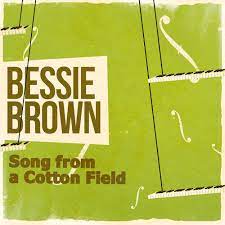
He played with Luckey Roberts at the Everglades Club in Palm Beach, Florida and traveled to New York City with him in the spring of 1926. Roberts introduced Anderson to Clarence Williams, who began using him on recordings. He recorded with blues and jazz singer Bessie Brown on her album Song From A Cotton Field in that year. During the period between 1927-28, Anderson worked with drummer George Howe and Luis Russell at the Nest Club, and with Jelly Roll Morton at the Rose Danceland.
1929 saw Ed subbing for Louis Armstrong at Connie’s Inn while Armstrong was in the revue Hot Chocolates. He played with Benny Carter at the Arcadia Ballroom, Charlie Johnson, and Bingie Madison, then joined The Mills Blue Rhythm Band from 1930 until mid 1934. He later played in Charlie Turner’s Arcadians, then joined Hazel Scott’s big band early in 1939.
After a stint with Frankie Newton’s band at the Mime Club in New York in 1941 he left fulltime music. Eventually Ed Anderson, who often went by Andy, gave up the trumpet, but maintained a residence in the city. The date of his death is unknown at this time.

More Posts: history,instrumental,jazz,music,trumpet
DENVER JAZZ ORCHESTRA
The Denver Jazz Orchestra is comprised of some of Denver’s finest jazz musicians who come together to celebrate and perform big band music. From swing, to latin, lush ballads to funk, the DJO does it all. The DJO has been entertaining and exciting audiences for more than 15 years at jazz clubs, festivals and concerts.
Be sure and reserve your seat today as their performances at Dazzle regularly sell out.
More Posts: adventure,club,ensemble,genius,jazz,music,preserving,travel