


Daily Dose Of Jazz…
Brian Lemon was born on February 11, 1937 in Nottingham, England to parents who were semi-professional dance-band violinists who both worked for the cigarette manufacturer John Player & Sons. Inspired by Fats Waller and later by Art Tatum and Teddy Wilson, he studied the piano with Reg Conroy, a local teacher, and was soon proficient enough to perform in palais bands in his home city.
By the mid-1950s, at 19, he moved to London and joined Freddy Randall’s group. After that, he worked with George Chisholm and Kenny Baker. Over the years, Brian worked with Benny Goodman, Charlie Watts, Scott Hamilton, Buddy Tate, Milt Jackson, Ben Webster, and Digby Fairweather. He led an octet that played songs by Billy Strayhorn.
For 10 years from 1994 Lemon recorded a sequence of 27 albums for Zephyr, with seven as leader. Zephyr was set up by retired businessman John Bune to record Lemon’s work. Adelaide Hall recorded an album with The Brian Lemon Half-Dozen. A rare copy is at the British Library.
After the development of severe osteoarthritis in his handsLemon retired from music around 2005. Pianist and arranger Brian Lemon passed away on October 11, 2014.
More Posts: bandleader,history,instrumental,jazz,music,piano

Daily Dose Of Jazz…
Erskine Butterfield, born February 9, 1913 in Syracuse, New York and began playing piano at an early age when his family moved to Newark, New Jersey, where he later studied piano. In the 1930s, he regularly appeared on radio, including WOR in New York City, and played with Noble Sissle’s orchestra. He made his first sound recording and reproduction in 1937 on the Variety record label.
In 1938, he signed with Decca Records for which he recorded over forty titles between 1940 and 1942, many of which were released. Butterfield was called the Singing Vagabond of the Keys by the Chicago Defender in 1939. He was innovative in utilizing black and white musicians together in his combo, which included session musicians such as clarinetist Jimmy Lytell, guitarist Carmen Mastren, and Haig Stevens on bass.
1939 saw Butterfield signing with Joe Davis of Beacon Records, with whom he would maintain a long term relationship. However, in 1943 he was drafted but continued to play in a group, recorded eight titles for Joe Davis under the name Erskine Butterfield and his Blue Boys in ‘44 and cutting V-Discs in 1945.
After World War II, Erskine formed a trio and toured extensively, but his music style was less successful commercially. He recorded for a number of small labels in the late 1940s, after which his recording activity dropped off. In 1956, however, he again recorded a number of titles for Joe Davis with a reformed group, Butterfield and his Blue Boys, including musicians such as Sam “The Man” Taylor on saxophone and Panama Francis on drums. He made appearances on The Nat King Cole Show, The Tony Martin Program and The Jo Stafford Show.
His light swing and traditional piano phrases resulted in some of his songs, such as Lovin’ Man and Because Of You, being used in film soundtracks. Pianist, singer, bandleader and composer Eskine Butterfield, credited with helping to invent the style of cocktail piano, passed away on July 11, 1961 in New York City.
More Posts: bandleader,history,instrumental,jazz,music,piano
Daily Dose Of Jazz…
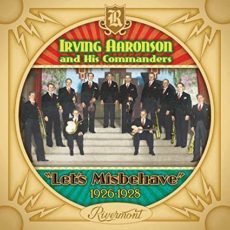
Irving A. Aaronson was born in New York on February 7, 1895 and learned to play the piano from Alfred Sendry at the David Mannes School for music. By age 11 he played accompaniment in silent movie theaters called nickelodeons. In 1921 he co-wrote a hit song, Boo-Hoo-Hoo.
When his band was signed with the Victor label, the band name was changed to Irving Aaronson and his Commanders. From 1926 to 1929, the band recorded for the label and had a notable success with Let’s Misbehave in 1927. The band appeared in Cole Porter’s Broadway musical Paris, in 1928 and broadcasted on KFWB in Hollywood, California in 1929.
In 1935, he starred in the Irving Aaronson Orchestra radio program on NBC. The band toured movie theatres and ballrooms across the US before calling it quits in the mid-1930s, But his band had included at various times musicians such as Phil Saxe, Joe Gillespie, Artie Shaw, Gene Krupa, Tony Pastor, and western movie actor Fuzzy Knight was the band’s drummer in the late Twenties.
By the time he turned 45, Irving was working as a musical director for MGM studios. He remained there in that capacity, voicing for television Mr. Nobody in the MGM’s animation Betty Boop for President and as an assistant to producer Joe Pasternak, until his death from a heart attack. Pianist, bandleader and composer Irving Aaronson passed away in Hollywood, California on March 10, 1963 at the age of 68. His most popular song, The Loveliest Night of the Year, was not recorded with his band but was adapted by Aaronson in 1950 for the Mario Lanza film The Great Caruso.
More Posts: bandleader,composer,history,instrumental,jazz,music,piano
Daily Dose Of Jazz…
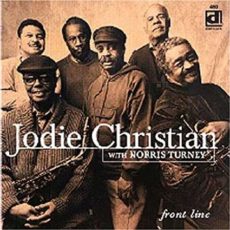
Jodie Christian was born on February 2, 1932 on 44th Street and Prairie Avenue in Chicago, Illinois. His grandfather sold his livestock and sent the family there once he realized the futility of raising a family as share-croppers. His mother was a church pianist, who helped him with music. The young Jodie attended Wendell Phillips High in Chicago. When his mother became director of the church choir, he took over on the piano; sometimes they played organ and piano duets in the church. His father sang and played the blues on the piano in speakeasies and rent parties, but ultimately stopped performing and followed his wife into the church.
Christian was one of the founders of the Association for the Advancement of Creative Musicians (AACM) with pianist Muhal Richard Abrams, drummer Steve McCall, and composer Phil Cohran. He and Abrams were also part of the Experimental Band. He worked at the Jazz Showcase club in Chicago and performed with Eddie Harris, Stan Getz, Dexter Gordon, Gene Ammons, Roscoe Mitchell, Buddy Montgomery, and John Klemmer.
He led his own group and recorded six albums, and another fifteen as a sideman with Von Freeman, Eric Alexander, Gene Amons, Lin Halliday, Les McCann, and Ira Sullivan to name a few. Pianist and bandleader Jodie Christian, noted for bebop and free jazz, passed away on February 13, 2012, aged 80, in Chicago.
More Posts: bandleader,history,instrumental,jazz,music,piano
Daily Dose Of Jazz…
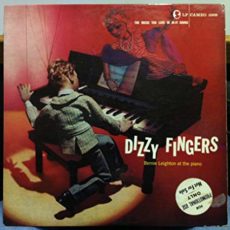
Bernie Leighton, born on January 30, 1921 in West Haven, Connecticut, first played piano professionally at the end of the 1930s. In the early Forties, he played with Bud Freeman, Leo Reisman, Raymond Scott and Benny Goodman before serving in the Army.
Following his discharge, he found work as a studio sideman through the Sixties with Dave Tough, Billie Holiday, Neal Hefti, Goodman again, Artie Shaw, John Serry, Sr., James Moody and Bob Wilber. He toured a year with Tony Bennett from 1972 to 1973.
While Leighton was best known as a sideman, he also recorded extensively as a leader, releasing albums on Keynote Records, Mercury Records, Columbia Records, Brunswick, Disneyland and Capitol. He also recorded a tribute to Duke Ellington released in 1974. He has a cameo role in the 1986 film Hannah and Her Sisters. Pianist Bernie Leighton passed away on September 16, 1994 in Coconut Creek, Florida.

More Posts: bandleader,history,instrumental,jazz,music,piano