

Daily Dose Of Jazz…
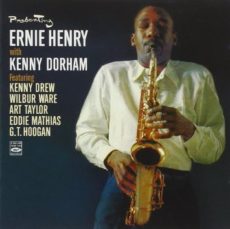
Ernie Henry was born on September 3, 1926 in Brooklyn, New York. He played in the late 1940s with Tadd Dameron, Fats Navarro, Charlie Ventura, Max Roach, and Dizzy Gillespie. From 1950 to 1952 he was in the band of Illinois Jacquet.
After a few years in the shadows, in the 1950s he returned to play with Thelonious Monk, Charles Mingus, Kenny Dorham, Kenny Drew, Wynton Kelly, Wilbur Ware, Matthew Gee, Art Taylor, Philly Joe Jones and Gillespie again in 1956.
He recorded four albums as a leader for the Riverside label shortly before his death Presenting Ernie Henry, Seven Standards and a Blues, Last Chorus and 2 Horns / 2 Rhythm.
Alto saxophonist Ernie Henry passed away of a heroin overdose at the age of 31 on December 29, 1957 in New York City.

Give A Gift Of Jazz – Share

More Posts: saxophone
Daily Dose Of Jazz…
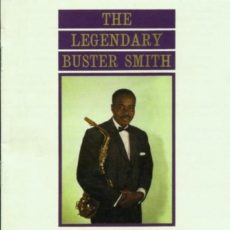
Buster Smith was born Henry Smith on August 24, 1904 Alsdorf, Texas, the third boy of five and earned the name “Buster” from his parents as he was an overweight baby when his mother gave birth. His early musical influences were his mother, and his father, who played guitar. At the age of four years, Buster and his brother Boston, a pianist, were playing organ, he played the keys and his brother stepped on the pedals. Soon thereafter, believing it would lead to a life of sin, his grandfather gave away the organ.
In 1919, Smith picked cotton for a week to earn himself the money to buy a $3.50 clarinet. He went on to learn to play several instruments by the time he was eighteen years old. Moving to Dallas in 1922, he joined the Voodie White Trio, playing alto saxophone and clarinet. The following year he began his professional career as an alto saxophonist with the medicine shows, though he had to play very loudly to draw in more customers. This experience defined his musical style, becoming known for being loud.
This period led to Oran “Hot Lips” Page inviting Smith to join his group, the Oklahoma City Blue Devils, in 1925. Over the next few years Buster wrote much of the group’s music, learning from banjo player Johnny Clark, writing lyrics with co-workers from the bank that he worked in.
As a Blue Devils he worked alongside Walter Page, Oran Page, Lester Young, Count Basie, Jimmy Rushing, and Emir “Bucket” Coleman. They toured the Kansas City area and the Midwest, playing jazz for a year, bringing all of its members into prominence. Basie and Page both left the group; and shortly afterwards so did Smith. He and Basie formed the Buster Smith-Count Basie Band of Rhythm, where the two innovated a louder style of jazz. Buster’s contribution to the unique sound was by using a tenor saxophone reed in his alto saxophone to achieve a louder, “fatter” sound. Young opted for a heavier reed, using a baritone saxophone reed on his tenor saxophone. This sound was later labelled the Texas Sax Sound.
Smith gained influence in the Texan music community and industry. He mentored saxophonist Charlie Parker during the 1930s, developing a father-son relationship. He played with a host of musicians including Duke Ellington, Ella Fitzgerald and Earl Hines but in 1941 he returned to Dallas and ceased touring but remained active in the local music scene. In the years that followed he wrote for jazz and blues bands, played often, and known as Professor Smith, taught many young Texan musicians, including Aaron “T-Bone” Walker and Red Garland among others. He also performed session work with Pete Johnson’s Boogie-Woogie Boys, Eddie Durham, Leo “Snub” Mosley, Bon and His Buddies, and the Don Redman Orchestra.
In the 1960s, Smith was involved in auto accident, his injuries causing him to give up the saxophone. Not to be dissuaded from performing he took up the bass guitar, led a dance band and played into the mid-Eighties with the Legendary Revelations. Alto saxophonist Buster Smith, who recorded only one album as a leader in 1959, passed away on August 10, 1991 of a heart attack in Dallas, Texas.
Jazz Is Global – Share
More Posts: saxophone
Daily Dose Of Jazz…
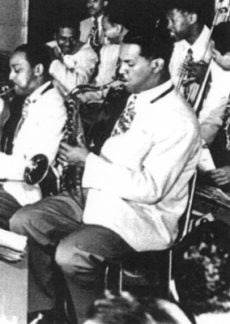
Bumps Myers was born Hubert Maxwell Myers on August 22, 1912 in Clarksburg, West Virginia. Influenced by Coleman Hawkins he played the tenor saxophone but also the alto and baritone. Growing up in California he began his musical career at the age of 17 in the Los Angeles area, playing with Curtis Mosby and His Dixieland Blue Blowers,
By 1927 he had recorded for the first time and two years later was playing in Seattle, Washington with Earl Whaley. The mid-1930s saw him with Buck Clayton and Teddy Weatherford, with whom he went on tour. From 1934 to 1936 he lived in Shanghai, China where he worked in Canidrome with Weatherford’s band and Buck Clayton. After returning to the United States in 1937 he played with Lionel Hampton and Les Hite .
The early Forties had Bumps working with the short-lived band of Lee and Lester Young. In 1942 and again in 1945 he worked at Jimmie Lunceford and 1943-48 in Benny Carter’s big band. Mid-1940s he performed several times with Jazz at the Philharmonic and in 1945 he played with Sid Catlett on.
1947 saw him playing with Benny Goodman and recording the hit Call It Stormy Monday (But Tuesday Is Just as Bad). Under his own name he released Bumps Myers & His Frantic Five in 1949 on the Blu, Selective and RPM labels.
In the 1950s, Myers worked as a studio musician, played with Red Callender, and Harry Belafonte in 1958 . After touring with Horace Henderson from 1961-62, Myers retired from music because of issues with his health.
In the field of swing and jazz, he was involved from 1927 to 1960 on some 90 recording sessions with Irving Ashby, Kay Starr, Lee Richardson, Ernestine Anderson, Freddie Slack, Mel Powell, Dan Grissom, Fletcher Henderson, Russell Jacquet, Louis Bellson and Maxwell Davis, Not limiting himself to jazz he also played on a number of rhythm and blues recordings by T-Bone Walker, George Vann, Amos Milburn, Jimmy Witherspoon, Helen Humes, Percy Mayfield, Tony Allen and B. B. King.
Swing saxophonist Bumps Myers, who never gained the notoriety or popularity of his contemporaries, due possibly to working mainly in the Los Angeles music scene, passed away on April 9, 1968 in Los Angeles, California.
Give A Gift Of Jazz – Share

More Posts: saxophone
Daily Dose Of Jazz…
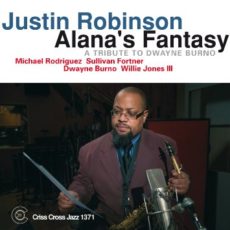
Justin Robinson was born August 14, 1968 in Manhattan, New York City and first began playing saxophone at the age of 13, while attending the High School of Music and Arts, formerly LaGuardia High School. His influences were Charlie Parker and Jackie McLean.
From 1984 to 1986 he was a part of the McDonald’s High School Jazz Band and at the age of 18 he joined with Philip Harper and Winard Harper actively helping in their formation of the Harper Brothers. By 1988 Betty Carter brought him into her band and from the early 1990s, he has played with Cecil Brooks III, Abbey Lincoln, Diana Ross, Little Jimmy Scott, Carnegie Hall Jazz Band, the Dizzy Gillespie All Star Band, Kate Higgins, Sam Newsome and especially Roy Hargrove, both in the Big Band as well as in the quintet.
After his 1991 recording debut with Justin Time on the Verve label, to the Bobby Watson, Eddie Henderson, Kenny Barron and Gary Bartz participated release of Challenge in 1998, on which he was accompanied by his childhood friend Stephen Scott. Always a thoughtful leader who takes his time to compose and record, his third project In The Spur Of The Moment was released in 2012.
Alto saxophonist Justin Robinson is currently touring with the quintet and big band of trumpeter Roy Hargrove.

More Posts: saxophone
Daily Dose Of Jazz…
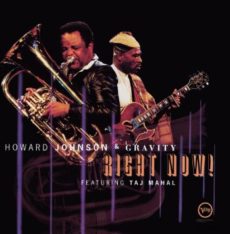
Howard Lewis Johnson was born August 7, 1941 in Montgomery, Alabama. In the 1960s he worked with Charles Mingus, Hank Crawford, Rahsaan Roland Kirk, Archie Shepp, and Hank Mobley on the album A Slice of the Top.
He began a long association with Gil Evans in 1966, arranger of a horn section that backed Taj Mahal on Mahal’s 1971 live album, The Real Thing, which featured three other tubists/multi-instrumentalists, Bob Stewart, Joseph Daley and Earl McIntyre. Howard played with The Band on their Rock of Ages live album, The Last Waltz and into the late 2000s with The Band drummer, Levon Helm’s Band. During the 1970s, he was the band conductor of the Saturday Night Live Band; he can be seen in several musical numbers, including playing bass saxophone in the King Tut sketch.
He has also led three tuba bands, collaborated with Tomasz Stanko, Substructure, Tuba Libre and GRAVITY, perhaps his best-known band. In 1981 he performed at the Woodstock Jazz Festival, held in celebration of the tenth anniversary of the Creative Music Studio.
He had a minor role in the 1983 film, Eddie and the Cruisers as Wendell’s replacement and also appeared in episodes of Matlock and Hill Street Blues. Johnson famously accompanied James Taylor in a performance of Jelly Man Kelly on Sesame Street in 1983, and also on tin whistle when Taylor sings to Oscar The Grouch.
Tubist, baritone saxophonist, arranger, conductor and bandleader Howard Johnson, who also plays bass clarinet, trumpet and other reed instruments, continues to perform, record and tour.
Dose A Day-Blues Away