

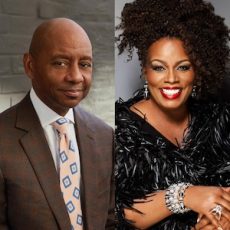
BRANFORD MARSALIS & DIANNE REEVES
Saxophone great and NEA Jazz Master Branford Marsalis and his superlative quartet are joined by fellow NEA Jazz Master and jazz’s greatest vocalist, Dianne Reeves, for a week devoted to the immortal music of John Coltrane, in honor of the centennial of his birth.
Saxophonist Branford Marsalis is one of the most influential and revered figures in contemporary music. The NEA Jazz master, three-time Grammy Award winner, and Tony and EMMY Award nominee is equally at home performing concertos with symphony orchestras and sitting in with members of the Grateful Dead, but the core of his musical universe remains the Branford Marsalis Quartet. After more than three decades of existence with minimal personnel changes, this celebrated ensemble is revered for its uncompromising interpretation of a kaleidoscopic range of both original compositions and jazz and popular classics.
The Branford Marsalis Quartet and Dianne Reeves will release a tribute album which revisits Coltrane’s seminal 1963 collaboration with Johnny Hartman. Originally recorded at Rudy Van Gelder’s studio in March of 1963, John Coltrane and Johnny Hartman was a sublime showcase for Coltrane, McCoy Tyner, Jimmy Garrison, and Elvin Jones, who gave remarkable depth and sensitivity to a selection of standards including Irving Berlin’s “They Say It’s Wonderful,” Guy Wood’s “My One and Only Love,” and the definitive version of Billy Strayhorn’s “Lush Life.” Bringing the songs to life was the distinctive, evocative baritone of crooner Johnny Hartman, who was the only vocalist Coltrane ever collaborated with.
Interpreting the songs with her own singular gifts, Reeves is a five-time GRAMMY winner who is accurately called “The most admired jazz diva since the heyday of Sarah Vaughan, Ella Fitzgerald and Billie Holiday” (NY Times). She is an artist who embodies the music’s enduring values of elegance, class, and improvisational poise, with an innate feel for swing.
Personnel:
Branford Marsalis ~ tenor saxophone
Dianne Reeves ~ vocals
Joey Calderazzo ~ piano
Eric Revis ~ bass
Justin Faulkner ~ drums
Tickets: $50.00 ~ $165.00
Thursday: Sold Out | Friday: Tickets Available | Saturday: Almost Sold Out | Sunday: Tickets Available
Showtimes: Thursday ~ Saturday @ 7:30pm | Sunday: 3:00pm
More Posts: adventure,bandleader,genius,instrumental,jazz,music,preserving,saxophone,travel,vocal
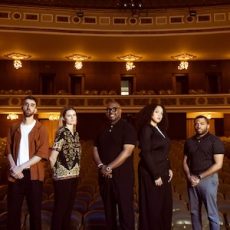
CHRISTIAN MCBRIDE’S URSA MAJOR
Bassist and composer Christian McBride’s most recent project is a quintet showcasing several of the most exciting young players on the scene. Returning to the Miner Auditorium stage for two nights, the cast features tenor saxophonist Nicole Glover, who has toured with Wynton Marsalis and Jazz at Lincoln Center Orchestra, performed with veteran masters such as drummer Al Foster, vocalist Dee Dee Bridgewater, and bassist Reggie Workman, and recorded with pianist Aaron Diehl’s Grammy-nominated 2023 Mary Lou Williams project Zodiac Suite.
Ely Perlman is an exciting young guitarist who has collaborated with Terreon Gully and Braxton Cook, and Chicago pianist Mike King has been touring with Dee Dee Bridgewater, and trumpeters Marquis Hill, Theo Croker, and Marcus Printup. Powering the band is Oakland native Savannah Harris, a remarkably poised young drummer who has made a major impact with the likes of vocalist Cécile McLorin Salvant, Kenny Barron, and Immanuel Wilkins.
Tickets: $40.00 ~ $125.00
More Posts: adventure,bandleader,bass,drums,genius,guitar,jazz,music,piano,preserving,saxophone,travel
Daily Dose Of Jazz…
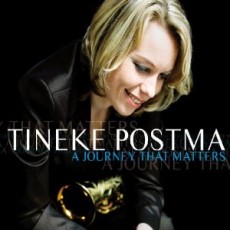
Tineke Postma was born on August 31, 1978 in Heereveen, The Netherlands. At the age of eleven she began playing the saxophone and studied at the Amsterdam Conservatory. Graduating the conservatory in 2003, Tineke received a Masters from the Manhattan School of Music in New York and during this period of her education Tineke was taught by David Liebman, Dick Oatts and Chris Potter. She has been teaching at the Amsterdam Conservatory since 2005.
Performing internationally the saxophonist and composer has worked with Esperanza Spaulding, Terri Lyne Carrington and Wayne Shorter; she has received numerous recognitions from Down Beat Poll, won the Dutch Edison Award, the Jazz Juan Revelations Award, the Midem International Jazz Revelation of the Year Award and The Sisters in Jazz All Star Award.
Postma leads the Tineke Postma Quartet and The Tineke Postma International Quartet featuring Geri Allen on piano, Scott Colley on bass and Terri Lyne Carrington on drums. They have played festivals around the globe and recorded five albums under the leaders name. Postma has recorded as a sideman and collaborator and continues to compose, perform and tour.
More Posts: saxophone
Requisites
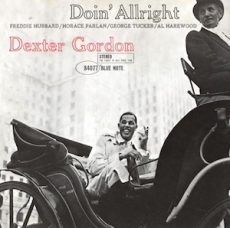
Doin’ Allright ~ Dexter Gordon | By Eddie Carter
This morning’s discussion came up after dinner a few nights ago, when I chose a few titles to play and considerreviewing for our jazz members. After listening, I’d settled on one of my favorite tenor saxophonists, Dexter Gordon. Doin’ Allright (Blue Note BLP 4077/BST 84077) was released in 1961 and is his Blue Note debut, celebrating his comeback from personal struggles and incarceration. The album showcases Gordon at his very best, backed by Freddie Hubbard on trumpet, Horace Parlan on piano, George Tucker on bass, and Al Harewood on drums. I own the 1992 Toshiba-EMI Japanese Stereo reissue in the Blue Note 4000 Series Ultra Collection, sharing the original catalog number.
The album opens with a classic by George and Ira Gershwin, I Was Doin’ All Right. The quintet gets things going with an easy medium groove on the melody. Dexter makes a relaxed entrance for the first solo, followed by Freddie, who swings smoothly and confidently in the second statement. Horace comes in last, complementing the horns with a laid-back reading before the group returns to reprise the theme and fade out gradually. You’ve Changed by Carl Fischer and Bill Carey slows down to a ballad tempo for an emotionally sensitive melody by Dexter. He continues communicating his heart and soul in the opening statement. Freddie speaks next in a warm, emotional tone, and Horace has a deeply expressive moment before the front line returns and slowly takes the song out.
Dexter’s For Members Only ends the first side with an infectious ensemble theme that gets things started. Dexter goes right to work with a relaxing opening statement. Freddie is next, swinging effortlessly with a bright tone and articulate, precise notes. Horace takes his turn last with a laid-back solo ahead of the ensemble’s restatement of the melody and close. Society Red, a funky blues by Dexter Gordon, gets the second side underway with the quintet’s easy-flowing melody. Freddie puts together the first appetizer of this soulful meal. Dexter then shares a rich, bluesy flavor, simmered to perfection, inviting the listener to savor every note. Horace adds a delightful touch of seasoning, and George adds the final ingredient, wrapping up a musical feast that feels like home ahead of the close.
It’s You or No One by Sammy Cahn and Jule Styne wraps up the album on a brisk note, beginning with Dexter’s introduction before the quintet’s lively theme. Dexter takes center stage first with an energetic solo. Freddie adds some bite with the second statement. Horace follows, delivering exuberant verses with an aggressive impact. George takes a short, robust walk in the fourth reading, and Al brings plenty of heat in the finale preceding the group’s return to take the song out. Alfred Lion produced the session, and Rudy Van Gelder managed the recording console. The album’s sound quality is demonstration-class, with a stunning soundstage that if you close your eyes, you’ll swear the musicians are playing right in front of your sweet spot. The front and back covers are glossy, and the record is absolutely quiet until the music starts.
If you’re in the mood for a terrific hard bop album to enjoy anytime of the day or evening, I highly recommend you check out Doin’ Allright on your next record store visit. It makes a great introduction for jazz newcomers discovering Dexter Gordon, and a title I’m sure will also please seasoned fans. It also proves that the tenor saxophonist was not only back, but definitely Doin’ Allright!
~ I Was Doin’ All Right, You’ve Changed – Source: Wikipedia.org © 2026 by Edward Thomas Carter

More Posts: choice,classic,collectible,collector,history,instrumental,jazz,music,saxophone
Daily Dose Of Jazz…
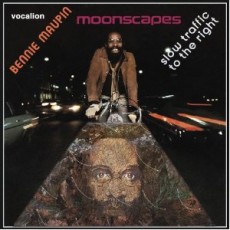
Bennie Maupin was born on August 29, 1940 in Detroit, Michigan and undertook extensive instrumental studies, both privately and at the Detroit Institute of Musical Art from age 14 until 1962. During this period his influences were Yusef Lateef, Wayne Shorter, John Coltrane and Sonny Rollins. By 1966 he was working with Roy Haynes followed by a two-year tenure with Horace Silver in ’68.
Maupin joined Herbie Hancock’s Mwandishi sextet and his Headhunters band, and then joined Miles Davis for the recording of Bitches Brew. He has also performed on several Meat Beat Manifesto albums.
Bennie is noted for having a harmonically advanced, “out” improvisation style, and as a composer, he has the ability to create brief melodies and song forms that create vast landscapes for improvisation.
Multireedist Bennie Maupin was also a member of the group “Almanac” with Cecil McBee, has recorded a half dozen albums as a leader and another two-dozen as a sideman. He has worked with the likes of Lee Morgan, Eddie Henderson, Marion Brown, John Beasley, Mike Clark, Jack DeJohnette, Darek Oles, Lonnie Smith, McCoy Tyner and Lenny White. He appears in the 2016 biopic I Called Him Morgan about trumpeter Lee Morgan and continues to pursue his career in music from jazz to rock to abstraction.
In January 2025 he lost his home, instruments, and other belongings in the Eaton Wild Fire in Los Angeles, California. Flutist, clarinetist and saxophonist Bennie Maupin continues to perform and record.