

Daily Dose Of Jazz…
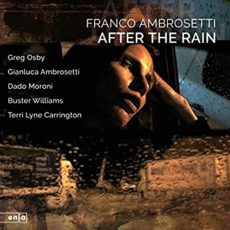
Franco Ambrosetti was born December 10, 1941 in Lugano, Switzerland and received classical piano training, but is a self-taught trumpeter. He matriculated through school and holds a Masters Degree in economics from the University of Basel. He frequently worked professionally with his father, a saxophonist who once played sax opposite Charlie Parker, in a group that also included George Gruntz, among others.
Ambrosetti has recorded with both American and European musicians and performed at jazz festivals and concerts with Kenny Clarke, Dexter Gordon, Phil Woods, Cannonball Adderley, Joe Henderson, Michael Brecker, Mike Stern, Hal Galper and Romano Mussolini, among others.
He has recorded some two-dozen albums as a leader most notably on the Enja Record label and another eighteen as a sideman. Trumpeter, flugelhornist and composer Franco Ambrosetti continues to perform, record and tour.
Sponsored By


More Posts: flugelhorn,trumpet
Daily Dose Of Jazz…
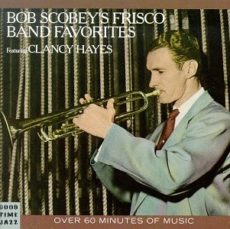
Robert Alexander Scobey, Jr. was born on December 9, 1916 in Tucumcari, New Mexico. He began his career playing in dance orchestras and nightclubs in the 1930s and by 1938 was working as second trumpeter for Lu Watters in the Yerba Buena Jazz Band. 1949 saw him leading his own band under the name Bob Scobey’s Frisco Band and the following year secured a three-year residency at the Victor & Roxie’s, which expanded their popularity.
Clancy Hayes joined the band to sing, play banjo bringing his own compositions such as Huggin’ and a Chalkin‘. The collaboration recorded over two hundred tracks until he left in 1959 to follow a solo career. The Frisco Band broadcasted in 1952 and 1953 on Rusty Draper’s television show. In 1953 Louis Armstrong sang with the band and the following year blues singer Lizzie Miles began recording and touring with the band, a relationship that lasted three years.
Beginning in 1955 Scobey and his band played San Quentin Prison, the roadhouse Rancho Grande, recorded for Verve Records and RCA Victor,. and toured colleges and universities, recorded many student favorites on the album College Classics.
Bob opened the Club Bourbon Street in Chicago, Illinois in 1959, and began suffering with stomach issues while touring in 1960. Trumpeter Bob Scobey passed away of cancer on June 12, 1963. His wife produced a biography titled He Rambled!, arranged for his band to form again and record some blues songs, and saw to the reissuing of his albums.

More Posts: trumpet

Daily Dose Of Jazz…
Russell Jacquet was born on December 4, 1917 in Saint Martinville, Louisiana, the elder brother of tenor saxophonist Illinois Jacquet. He had stints with Floyd Ray and Milt Larkin before he studying music at Wiley College and Texas Southern University.
Moving west he played with his brother’s band for a time, later forming his own group, that became the house band at the Cotton Club from 1945 to 1949. After that residency ended Russell rejoined his brother’s group. He would later play with several small groups in Oakland, California, as well as in Houston, Texas with Arnett Cobb. He also performed with his brother on a few dates in New York City.
Trumpeter Russell Jacquet passed away on February 28, 1990 in Los Angeles, California. He left a small catalogue of recordings as a leader during his Cotton Club years and four as a sideman with his brother, recorded between 1951 and 1969 on Clef, Argo and Prestige record labels.

Inspire A Young Mind
#preserving genius
More Posts: trumpet
Daily Dose Of Jazz…
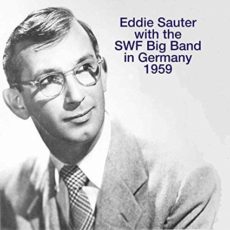
Edward Ernest Sauter was born December 2, 1914 in Brooklyn, New York and studied music at Columbia University and the Juilliard School. He began as a drummer and then played trumpet professionally, most notably with Red Norvo’s orchestra, eventually becoming Norvo’s full-time arranger.
Eddie went on to arrange and compose for Artie Shaw, Tommy Dorsey, Woody Herman and Benny Goodman, earning a reputation for intricate, complex, and carefully crafted works such as Benny Rides Again, Moonlight on the Ganges and Clarinet a la King.
From 1952 to 1958 he co-led the Sauter-Finegan Orchestra and between 1957 and 1959 he was Kurt Edelhagen’s successor as leader of the SWF Orchestra in Baden-Baden, Germany. By 1961, he was working with tenor saxophonist Stan Getz on Focus, a unique collaboration of string compositions, and featuring drummer Roy Haynes on I’m Late, I’m Late, the only selection to feature a non-string instrument other than Getz. They collaborated again during Sauter’s work composing the score for the 1965 film Mickey One, starring Warren Beatty.
He would venture into composing for television including the third season theme to Rod Serling’s Night Gallery. He also orchestrated a number of Broadway musicals, most notably 1776, but also The Apple Tree and It’s a Bird…It’s a Plane…It’s Superman. His composition World Without Time is used as the theme music for the public affairs show The Open Mind.
Composer, arranger, drummer and trumpeter Eddie Sauter, who was prominent during the swing era, passed away of a heart attack in New York City on April 21, 1981.
Dose A Day-Blues Away
Daily Dose Of Jazz..
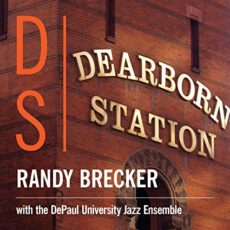
Randal Edward Brecker was born November 27, 1945 in the Philadelphia, Pennsylvania suburb of Cheltenham to a musical family. Choosing the trumpet over the clarinet at school when he was eight, it was an easy selection after hearing Dizzy Gillespie, Miles Davis, Clifford Brown and Chet Baker at home. He attended Cheltenham High School and then Indiana University from 1963 to 1966 studying with Bill Adam, David Baker and Jerry Coker. He later moved to New York and performed with Clark Terry’s Big Bad Band, the Duke Pearson and the The Thad Jones/Mel Lewis Orchestras.
By 1967 Randy ventured into jazz-rock with the band Blood, Sweat & Tears, on their first album Child Is Father To The Man, but left to join the Horace Silver Quintet. He recorded his first solo album Score in 1968 and featured his brother Michael. Leaving Silver, he then joined Art Blakey’s Jazz Messengers before teaming up with brother Michael, Barry Rogers, Billy Cobham and John Abercrombie to form the fusion group Dreams. They recorded two albums for Columbia Records before disbanding in 1971. In the early Seventies Randy performed live with The Eleventh House, Stevie Wonder and Billy Cobham and recorded several albums with his brother under pianist and composer Hal Galper.
By 1975, Randy and Michael formed the Brecker Brothers band, releasing six albums for Arista and garnered seven Grammy nominations between 1975 and 1981. After the Brecker Brothers disbanded in 1982, he recorded and toured as a member of Jaco Pastorius’ Word of Mouth big band. It was soon thereafter that he met and later married Brazilian jazz pianist Eliane Elias, formed their own band, toured the world several times and recorded one album named after their daughter together, Amanda on Passport Records.
The 1990s would see Randy and Michael reunited for a world tour and a triple-Grammy nomination for the GRP recording The Return of the Brecker Brothers. Their 1994 follow-up album Out of the Loop won two Grammy Awards and he went on to record an album with Polish composer Włodek Pawlik. His first Grammy as a solo artists came from his project Into the Sun and this was followed by a series of recordings over the next decade and winning his third Grammy for Best Contemporary Jazz Album with 34th N Lex. He toured Europe, performed and recorded live and won a fourth Grammy with the WDR Big Band, and released a two CD set of live recordings with the Randy Brecker Band featuring Dave Kikoski, Victor Bailey, Steve Smith, Rodney Holmes and Hiram Bullock. He would go on to win a fifth Grammy with his album Randy in Brazil, and a sixth with Night in Calisia, a collaboration between Brecker, the Wlodek Pawlik Trio, the Kalisz Philharmonic Orchestra and Adam Klocek
Throughout the years he has performed and recorded with David Sanborn, Mike Stern, Bill Lee, Dave Weckl, Ada Rovatti, Stanley Turrentine, Billy Cobham, Larry Coryell, Bruce Springsteen, Lou Reed, Sandip Burman, Charles Mingus, Blood, Sweat & Tears, Horace Silver, Frank Zappa, Parliament-Funkadelic, Chris Parker, Dire Straits, Todd Rundgren, Blue Öyster Cult, Richard Barone, Spyro Gyra, Barbara Dennerlein Aerosmith Arkadia Jazz All Stars, Patti Austin, Gato Barbieri, George Benson, Carla Bley, Ron Carter, Robin Eubanks, Johnny Hodges, Jaroslav Jakubovič, Hubert Laws, Yusef Lateef, Arif Mardin, Brother Jack McDuff, Alphonse Mouzon, Idris Muhammad, Duke Pearson, Don Sebesky, Stanley Turrentine, Miroslav Vitous, Roseanna Vitro, Kenny Werner, Jack Wilkins, Charles Williams among others.
Trumpeter and flugelhornist Randy Brecker continues to compose, record, perform and tour.
Put A Dose In Your Pocket
More Posts: flugelhorn,trumpet