

Daily Dose Of Jazz…
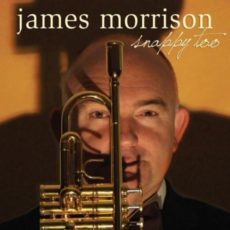
James Lloyd Morrison was born on November 11, 1962 in Boorowa, New South Wales, Australia. Though his father was a Methodist minister, he comes from a musical family with his mother playing alto saxophone, piano and organ, his sister is a trumpeter, and his older brother a jazz drummer. Due to his father’s ministry the family relocated to various locales in New South Wales before settling in Pittwater.
From the age of seven Morrison practiced on his brother’s cornet, attended Mona Vale Primary School and Pittwater High School, then he enrolled at Sydney Conservatorium of Music where he completed a jazz course. While there he met Don Burrows, who became his mentor.
In 1983 Morrison joined his brother John’s 13-piece group, Morrison Brothers Big Bad Band and a year later he was playing trumpet, trombone and piano, his brother on drums, Warwick Alder on trumpet, Paul Andrews on alto saxophone, Tom Baker on alto and baritone saxophones, Peter Cross on trumpet, Glenn Henrich on vibraphone, Jason Morphett on tenor saxophone, and Craig Scott on bass. The group released their debut album, A Night in Tunisia, in 1984 on the ABC Records label.
Morrison has performed with Dizzy Gillespie, Don Burrows, Ray Charles, B. B. King, Ray Brown, Wynton Marsalis, Graeme Lyall, Frank Sinatra, Cab Calloway, Jon Faddis, Woody Shaw, Whitney Houston, Arturo Sandoval, Phil Stack, George Benson, Mark Nightingale, Herbie Hancock, Quincy Jones, Gina Jeffreys and Red Rodney, just to name a few. His long association with composer and pianist Lalo Schifrin has led James to record a number of CDs for Schifrin’s Jazz Meets the Symphony series, with the London and the Czech National symphony orchestras.
Morrison sponsors yearly scholarships for young musicians, and is actively involved with several youth bands. He discovered his regular vocalist, Emma Pask, at a school concert when she was 16 and has since gone on to become an internationally renowned jazz singer. He is the chairman of Generations in Jazz, one of the largest youth jazz events in the world. He has been the hosts of the in-flight jazz radio station for Qantas Airways.
Morrison designed trumpets and trombones, built his own recording studio, recorded top Australian jazz musicians including Dan Clohesy, Jake Barden, Don Burrows, Liam Burrows, John Morrison, The Swing City Big Band, The Generations In Jazz Academy Big Band, Graeme Lyall and more. He was appointed a Member of the Order of Australia, was nominated for Best Jazz Album, in 1992 for Manner Dangerous, 1993 for Two the Max, a collaboration with Ray Brown, and was inducted into the Graeme Bell Hall of Fame.
He has received an honorary Doctor of Music from the Edith Cowan University and from the University by Griffith University, Morrison is also an Adjunct Professor of the University of South Australia and a Vice Chancellor’s Professorial Fellow. He continues to perform, record and tour.

Daily Dose Of Jazz…
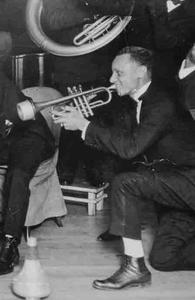
Amos White was born on November 6, 1889 in Charleston, South Carolina and grew up an orphan playing in the Jenkins Orphanage band in his teens. In addition, he traveled with minstrel shows and circuses.
After attending Benedict College, he returned to the orphanage to take a teaching position. During World War I, White played in the 816th Pioneer Infantry Band in France, then settled in New Orleans, Louisiana after the war.
Working as a typesetter, he played jazz in his spare time, working with Papa Celestin and Fate Marable among others. In the 1920s, he appeared on many records by blues singers such as Bessie Smith and Lizzie Miles, and played in the Alabamians. In 1928, he became the leader of the Georgia Minstrels.
In the 1930s, White moved to Phoenix, Arizona, where he played with his own group and with local dance groups, including Felipe Lopez’s. Later in the decade he relocated to Oakland, California, where he played locally into the 1960s in marching bands.
Trumpeter Amos White passed away on July 2, 1980 in Oakland, California.

Inspire A Young Mind

More Posts: trumpet
Daily Dose Of Jazz…
Johnny Windhurst was born John Henry Windhurst on November 5, 1926 in New York City, New York and was a self-taught trumpeter known for his solos. He considered Bix Beiderbecke, Wild Bill Davison, and Bunny Berigan among his influences and his feathery vibrato and mobility was mixed with the delicate playing style of Bobby Hackett.
At 15 he played his first public performance at Nick’s in New York City and made his professional debut during the spring of 1944 at one of Eddie Condon’s concerts at the Town Hall in New York City. At 18 years old, he was chosen to replace Bunk Johnson by Sidney Bechet to play at the Savoy Cafe in Boston, Massachusetts. Windhurst was initially recruited to the band to play the cornet and this engagement launched his career as a trumpeter.
He went on to play with Art Hodes and James P. Johnson at the Jazz at Town Hall concert in 1946. He then moved to the midwest and after a brief stint in the Chicago jazz scene he returned to the Savoy Cafe as a member of Edmond Hall’s band. Johnny eventually moved west to experience the West Coast jazz scene in California. His inability to read music had him declining gigs with Benny Goodman and Woody Herman while emphasizing his preference of informal jamming. Over the years, he played with musicians Louis Armstrong, Nappy Lamare, Walt Gifford, Edmond Hall and Eddie Condon. He led his own band, Riverboat Five, through Columbus, Ohio and Boston for several years, refraining from playing the most popular east coast venues and nightclubs to play college campuses and other small venues.
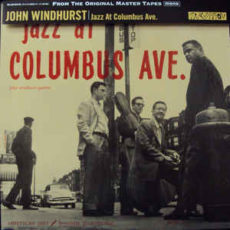
During the 1950s Windhurst worked with Ruby Braff in one of the groups known as Jazz at Storyville, performed at Condon’s club and performed with George Wettling, Jack Teagarden, Barbara Lea and took a stage role with actor Conrad Janis in an off-broadway musical titled, Joy Ride. He only made one recording with his swing quartet, the John Windhurst Quartet that included Buell Neidlinger as a sideman, titled Jazz at Columbus Avenue.
Throughout the 1960s and 70’s he opted to perform primarily in obscure venues in out-of-the-way corners of the USA. Despite his range of talent and success, Windhurst was seemingly content to hide from the big-time spotlight. He eventually moved upstate to Poughkeepsie with his mother, where he finished his career in a dixieland band at Frivolous Sal’s Last Chance Saloon. Several years later, after receiving an invitation to play the Manassas jazz festival in 1981, Windhurst passed away of a heart attack on October 2, 1981 in Dutchess County, New York.
Sponsored By

www.whatissuitetabu.com
More Posts: trumpet
Daily Dose Of Jazz…
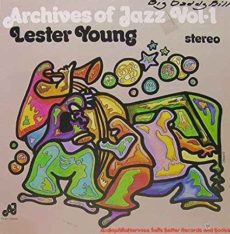
Jesse Drakes was born October 22, 1924 in New York City. He hung out at Minton’s Playhouse in his youth and attended Juilliard in the 1940s. In the 1940s he played with Al Cooper’s Savoy Sultans, Sid Catlett, J.C. Heard, Edie Heywood, Deke Watson, and Sarah Vaughan. He worked extensively with Lester Young, the pair collaborated on and off between 1948 and 1956.
During this period Drakes played with Harry Belafonte, Gene Ammons, Sonny Stitt, Louie Bellson and Duke Ellington. By the late 1950s he was playing less jazz and more R&B music, touring with King Curtis and playing at the Motown studios in the 1960s. From 1969 he was based out of New York, leading dance ensembles and singing.
Trumpeter Jesse Drakes, who never recorded as a leader, was found dead in his apartment in New York City on May 1, 2010, so his actual date of death is therefore unknown.
Sponsored By
www.whatissuitetabu.com
More Posts: trumpet
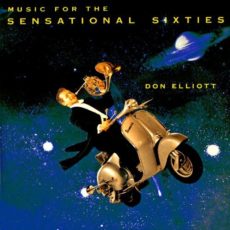
Daily Dose Of Jazz…
Don Elliott was born October 21, 1926 in Somerville, New Jersey and played mellophone in his high school band and played trumpet for an army band. After study at the University of Miami he added vibraphone to the list and recorded with Terry Gibbs and Buddy Rich before forming his own band.
From 1953 to 1960 he won the DownBeat readers poll several times for miscellaneous instrument-mellophone. Known as the “Human Instrument”, Don additionally performed jazz as a vocalist, trombonist, flugelhornist and percussionist. He pioneered the art of multitrack recording, composed countless prize-winning advertising jingles, prepared film scores, and built a thriving production company.
Elliott scored several Broadway productions including James Thurber’s The Beast in Me and A Thurber Carnival, in the latter of which he performed with his quartet. He also provided one of the voices for the novelty jazz duo the Nutty Squirrels. He lent his vocal talents to such motion picture soundtracks as The Getaway starring Steve McQueen, $ (Dollars) starring Warren Beatty, and The Hot Rock starring Robert Redford, as well as composing the score to The Happy Hooker starring Lynn Redgrave.
Elliott owned and operated one of the very first multitrack recording studios in New York City and in Weston, Connecticut and recorded over 60 albums and 5,000 advertising jingles throughout his career. A longtime associate of Quincy Jones, he contributed vocal work to many of Jones’ film scores. As sideman he performed and recorded with Phil Bodner, Miles Davis, Lee Konitz, Jackie McLean, Paul Desmond, Billy Taylor, Billy Eckstine, Bill Evans, Urbie Green, Michel Legrand, George Shearing, Marty Bell, Bob Corwin, Louis Bellson and Mundell Lowe among others.
Trumpeter, vibraphonist, vocalist, and mellophone player Don Elliott, whose recording Calypso Jazz is considered by some jazz enthusiasts to be one of the definitive calypso jazz albums, passed away of cancer on July 5, 1984 in Weston, Connecticut.
Dose A Day-Blues Away
More Posts: mellophone,trumpet,vibraphone,vocal