

Daily Dose Of Jazz…
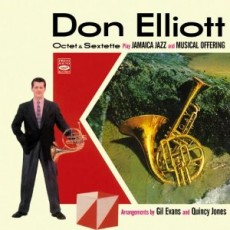
Don Elliott was born on October 21, 1926 in Somerville, New Jersey. He played mellophone in his high school band and played trumpet for an army band. After study at the University of Miami he added vibraphone to his arsenal of instruments. He recorded with Terry Gibbs and Buddy Rich before forming his own band.
From 1953 to 1960 he won the Down Beat readers poll several times for “miscellaneous instrument-mellophone.” Known as the “Human Instrument”, Elliott additionally performed jazz as a vocalist, trombonist, flugelhornist and percussionist. He pioneered the art of multi-track recording, composed over 5000 jingles with a countless number being prize-winning advertising jingles, prepared film scores, recorded over 60 albums and built a thriving production company.
Don scored several Broadway productions, such as The Beast In Me and A Thunder Carnival, the latter of which he performed with the Don Elliott Quartet, provided one of the voices for the novelty jazz duo the Nutty Squirrels, and lent his vocal talents to such motion picture soundtracks as The Getaway, $ (Dollars), The Hot Rock and The Happy Hooker.
His album Calypso Jazz is considered by some jazz enthusiasts to be one of the definitive calypso jazz albums. He worked with Paul Desmond, Ruby Braff, Bill Evans, Michel Legrand, Art Farmer, George Shearing and Mundell Lowe among others over his career. Multi-instrumentalist, vocalist, publisher and producer Don Elliott, who was a longtime associate of Quincy Jones, passed away of cancer in Weston, Connecticut on July 5, 1984.
More Posts: flugelhorn,mellophone,percussion,trombone,trumpet,vibraphone,vocal
Daily Dose Of Jazz…
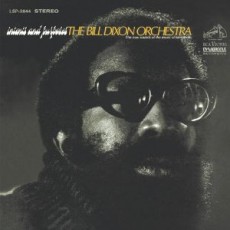
Bill Dixon was born on October 5, 1925 in Nantucket, Massachusetts and his family later moved to Harlem, New York City when he was about 7. It wasn’t until some twenty years later that he became interested in music and trumpet began his five-year studies at the Hartnette Conservatory of Music in 1946. He studied painting at Boston University, the WPA Arts School and the Art Students League. During the early 1950s while employed at the United Nations, he founded the UN Jazz Society.
By the 1960’s Dixon established himself as a major force in the jazz avant-garde movement, organizing and producing the “October Revolution in Jazz”. This first free-jazz festival comprised four days of music and discussions at the Cellar Café in Manhattan with musicians such as Cecil Taylor and Sun Ra participating.
Bill would later found the Jazz Composers Guild, become a professor of music at Bennington College, establish their Black Music Division, and was one of four featured musicians in the Canadian documentary Imagine the Sound in 1981 with Cecil Taylor, Archie Shepp and Paul Bley.
Dixon recorded relatively little over the decade and a half beginning in the late Sixties but co-led a few sessions with Archie Shepp, appeared on Cecil Taylor’s “Conquistador!” and some solo trumpet recordings has emerged. His recording career as a leader and sideman would pick up in the 80s into the new millennium with his last album being issued posthumously in 2011.
On June 16, 2010, Bill Dixon, who played trumpet, flugelhorn and piano died in his sleep at his home after suffering from an undisclosed illness.
More Posts: flugelhorn,piano,trumpet
Daily Dose Of Jazz…
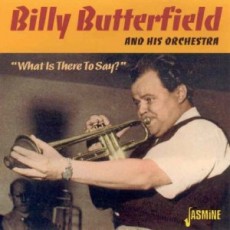
Billy Butterfield: The Trumpet Player Who Almost Became a Doctor
What if one of jazz’s most lyrical trumpet voices had ended up in a white coat instead of on a bandstand? Billy Butterfield, born January 14, 1917, in Middletown, Ohio, started out on cornet as a kid, then pivoted to pre-med studies before the irresistible pull of music brought him back—and thank goodness it did.
A Warm Tone Finds Its Audience
By the late 1930s, Butterfield’s warm, singing tone was turning heads when he joined Bob Crosby’s swinging orchestra. From there, he became the go-to trumpeter for the era’s biggest bandleaders—Artie Shaw, Les Brown, and Benny Goodman all recognized what they had when Butterfield stepped up to the microphone. His sound wasn’t about flash or fury; it was about beauty, control, and emotion that could break your heart.
War, Then a Perfect Recording
When World War II called, Butterfield served from 1943 to 1947, leading his own Army orchestra and bringing music to troops who desperately needed it. After the war, he signed with Capitol Records and delivered one of those perfect moments that defines an era: “Moonlight in Vermont,” featuring Margaret Whiting’s ethereal vocals floating over his exquisite muted trumpet. It’s the kind of recording that still stops people in their tracks seventy years later.
Leading His Own Way
The 1950s brought fruitful collaborations with arranger Ray Conniff, and by the 1960s, Butterfield was leading his own orchestra for Columbia Records—proof that the sideman had grown into a compelling leader. But perhaps his most enduring partnership came in the late 1960s when he joined the aptly named World’s Greatest Jazz Band alongside fellow trumpeter Yank Lawson and bassist Bob Haggart. It was a dream team of veteran musicians playing classic jazz with authority and joy, and Butterfield remained with them until his final days.
A Life Well Played
Throughout it all, Butterfield stayed busy as a sought-after guest artist, bringing his mastery of trumpet, flugelhorn, and cornet to stages around the globe. Whether in an intimate club or a grand concert hall, that distinctive tone—thoughtful, melodic, perfectly controlled—made every performance memorable.
A Legacy in Every Note
Billy Butterfield left us on March 18, 1988, but that gorgeous sound—warm as a summer evening, clear as a bell, romantic without being sentimental—lives on in every recording. The medical profession’s loss became jazz’s eternal gain.
Sometimes the world needs a great doctor. But sometimes it needs a trumpet player who can make “Moonlight in Vermont” sound like the most beautiful thing you’ve ever heard. Billy Butterfield was that player, and we’re all the richer for the choice he made.
More Posts: bandleader,flugelhorn,trumpet

Daily Dose Of Jazz…
Herbert Anthony Charles Spanier was born in Cupar, Canada on December 25, 1928. He played guitar and harmonica at five, bugle in Regina, Canada cadet bands, and trumpet in high school. One of the first beboppers in Canada, and a figure of some legend on the Canadian jazz scene,
He played with Paul Perry and with his own band ‘Boptet’ in Regina before working in Chicago, Illinois from 1949-1950 and from 1950-1954 in Toronto, Canada. He was a sideman to Paul Bley in New York 1954-1955 and Los Angeles, California 1958-1959, and toured out of New York with the Claude Thornhill and Hal McIntyre orchestras in 1955.
He was an influential jazz musician in Montreal, Canada from 1956-1958 and between 1960-1971. Spanier taught briefly at Sir George Williams University, performed in various dance, hotel, and CBC orchestras, contributed music to NFB films. Herbie was the leader on the CBC’s ‘Jazz en Liberté’ and in various clubs. Returning to Toronto in 1971, he was a featured soloist for nine years with Nimmons ‘N’ Nine Plus Six.
For the next two and a half decades he led his own groups, won the Juno Awards, received a Special Recognition Award and recorded sessions in 1993-1994 in which he produced new works which combined with earlier recordings on compact discs.
Trumpeter, flugelhornist, pianist, and composer Herbie Spanier died in Toronto, Canada on December 13, 2001.

More Posts: bandleader,composer,flugelhorn,history,instrumental,jazz,music,piano,trumpet
Daily Dose Of Jazz…
Alphonse “Al” Goyens was born October 1, 1920 in Wetteren, Belgium. He took piano lessons as a child but abandoned them at the age of twelve. In 1936, he bought a trumpet and began playing music again, teaching himself and playing with amateur bands. Completing a degree in industrial engineering, he was interned in Germany at the outbreak of the war and had to stop playing. Starting again he played too intensely, which paralyzed his lips, but overcame this situation through careful practice.
His return from captivity saw him a member of orchestras led by Henri Van Bemst and Jean Omer, making his first recordings with the latter. He then joined the orchestra of Léo Souris who played for the American army in Germany. Returning to Belgium, Al joined other musicians to form the Orchestre régulier du Cosmopolite , which gave him the opportunity to perform with major names of the jazz scene who were guests in Brussels.
In 1949 he and his orchestra again toured for the US Army, performing in Germany, the Azores, and the USA. Goyens led his orchestra for nearly a decade from 1949 featuring Jacques Pelzer, Bobby Jaspar, Francy Boland, Jean Warland, Freddy Rottier, and occasionally Don Byas and Kenny Clarke.
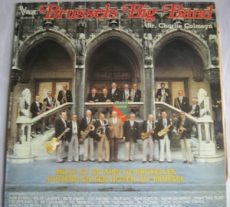
Once again he went on to work for the US Armed Forces and later with an international orchestra in Spain and the United States. Al later arranged and played in the Brussels Big Band. His favorite trumpeters were Clifford Brown, Dizzy Gillespie, and Clark Terry but his playing was more reminiscent of Harry Edison.
Trumpeter, arranger and orchestra leader Al Goyen played flugelhorn, and bugle, who never recorded as a leader, appreciated the sound of the muted trumpet, died on January 30/31, 2008 in Forest/Vorst, Belgium.

More Posts: arranger,bandleader,bugle,flugelhorn,history,instrumental,jazz,music,trumpet