

Daily Dose Of Jazz…
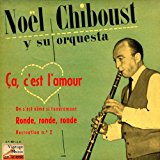
Noël Chiboust was born on October 14, 1909 in Thorigny-sur-Marne , Département Seine-et-Marne, France. He began his career as a violinist with Ray Ventura and during the early Thirties played trumpet in the Michel Warlop Orchestra. By 1936 he was involved in the concert series la semaine à Paris, by the Hot Club de France. At this time in his career he also joined the André Ekyan Orchestra until 1938, then played in the Swing Band of Philippe Brun followed by an early 1940s stint with Alix Combelle.
Around the mid 1930s he recorded with Django Reinhardt , Stéphane Grappelli , Bill Coleman and Coleman Hawkins, joined Eddie Brunner in 1938 at Cabaret Bagatelle. The late 1930s saw him giving up the trumpet and joining the tenor saxophone and clarinet sections when he joined the Marcel Bianchi Orchestra.
From 1940 he recorded under his own name for the French label Swing releasing a few 78s. Starting in 1944 he performed with an orchestral cast including Hubert Rostaing, and with Jack Diéval and Lucien Simoen at Club Schubert. From 1947 to 1950 he had an engagement at Cabaret le Drap d’Or.
He turned his attention to popular music as well as the rock and roll to and by 1959 released several EPs and singles for Polydor Records with songs like Telstar, Dynamite Charleston and Yes Sir That’s My Baby.
Trumpeter, tenor saxophonist, clarinetist, arranger, composer and band leader in the field the swing and popular music era Noël Chiboust passed away on January 17, 1994.

Miami
Daily Dose Of Jazz…
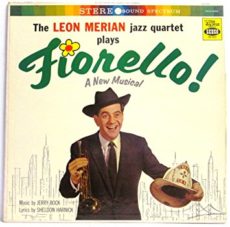
Leon Merian was born Vahan Leon Megerdichian on September 17, 1923 in Braintree, Massachusetts to Armenian immigrants and raised in Boston’s struggling Roxbury district. Showing an early interest in music, his first trumpet was a Christmas present at age 10 that led to taking lessons and by sixteen he was playing with the school band. Before long he was sitting in with musicians in local Boston clubs while still in high school in the late Thirties. He passed on a physics scholarship to pursue his music.
Early in his career, a record producer persuaded him to legally shorten his last name to Merian and he had already stopped using his first name as a child to avoid being teased. One of the first white musicians to play with a black band in the 1940s, he was hired by Lucky Millinder in 1942 at the age of 19 Charlie Shavers and Sonny Stitt and Gene Krupa and as the band toured the South got his initial introduction to racial discrimination. Leon recorded and performed with Frank Sinatra, Ella Fitzgerald, Elvis Presley, Dizzy Gillespie and other notable singers and jazz bands during a career of big bands, recording studios, major network orchestras, Broadway orchestra pits and nightclubs.
Merian played on the soundtracks of the Oscar-winning movies The Godfather and Ben-Hur, performed in Cole Porter’s Broadway musical Silk Stockings starring Rosalind Russell, and worked with the studio orchestras at ABC, CBS and NBC.
After serving as department chairman of foreign languages at New Rochelle High School in New York and at Endicott College in Beverly, Massachusetts, Merian went into the Milton, Massachusetts public schools, where he was chairman of the foreign languages department until he retired in 1982 to concentrate on music. Moving south to Florida in the late Eighties he led a 14-piece Leon Merian Big Band and his smaller Leon Merian Quintet in clubs and concert performing one his last at the age of 80.
Trumpeter, bandleader and educator Leon Merian, whose career spanned some sixty years, passed away on August 15, 2007 due to complications from diabetes.

Jazz Is Global – Share

More Posts: trumpet
Daily Dose Of Jazz…
Conny Jackel was born Horst Konrad Jackel on August 30, 1931 in Offenbach am Main, Germany. He first worked as a steel fitter, then in 1951 he played at the conservatory and in the clubs of the US Army in France, the Netherlands and Germany in 1952. In 1955 he became a member of Helmut Brandt Combo, contributing to their success.
By 1959 Jackel had joined the Harald Banter Band in Cologne playing demanding arrangements for two years. In 1961 he joined the orchestra of Erwin Lehn in Stuttgart, where he also worked with Miles Davis, Chet Baker, Dizzy Gillespie and Frank Sinatra on stage.
From 1964 to 1969 he was a member of the Albert Mangelsdorff led Jazz Ensemble of Hessischer Rundfunk . From 1967 Conny played first trumpet in the Dance Orchestra of Hessischer Rundfunk under Willy Berking and the HR Big Band headed by Heinz Schönberger . In addition, he performed with Joki Friendand, Rudi Sehring, Attila Zoller and Charly Antolini. He recorded with Gustl Mayers Swing All Stars and the trio of Manfred Kullmann . Then he was a member of the jazz band Hanauer Sugarfoot Stompers and played with other traditional bands of the region such as the Phoenix Jazz Band.
In 1999 a bout with cancer caused Jackel to have his lower jaw removed forcing him to give up playing trumpet. Occasionally he would play drums as also in the Book Readers active as a drummer. For his contributions to jazz, he was inducted into the Knights of Ronneburg on September 9, 2006.
Trumpeter and flugelhornist Conny Jackel passed away after a long illness and the consequences of an operation on April 28, 2008 in Bad Nauheim, Germany.
Take A Dose On The Road
More Posts: drums,flugelhorn,trumpet

Daily Dose Of Jazz…
Anthony Branker was born August 28, 1958 in Elizabeth, New Jersey and raised in Piscataway and Plainfield, New Jersey. He attended the music program and graduated from Piscataway High School, then went on to Princeton University for his B.A. in Music, the University of Miami for a Master of Music in Jazz Pedagogy and finally to Columbia University, Teachers College receiving degrees of Master of Education and Doctor of Education; with specialties in Music and Music Education.
Hailing from Trinidad and Barbados heritage his family boasts a musical director and pianist with the Platters, a composer and pianist who worked with the Copasetics and Billy Strayhorn, and a music producer and bassist who has worked with Roberta Flack, Cyndi Lauper, Simply Red and others.
His lists of fellowships, commissions, compositions and collaborations while at Princeton University are extensive. He has been a Fulbright Scholar, received a grant from the National Endowment for the Humanities, and has conducted symphonies, orchestras and ensembles all over the world. Branker has performed and recorded with the Spirit of Life Ensemble and has shared the stage in a variety of musical settings with such artists as Ted Curson, Talib Kibwe, Guilherme Franco & Nova Bossa Nova, Steve Nelson, Marcus Belgrave, Billy Higgins, John Hicks, Michael Cochrane, Calvin Hill, Bobby Watson, Jacky Terrasson, Steve Nelson, Bob Mintzer, Don Braden, Ralph Peterson Jr.,Orrin Evans, Antonio Hart, Clark Terry, Phil Woods, Slide Hampton, Jimmy Heath, Jon Faddis, Ted Curson, Oliver Lake, Frank Foster, Benny Carter, Conrad Herwig, Eddie Henderson, James Weidman, Stanley Jordan, Benny Carter, Ralph Peterson, Terence Blanchard, Big John Patton, Roscoe Mitchell, Gary Burton,among numerous others, and has performed in the critically acclaimed Off-Broadway production of Dinah Was: The Dinah Washington Musical.
As an educator Anthony recently retired from Princeton University after 27 years on the faculty and the endowed chair in jazz studies, serving as founding director of the Program in Jazz Studies, director of university jazz ensembles program, and associate director of the Program in Musical Performance.
In 1999 with medical problems stemming from two brain aneurysms and the discovery of an arteriovenous malformation caused trumpeter, composer, educator, scholar, and conductor Anthony Branker to give up trumpet playing and to take a leave of absence from teaching.
Give The Gift Of Knowledge
More Posts: trumpet
Daily Dose Of Jazz…
Eddie Gale was born in Brooklyn, New York on August 15, 1941 and early in life he studied trumpet with Kenny Dorham. In the early 1960s he was introduced to Sun Ra by drummer Scoby Stroman and spent many hours exposed to Sun Ra’s philosophy about music and life. During this period he explored the use of trills, placement of whole tones and then a space chord, all ideas he could not find in exercise books.
During the 1960s and 1970s, he toured and recorded extensively with Sun Ra, until Ra’s death in 1993. In 1972 he moved to San Jose California, has helped to bring jazz into the 21st century by delving into the hip-hop world with the Oakland group Coup and by the late 1990s. Eddie has held regular creative music workshops at the Black Dot Cafe, a grassroots performance space in Oakland ran by artist/activist Marcel Diallo and his Black Dot Artists Collective.
Gale also held He has recorded with Cecil Taylor, Larry Young, and Elvin Jones, and performed with John Coltrane, Jackie McLean, Booker Ervin, and Illinois Jacquet.
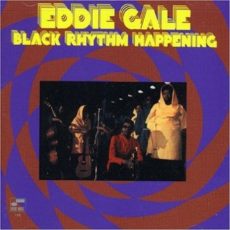
Trumpeter Eddie Gale, known for his work in free jazz, has recorded his debut album as a leader Ghetto Music in 1968 and has since recorded four more as well as several more as a sideman. He continues to record, perform and educate young musicians.
Put A Dose In Your Pocket

#preserving genius
More Posts: trumpet