

Daily Dose Of Jazz…
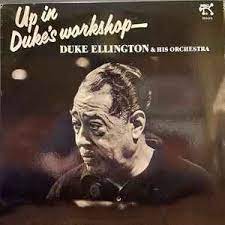
Fred Stone was born on September 9, 1935 in Toronto, Ontario, Canada and was the son of saxophonist Archie Stone. His initial musical studies were with his father. At the age of 14 he began studying the trumpet with Donald Reinhardt in Philadelphia, Pennsylvania and spent every summer in that city from 1950–1955. At home he studied music theory and music composition with Gordon Delamont and John Weinzweig.
Commencing his performance career in 1951 at the age of 16 he played in Benny Louis’s big band. From 1955 to 1967 he was a trumpeter in various orchestras related to the Canadian Broadcasting Corporation, including the CBC Symphony Orchestra. During the late 1950s and 1960s he performed widely as a concert soloist with orchestras throughout North America. He was an active performer as a jazz musician, playing regularly with Ron Collier , Phil Nimmons , the Boss Brass, and Lighthouse and he toured North America and Europe with the Duke Ellington Orchestra.
Returning to Toronto in 1971, Stone became highly involved with his work as a teacher, and operated his own private studio where he taught improvisational theory and music composition. His performance career virtually ceased for the remainder of the decade, although he remained active as a composer. Between 1971 and 1983 he mainly focused on his work as a composer and teacher, making only periodic public performances, and often with ensembles composed largely of his students.
In 1984 he formed Freddie’s Band, a jazz ensemble in residence at The Music Gallery in Toronto. Flugelhornist, trumpeter, pianist, composer, writer, and music educator Fred Stone recorded eleven albums as a sideman before he transitioned on December 10, 1986.

More Posts: educator,flugelhorn,history,instrumental,jazz,music,trumpet,writer
Daily Dose Of Jazz…
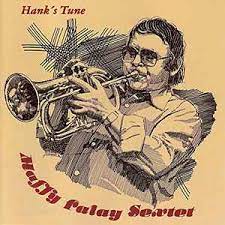
Muvaffak “Maffy” Falay was born on August 30, 1930 in Karşıyaka, Turkey and moved later with his family to Kuşadası,Turkey. In 1942 he heard that a teacher would be arriving in Kuşadası to establish a municipal band team and ast the age of 12 started his career in music in Kuşadası Municipality Band. He learned to read music and to play the trumpet with excellent skills with 5 hours of practice per day in just 3 months.
He studied trumpet and piano in Ankara Conservatory and in 1960, he joined the radio orchestra of Kurt Edelhagen in Cologne, Germany. After departing from Edelhagen he toured Europe with the Kenny Clarke/Francy Boland Big Band and played on six of the band’s albums.
Maffy’s next gigs were playing in orchestras led by Benny Bailey, Åke Persson, Phil Woods, Sixten Eriksson and Quincy Jones. By 1965 he decided to move to Sweden where he played for the radio jazz orchestra, and toured around the Americas at the same time. 1970 saw him playing in the Dizzy Gillespie Reunion Orchestra, and he also played with Dexter Gordon, Stan Getz, and Elvin Jones.
In 1971, he formed the band Sevda, featuring Bernt Rosengren, Okay Temiz, Gunnar Bergsten, Ove Gustafsson and Salih Baysal. In 2005, he received the Lifetime Achievement Award at the Istanbul Jazz Festival. Trumpeter Maffy Falay transitioned on February 22, 2022 at the age of 91.
Bestow upon an inquiring mind a dose of a Karşıyaka trumpeter to motivate the perusal of the genius of jazz musicians worldwide whose gifts contribute to the canon…

More Posts: bandleader,history,instrumental,jazz,music,trumpet
JOE GRANSDEN QUARTET & ROBYN SPRINGER
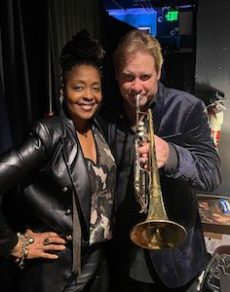
Trumpeter Joe Gransden brings his quartet along with his special guest, vocalist Robyn Springer for a swinging weekend of four performances on Friday and Saturday night.
More Posts: adventure,album,club,festival,genius,jazz,museum,music,preserving,restaurant,travel,trumpet,vocal

Daily Dose Of Jazz…
Andrew Anderson was born on August 12, 1912 in Mandeville, Louisiana. He played in the Young Tuxedo Band and the Allen Brass Band. In the mid to late Twenties he played with Joe Oliver in Chicago, Illinois.
He led the Pelican State Band in the late 1930s and continued playing in New Orleans with various bands until the 1980s. In the Seventies and Eighties he played and recorded with the New Orleans Ragtime Orchestra.
Trumpeter Andy Anderson transitioned on December 19, 1982.
More Posts: history,instrumental,jazz,music,trumpet
Requisites
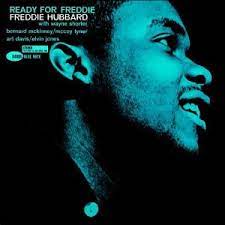
Ready For Freddie ~ Freddie Hubbard | By Eddie Carter
Freddie Hubbard steps into the spotlight of this morning’s discussion with an excellent 1962 blowing session titled Ready For Freddie (Blue Note BLP 4085/BST 84085). This choice from the library is the trumpeter’s fourth album as a leader and he’s working with a stellar supporting cast. Bernard McKinney on euphonium, Wayne Shorter on tenor sax, McCoy Tyner on piano, Art Davis on bass, and Elvin Jones on drums complete the sextet. For those who don’t know about the euphonium, it’s a medium-sized, tenor-voiced brass instrument that’s usually featured in a brass band and is a member of the tuba family. My copy used in this report is the 1995 Blue Note Connoisseur Series US Stereo Audiophile reissue (B1-32094).
Arietis by Freddie Hubbard starts Side One with the sextet grabbing the listener’s attention from the opening notes of their swinging melody. Freddie takes us on an exuberant joyride in the opening solo. Wayne continues surging ahead on the second statement, then Bernard digs into the third reading with agility. McCoy soars into a satisfying summation ahead of the song’s finale. Weaver of Dreams by Jack Elliot and Victor Young begins at a deceptively slow tempo with McKinney and Shorter’s introduction segueing into Hubbard’s sensitive theme. The pace picks up for a beautifully delicate opening statement by Freddie. McCoy comes in next for an affectionate interpretation leading to Hubbard’s haunting climax.
Wayne Shorter’s Marie Antoinette affords everyone except Elvin a solo opportunity beginning with the group establishing a relaxed mood in the opening chorus. Wayne begins with an easy-going toe-tapper. Freddie infuses an optimistic spirit into the second solo. Bernard moves things along at a comfortable pace, then McCoy gives us a few compelling moments. Art adds to the fun with a few airy bass notes leading to the closing chorus that dissolves into nothingness. Birdlike by Freddie Hubbard begins Side Two at a brisk beat with the group’s collective melody. Hubbard gets things going first, then Shorter puts together a mesmerizing performance. McKinney has a few attractive lines in the third spot. Tyner and Davis keep the energy going with two quick readings into the quintet’s finale.
Freddie Hubbard’s Crisis opens with the trio’s simple introduction segueing into a soothing melody. Freddie, Wayne, Bernard, and McCoy all make their point in four enchanting interpretations. Elvin offers an impressive climax into the sextet’s reprise and fadeout. Ready For Freddie was produced by Alfred Lion and Rudy Van Gelder was the recording engineer. The reissue producer is Michael Cuscuna and Larry Walsh did the mastering from the original analog tapes. The sound quality is excellent with a spacious soundstage and the instruments come through your speakers vibrantly as if the musicians are playing in front of you. The record is pressed on 180-gram Virgin Vinyl and is silent until the music starts. If you’re in the mood for an excellent Hard-Bop album, I invite you to check out Ready For Freddie by Freddie Hubbard. It’s sure to occupy a proud place in any novice or seasoned jazz fan’s library for years to come!
~ Euphonium – Source: Wikipedia.org ~ © 2022 by Edward Thomas Carter

More Posts: choice,classic,collectible,collector,history,instrumental,jazz,music,trumpet