


JEREMY DAVENPORT
A born entertainer known for his vocal and trumpet playing skills, Jeremy Davenport infuses his unique style and mood of storytelling creating not only a modern edge but also the distinct feeling of a lifestyle reminiscent of a time when Jazz was at its peak of popularity.
Valet Parking ~ $10.00 prepaid
Valet parking is available for all Jazz St. Louis performances. Discounted $10 valet parking may be purchased when ordering your tickets. Please make sure to select the correct date and time when adding parking to your cart with your tickets before purchasing.
Performances:
November 25 ~ 7:30pm | 9:30pm
November 26~ 7:30pm | 9:30pm
More Posts: adventure,album,club,festival,genius,jazz,museum,music,preserving,restaurant,travel,trumpet
Daily Dose Of Jazz…
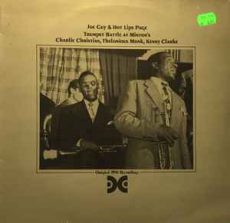
Joseph Luke Guy was born in Birmingham, Alabama on September 20, 1920 but much of his early personal life is obscured. He began his professional music career performing in New York City, and joined Fats Waller’s backup band in the late 1930s. Following that, in 1938, he succeeded Dizzy Gillespie in Teddy Hill’s orchestra.
Patterning his playing style after his musical role model, Roy Eldridge, despite his range, speed, and potential, Joe never managed to surpass Eldridge’s abilities, though he was considered a musical talent when taking into account his young age.
In 1940 he became a key soloist in Coleman Hawkins’ short-lived big band. 1941–42 saw Guy as a regular performer as a member of the after-hours band at Minton’s Playhouse alongside Nick Fenton, Kenny Clarke, and Thelonious Monk in jam sessions with early bop music. During this period he was actively involved in numerous recordings by Jerry Newman, and also appeared on songs by Charlie Christian, Hot Lips Page, Roy Eldridge, and Don Byas.
Incorporating Gillespie’s influences into his playing, Joe’s performance on Monk’s 1942 song Epistrophy is arguably the highlight of his recording career. Much of his appearances as an instrumentalist are marked by his enthusiasm and tempo, however, on occasions would over exert himself and consequently sound erratic.
Struggling with a heroin addiction throughout the majority of his brief career, in 1945–46 Guy was involved with Billie Holiday both professionally and intimately. When they were both busted for drug possession, the two cut ties thereafter. Afterwards, sidelined him from further success, he moved back to his hometown and fell into relative obscurity among the music industry.
Trumpeter Joe Guy, who performed locally in his hometown and advised others about the dangers of his addiction, transitioned on June 1, 1962, at the age of 41.

More Posts: history,instrumental,jazz,music,trumpet

Daily Dose Of Jazz…
Cuong Vu was born on September 19, 1969 in Saigon, Vietnam and immigrated to Seattle with his family when he was six. At 11 he began to play the trumpet and later received a scholarship from the New England Conservatory of Music.
After graduation, in 1994 Vu moved to New York City and formed the group Ragged Jack with Jamie Saft, Andrew D’Angelo, and Jim Black. Since that time he has worked with Laurie Anderson, David Bowie, Dave Douglas, Myra Melford, Gerry Hemingway, and Mitchell Froom.
While a member of the Pat Metheny Group, he won two Grammy Awards for Best Contemporary Jazz Album: Speaking of Now and The Way Up. Cuong worked with Metheny mainly as a trumpeter, but also contributed vocals, guitar and various small percussion.
As an educator, he serves as chair and professor in the jazz studies department of the University of Washington’s School of Music. Trumpeter Cuong Vu has recorded eleven albums as a leader, thirty-three as a sideman, and continues to lead his own band with bassist Stomu Takeishi and drummer Ted Poor.
More Posts: bandleader,guitar,history,instrumental,jazz,music,trumpet,vocal
Daily Dose Of Jazz…
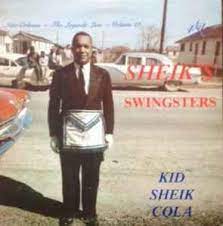
George Colar, better known as Kid Sheik or Kid Sheik Cola, was born on September 15, 1908 in New Orleans, Louisiana. In his youth he started playing blues piano around 1920, but took up trumpet after being inspired by and taking lessons from Wooden Joe Nicholas and Chris Kelly for whom he sat in from time to time. During this period he briefly had a band of his own.
In the Thirties he played second trumpet with Buddy Petit, marched with Kid René’s band and from 1952 was a member of the Eureka Brass Band. He worked with George Lewis in the mid-1940s. His Gin Mill Blues is considered a nice fish fries boogie.
Over the years, Kid Sheik performed with many jazz notables, including Harold Dejan’s Olympia Brass Band and Louis Armstrong. By the 1960s he had his own band. He was still blowing strong in New Orleans in 1970.
Kid Sheik was the subject of the official New Orleans Jazz & Heritage Festival poster in 1990. He is featured in a 35mm twelve-minute black and white film directed by Frank Decola titled The Cradle Is Rocking, a copy of which is in the Folkstreams Collection in the Southern Folklife Collection of the Wilson Library at the University of North Carolina in Chapel Hill.
He is most associated with Dixieland jazz and was a long-term performer with the Preservation Hall Jazz Band. In his later years, he married pianist Sadie Goodson. Trumpeter Kid Sheik Cola, who got his nickname from his chic style of dress, transitioned on November 7, 1996.
More Posts: bandleader,composer,history,instrumental,jazz,music,trumpet
Daily Dose Of Jazz…
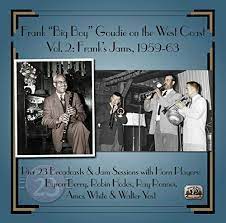
Frank “Big Boy” Goudie was born on September 13, 1899 in Youngsville, Louisiana, 150 miles west of New Orleans, Louisiana in the area of the state known as Cajun country, where he lived until the age of eight. His family then moved to New Orleans, where he began playing cornet, and became proficient enough to find work with local bands such as Papa Celestin’s Original Tuxedo Band and the Magnolia Band, two of the top New Orleans bands at that time. He began studying clarinet and tenor saxophone, which would eventually become his primary instruments.
Arriving in New Orleans around 1907 meant Frank had a front-row seat to the blossoming of early jazz with King Oliver, Kid Ory, Johnny Dodds, Freddie Keppard, Jimmie Noone and a host of others, were in their prime and working at many venues throughout the city.
With the 1918 closure of Storyville and the early 1920s, New Orleans experienced a diaspora of musicians, one of whom was Goudie. In 1921 he joined a band accompanying a traveling minstrel show, and for the next four years he performed in Louisiana, Texas, New Mexico and California. He joined another traveling group, Frank Matthews and the Louisiana High Browns, ending up in Tampico, Mexico in 1925.
That same year he sailed to France, making Paris his home base for the next 14 years. Work was plentiful for expat Black musicians in Paris prior to World War II. He would go on to work with bands led by Benny Peyton, Louis Mitchell, Sam Wooding, Noble Sissle, Freddy Johnson, Bill Coleman, and Willie Lewis during the Thirties. He worked at “Bricktop’s,” owned and operated by Ada “Bricktop” Smith, who was a supporter of American jazz musicians. Frank played often and recorded with Django Reinhardt.
While living in Europe, Goudie carried a wicker suitcase full of upholstery tools with which to augment his income – a trade he learned as a young man in New Orleans. He left Paris in late 1939, moving to South America, where he worked in Brazil and Argentina with guitarist Oscar Aleman, and fronted his own groups.
In 1946, Frank moved back to Paris, playing there with Arthur Briggs, Harry Cooper, and Bill Coleman. In 1951, he moved to Berlin, led his own band and recorded there in 1952 and 1953 and in Yugoslavia in 1955.
Returning to the States in 1957 to run his uncle’s business in San Francisco, California, his presence became known to the close-knit Bay Area jazz community. It didn’t take long before he again was in demand and playing with trumpeter Marty Marsala, pianists Earl Hines, Bill Erickson and Burt Bales, trombonist Bob Mielke and other local groups.
Trumpeter, alto and tenor saxophonist and clarinetist Frank Goudie, who as a young man, his great height earned him the nickname “Tree,” and he became known as “Big Boy” during his years in Paris, transitioned from cancer at age 64, in San Francisco on January 9, 1964.
More Posts: bandleader,clarinet,history,instrumental,jazz,music,saxophone,trumpet