

Daily Dose Of Jazz…
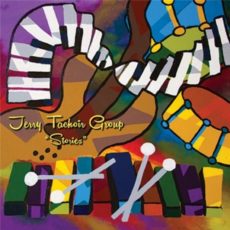
Jerry Tachoir was born August 7, 1955 in McKeesport, Pennsylvania. A chance meeting with Gary Burton led to him matriculating through Berklee College of Music, studying with Burton and graduating summa cum laude in 1976.
Tachoir has been nominated for a Grammy, released several albums with his band, the Group Tachoir, and as an educator he has taught privately for over a quarter of a century, held clinics and master classes and authored A Contemporary Mallet Method: An Approach to the Vibraphone and Marimba,
He has released an instructional vibraphone video titled Master Study Series and the Vibraphone Vol. I and II. Vibraphone and marimba player Jerry Tachoir has led his quartet for twenty-five years throughout the U.S., Canada and Europe, and continues to compose, record and tour.


#preserving genius
More Posts: marimba,vibraphone
Daily Dose Of Jazz…
Frank Ricotti was born on January 31, 1949 in London, England and played in the National Youth Jazz Orchestra while a teenager, then attended Trinity College of Music from 1967 to 1970. From 1968 through 1974 hep performed with Neil Ardley, Dave Gelly, Graham Collier, Mike Gibbs, Stan Tracey, Harry Beckett, Norma Winstone and Gordon Beck.
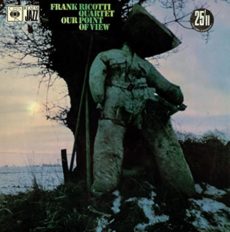
In the late 1960s and early 1970s, Ricotti led his own jazz quartet with a line-up of the band featuring the guitarist Chris Spedding, bassist Chris Laurence and drummer Bryan Spring. Together they recorded the album Our Point of View, and released it in 1969. By 1971, in partnership with bassist Mike de Albuquerque, he released the album First Wind. He recorded with Oliver Nelson on the album Oliver Edward Nelson in London with Oily Rags for the Flying Dutchman label in 1974.
The 1980s saw Frank playing with Chris Laurence and John Taylor in the group Paragonne, and then played with Beck again in 1984. After this he worked primarily as a studio musician recording with groups outside the jazz genre, such as, Status Quo, Freddie Mercury, Pet Shop Boys, Swing Out Sister, Belle and Sebastian, Clannad, Barclay James Harvest, Meat Loaf, Elkie Brooks, Rick Wakeman, Tina Turner, Aztec Camera, Thomas Anders, and Alphaville.
Between 1984 and 1987 Ricotti wrote the soundtrack music for Yorkshire Television’s The Beiderbecke Trilogy, in the style of Bix Beiderbecke. The music was performed by his band, the Frank Ricotti All Stars, and featured Kenny Baker on cornet. The band made a cameo appearance in the final series, playing in a jazz club and the soundtrack album was released in 1988.
In 2007 he played vibes on Mark Knopfler’s album Kill to Get Crimson and vibraphonist and percussionist Frank Ricotti continues to perform, record and compose.

#preserving genius
More Posts: percussion,vibraphone
Daily Dose Of Jazz…
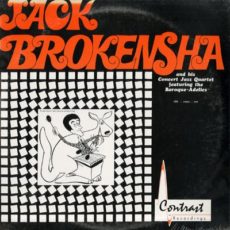
Jack” Brokensha was born John Joseph Brokensha on January 5, 1926 in Nailsworth, South Australia. He studied percussion under his father, and played xylophone in vaudeville shows and on radio. He played with the Australian Symphony Orchestra during the war years from 1942–44, and then joined a band in the Air Force from 1944 to 1946.
Forming his own group, Jack began performing in Melbourne in 1947, moving around Australia and playing in Sydney from 1949 to mid–50, Brisbane later in 1950 and Adelaide in 1951. By 1953 he had moved to Windsor, Ontario, Canada with Australian pianist Bryce Rohde and together they formed the Australian Jazz Quartet/Quintet. They enlisted fellow Australian bassoonist/saxophonist Errol Buddle and American saxophonist/flutist/bassist Dick Healey to complete the ensemble that toured together until 1958 and often grew to quintet /sextet to record.
Leaving Canada for Detroit, Michigan, Brokensha was hired by Berry Gordy of Motown Records as a percussionist, becoming one of the few white members of Motown’s Hitsville U.S.A. recording studio’s house band, The Funk Brothers. He was given the nickname “White Jack”, to distinguish him from Jack Ashford, an African American percussionist nicknamed “Black Jack”.
During the 1970s he ran “Brokensha’s”, a steakhouse high up in a Downtown Building whilst working at Motown. Though relatively small, the club had good food and Jack’s great music, with occasional appearance by his friend and pianist Detroit resident, pianist Bess Bonnier. Following tours of Australia with Sammy Davis, Jr. and Stan Freberg, he founded his own music production company and did a session with Art Mardigan in 1963. Jack then became more active in radio as a disc jockey and writing music for television. He recorded as a leader again in 1980 and continued to lead his own group well into the 1990s. The Australian Jazz Quartet also reunited for tours and recording in 1994, leaving a small collection of some thirteen albums as a leader and member of the quartet.
Vibraphonist Jack Brokensha moved to Sarasota, Florida, where he passed away due to complications from congestive heart failure, at age 84 on October 28, 2010.
#preserving genius
More Posts: drums,vibraphone
Daily Dose Of Jazz…
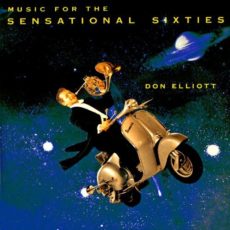
Don Elliott was born October 21, 1926 in Somerville, New Jersey and played mellophone in his high school band and played trumpet for an army band. After study at the University of Miami he added vibraphone to the list and recorded with Terry Gibbs and Buddy Rich before forming his own band.
From 1953 to 1960 he won the DownBeat readers poll several times for miscellaneous instrument-mellophone. Known as the “Human Instrument”, Don additionally performed jazz as a vocalist, trombonist, flugelhornist and percussionist. He pioneered the art of multitrack recording, composed countless prize-winning advertising jingles, prepared film scores, and built a thriving production company.
Elliott scored several Broadway productions including James Thurber’s The Beast in Me and A Thurber Carnival, in the latter of which he performed with his quartet. He also provided one of the voices for the novelty jazz duo the Nutty Squirrels. He lent his vocal talents to such motion picture soundtracks as The Getaway starring Steve McQueen, $ (Dollars) starring Warren Beatty, and The Hot Rock starring Robert Redford, as well as composing the score to The Happy Hooker starring Lynn Redgrave.
Elliott owned and operated one of the very first multitrack recording studios in New York City and in Weston, Connecticut and recorded over 60 albums and 5,000 advertising jingles throughout his career. A longtime associate of Quincy Jones, he contributed vocal work to many of Jones’ film scores. As sideman he performed and recorded with Phil Bodner, Miles Davis, Lee Konitz, Jackie McLean, Paul Desmond, Billy Taylor, Billy Eckstine, Bill Evans, Urbie Green, Michel Legrand, George Shearing, Marty Bell, Bob Corwin, Louis Bellson and Mundell Lowe among others.
Trumpeter, vibraphonist, vocalist, and mellophone player Don Elliott, whose recording Calypso Jazz is considered by some jazz enthusiasts to be one of the definitive calypso jazz albums, passed away of cancer on July 5, 1984 in Weston, Connecticut.

Dose A Day-Blues Away
More Posts: mellophone,trumpet,vibraphone,vocal
Daily Dose Of Jazz…
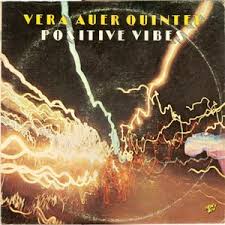
Vera Auer was born on April 20, 1919 in Vienna, Austria, the grandniece of violinist Leopold Auer. She learned classical piano and later accordion. In 1948, along with guitarist Attila Zoller formed a combo. She later added vibraphone to her list of instruments and teamed with Helmuth Zukovits on bass and Franz Mikuliska on drums.
In 1950 the group performed and recorded under her own name and appeared on the Austrian radio AG RAVAG. 1951 saw the band The Audience Award for best combo at the taking was the band at the Vienna Jazz Competition. This was followed by her first tour abroad in Turkey and West Germany, where they also played with Friedrich Gulda.
Vera would go on to play with Joe Zawinul, Hans Salomon and Toni Stricker in her band. By 1954 she was playing mainly in West Germany due to poor working conditions for jazz musicians in Austria. She accompanied Donald Byrd, Lucky Thompson and Art Taylor. In 1956 she performed with Jean-Louis Chautemps at the German Jazz Festival.
In 1959 after marrying Brian Boucher and moved to the United States the next year. She attended the Lenox School of Jazz studying under Gunther Schuller, John Lewis and George Russell. She played with Dave Burns, Cal Massey, J. J. Johnson, Mal Waldron, Ted Curson, Zoot Sims, Walter Perkins and Richard Williams. Around 1970, she recorded as a leader an LP titled Positive Vibes with her quintet, which wasn’t released until 1977 and still amazingly fresh sounds.
She continued to perform into the Nineties on the Jazz Mobile and Jazz Vespers of St. Peter’s Church in New York City. In 1984 the American Public Broadcasting Service Program dedicated a one-hour portrait of her. On August 2, 1996 vibraphonist Vera Auer passed away in Newsane, Vermont.
Take A Dose On The Road
More Posts: vibraphone