

Daily Dose Of Jazz…
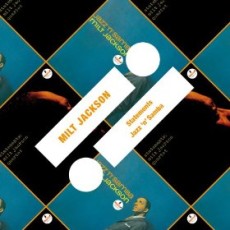
Milt Jackson was born Milton Jackson on January 1, 1923 in Detroit, Michigan. Discovered by Dizzy Gillespie and hired in 1946 for his sextet and also for his larger ensembles. He quickly acquired experience working with the most important figures in jazz of the era, including Woody Herman, Howard McGhee, Thelonious Monk and Charlie Parker.
In the Gillespie big band, Jackson fell into a pattern that led to the founding of the Modern Jazz Quartet. He was part of Gillespie’s small group swing tradition within a big band, consisting of pianist John Lewis, bassist Ray Brown and drummer Kenny Clarke. They would become a working group in their own right around 1950 and became the Milt Jackson Quartet but by the time Percy Heath replaced Ray Brown, in 1952 they became the Modern Jazz Quartet.
After some twenty years the MJQ disbanded in 1974 and Jackson pursued more money and his longed for improvisational freedom. The group reformed in 1981, however, and continued until 1993, after which Jackson toured alone, performing in various small combos, although agreeing to periodic MJQ reunions.
He recorded prolifically, his tunes, “Bluesology”, “Bags & Trane”, “The Late, Late Blues” and “Bag’s Groove” are jazz standards. He has recorded with J.J. Johnson, Roy McCurdy, B.B. King, John Coltrane, Wes Montgomery, Hank Mobley, Oscar Peterson, Stanley Turrentine, Don Sebesky, Cannonball Adderley and Ray Charles on the very short list.
A very expressive player, Bags, as he was affectionately known and referring to the bags under his eyes from staying up all night, differentiated himself from other vibraphonists in his attention to variations on harmonics and rhythm. He became one of the most significant vibist and was at the top of his game for 50 years playing bop, blues, and ballads with equal skill and sensitivity. Vibraphonist Milt Jackson, thought of as a bebop player but equally remembered for his cool swinging solos, left the jazz world on October 9, 1999 in Manhattan, New York.

More Posts: vibraphone
Daily Dose Of Jazz…
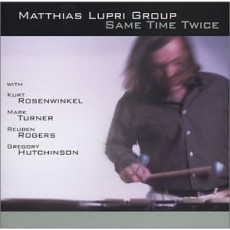
Matthias Lupri was born Matthias Albrecht Lupri on October 29, 1964 in Germany but grew up in Manhattan, Kansas and Alberta, Canada. Initially he played the drums, playing in blues, rock and country music bands as a teenager. In his early 20’s he studied music at Mount Royal College, where he heard Gary Burton’s recordings and became interested in jazz vibraphone music.
Lupri practiced the instrument for the next five years while on the road with rock bands as a drummer, and then enrolled at Berklee College of Music to study with Burton himself.
After graduating Matthias easily slid into the jazz circles in the U.S. and around the world. He has performed and recorded with Greg Osby, Chris Potter, Kurt Rosenwinkel, Mark Turner, Greg Hutchinson, Reuben Rogers, Rick Margitza and George Garzone among others and has been sought after on the national and international jazz festival circuit.
Vibraphonist Matthias Lupri’s has released six recordings as a leader that have charted in radio’s Top 40 Gavin, CMJ and Chart Magazine Canada, has been heard on the television show “Alias”, and was named as a rising artist on vibraphone twice in the Down Beat critics poll. He continues to perform, collaborate, record and tour.
More Posts: vibraphone
Daily Dose Of Jazz…
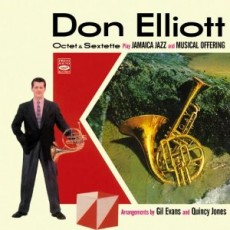
Don Elliott was born on October 21, 1926 in Somerville, New Jersey. He played mellophone in his high school band and played trumpet for an army band. After study at the University of Miami he added vibraphone to his arsenal of instruments. He recorded with Terry Gibbs and Buddy Rich before forming his own band.
From 1953 to 1960 he won the Down Beat readers poll several times for “miscellaneous instrument-mellophone.” Known as the “Human Instrument”, Elliott additionally performed jazz as a vocalist, trombonist, flugelhornist and percussionist. He pioneered the art of multi-track recording, composed over 5000 jingles with a countless number being prize-winning advertising jingles, prepared film scores, recorded over 60 albums and built a thriving production company.
Don scored several Broadway productions, such as The Beast In Me and A Thunder Carnival, the latter of which he performed with the Don Elliott Quartet, provided one of the voices for the novelty jazz duo the Nutty Squirrels, and lent his vocal talents to such motion picture soundtracks as The Getaway, $ (Dollars), The Hot Rock and The Happy Hooker.
His album Calypso Jazz is considered by some jazz enthusiasts to be one of the definitive calypso jazz albums. He worked with Paul Desmond, Bill Taylor, Billy Eckstine, Bill Evans, Urbie Green, Michel Legrand, George Shearing and Mundell Lowe among others over his career. Multi-instrumentalist, vocalist, publisher and producer Don Elliott, who was a longtime associate of Quincy Jones, passed away of cancer in Weston, Connecticut on July 5, 1984.
More Posts: flugelhorn,mellophone,percussion,trombone,trumpet,vibraphone,vocal
Daily Dose Of Jazz…
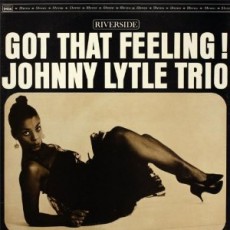
Johnny Lytle was born John Dillard Lytle on October 13, 1932 in Springfield, Ohio, the son of a trumpeter father and an organist mother. He began playing the drums and piano at an early age. Before studying music in earnest, he was a boxer and was a successful Golden Gloves champion. During the late ’50s, Lytle continued to box, but landed jobs as a drummer for Ray Charles, Jimmy Witherspoon and Gene Ammons.
Switching from drums to vibraphone Johnny toured with organist Hiram “Boots” Johnson in 1955 and then formed his first group in 1957 with saxophonist Boots Johnson, organist Milton Harris and drummer William “Peppy” Hinnant. He so impressed Grammy winning producer Orrin Keepnews who signed him to his Jazzland label in 1960.
Known for his great hand speed and showmanship, Lytle was also a songwriter, penning many of his own hits, including “The Loop,” “The Man,” “Lela,” “Selim” (honoring Miles Davis), and the jazz classic “The Village Caller”. He recorded more than 30 albums for various jazz labels including Tuba, Jazzland, Solid State and Muse. Throughout his career he performed and recorded with a host of jazz greats including Louis Armstrong, Lionel Hampton, Miles Davis, Nancy Wilson, Bobby Timmons and Roy Ayers.
Johnny never recorded with any of the major record labels fearing loss of control of his music and creative development, thus never gaining the status of a jazz icon like some of his peers, but finding success early in his career with chart-topping albums like A Groove, The Loop, and Moonchild. Nicknamed “Fast Hands,” he always kept an audience’s attention, was popular on the jazz circuit and built a respectable catalog of music with recordings in the ’70s,’80s and ’90s. Johnny toured throughout the U.S. and Europe, with his last performance one month before his passing on December 15, 1995 in his hometown of Springfield. The street where the vibraphonist and drummer used to live was renamed Johnny Lytle Avenue in his honor.

More Posts: drums,vibraphone
Requisites
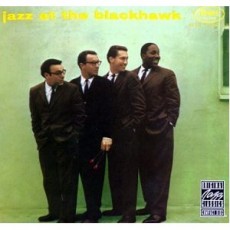
Jazz At The Blackhawk: The quartet that Cal Tjader kept together during 1956-57 was devoted to straight-ahead jazz. His Latin fans found ample consolation in the enjoyment of one of the most swinging groups the vibra-harpist ever led. This set was captured at The Blackhawk in San Francisco with an audience that actually got the sound and inspired the players.
Personnel: Cal Tjader – vibes, Vince Guaraldi – piano, Gene Wright – bass, Al Torre – drums
Record Date: Live at the Blackhawk, San Francisco / January 20, 1957
Songs: Bill B., Land’s End, I’ll Remember April, Blues In The Night, Thinking Of You, MJQ, I’ve Never Been In Love Before, Two For Blues Suite, When The Sun Comes Out, Lover, Come Back To Me

More Posts: collectible,vibraphone