

Daily Dose Of Jazz…
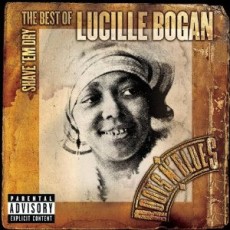
Lucille Bogan was born in Amory, Mississippi on April 1, 1897 but was raised in Birmingham, Alabama and at age five she was named Lucille Anderson. In 1916 she married railway man Nazareth Lee Bogan and she received her training singing in the rowdiest juke joints of the 1920s. She first recorded vaudeville songs in New York for Okeh Records in 1923. That same year she recorded “Pawn Shop Blues” in Atlanta, which was the first time a black blues singer had been recorded outside New York or Chicago.
Among the first blues singers to be recorded, in 1927 Lucille signed with Paramount Records in Chicago, recording her first big success, “Sweet Petunia”, later covered by Blind Blake. By 1930 her recordings had begun to concentrate on drinking and sex, with songs such as “Sloppy Drunk Blues”, “Tricks Ain’t Walkin’ No More” and “Black Angel Blues” later covered by B. B. King as “Sweet Little Angel”. She would later record for Brunswick Records.
Many of Bogan’s songs, most of which she wrote herself, have thinly-veiled humorous sexual references with the theme of prostitution featured prominently in several of her recordings. In the early Thirties Lucille returned to New York and recorded prolifically under the pseudonym Bessie Jackson until the middle of the decade. Lucille Bogan does not appear to have recorded after 1935, spending some time managing her son’s jazz group, Bogan’s Birmingham Busters, before moving to Los Angeles, where she died on August 10, 1948 from coronary sclerosis.
More Posts: vocal
Daily Dose Of Jazz…
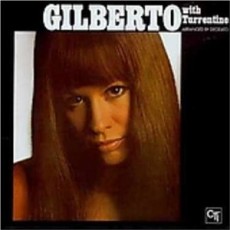
Astrud Gilberto was born Astrud Weinert on March 30, 1940 in the state of Bahia and raised in Rio de Janiero, the daughter of a Brazilian mother and a German father, She married Joao Gilberto in 1959, emigrating to the United States in 1963 and has continued to reside in the US ever since. They divorced in the mid-1960s and she began a relationship with her musical partner, Stan Getz.
Although now widely known for her samba and bossa nova music, she had never sung professionally and it was at the behest of her husband Joao that she sang on the recording of the Getz/Gilberto album featuring Stan Getz, Joao Gilberto and Antonio Carlos Jobim. Providing the English vocals to the 1965 Grammy Award-winning song “The Girl From Ipanema”, and her career was launched garnering her worldwide recognition and establishing her as a jazz and pop singer.
Her first solo album was The Astrud Gilberto Album in 1964, went on tour with Stan Getz singing bossa nova and American jazz standards, Gilberto didn’t start to record her own compositions until the 1970s. Her repertoire included such standards as “The Shadow Of Your Smile”, “It Might As Well Be Spring”, “Love Story”, “Fly Me To The Moon”, “Day By Day”, “Here’s That Rainy Day” and “Look to the Rainbow”.
Astrud has recorded songs in Portuguese, English, Spanish, Italian, French, German and Japanese, has received the “Latin Jazz USA Award for Lifetime Achievement”, inducted into the “International Latin Music Hall of Fame”, contributed to the Aids benefit album Red Hot + Rio, has had numerous versions of her songs sampled and used in movies, is a fine artist and ardent animal rights advocate.
More Posts: vocal
From Broadway To 52nd Street…
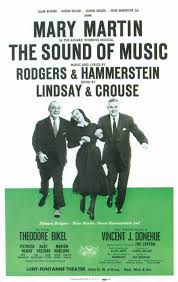
The Sound Of Music brought up the curtain of the Lunt Fontanne Theatre on November 16, 1959 and finished with a blockbuster run of 1443 performances. The show starred Mary Martin and Theodore Bikel. The song My Favorite Things composed by Richard Rodgers and Oscar Hammerstein went on to become a jazz standard. The show won a Tony Award for Best Musical.
The Story: Based on the Trapp family story the musical takes us on their journey to escape the Nazis. Set in Salzburg, Austria just before World War II, Maria Rainer, one of the postulates from Nonnberg Abbey is wrestling with her decision to joining monastic life or pursue more secular endeavors. With the help of the Mother Abbess she is placed in the home of Captain Georg von Trapp to act as governess to his seven children. As war looms over their happy existence they escape to Switzerland over the Alps.
Details of the von Trapp history were changed for the musical. They lived in a villa outside Salzburg, Maria was a tutor for one child, the names and ages were altered, and the family spent time in Austria after Maria and the Captain were married. Opposing the Nazi regime, he declined a commission in the German Navy, left Austria for Italy, then on to London and finally to the United States. The escape over the mountains on foot provided more drama for the play.
Broadway History: Broadway theatre,commonly called simply Broadway, is theatrical performances presented in one of the 40 professional theatres with 500 or more seats located in the theater District and Lincoln Center along Broadway in the Manhattan borough of New York City. Along with London’s West End theatres, Broadway theatres are widely considered to represent the highest level of commercial theatre in the English-speaking world.
Sponsored By

www.whatissuitetabu.com
From Broadway To 52nd Street
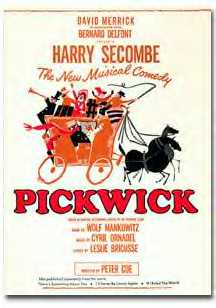
Pickwick opened at the 46th Street Theatre on October 4, 1965 and ran 56 performances with the music composed by Cyril Ornadel and Leslie Bricusse. The song that rose to great heights is the Great American songbook and became a jazz standard was If I Ruled The World.
The Story: Set in England in 1828, the story centers on wealthy Samuel Pickwick and his valet Sam Weller, who are in a debtors’ prison where they recall the misadventures that led to their imprisonment. On the previous Christmas Eve, Pickwick introduced his friend Wardle, Wardle’s daughters, Emily and Isabella, and their Aunt Rachael to Nathaniel Winkle, Augustus Snodgrass, and Tracy Tupman, three members of the Pickwick Club. Soon, Alfred Jingle joined them and tricked Tupman into paying for his ticket to a ball that evening. Upon learning Rachael is an heiress, Jingle set out to win her hand and eventually succeeded. Pickwick engages Sam Weller as his valet and, through a series of misunderstandings, he inadvertently leads his landlady, Mrs. Bardell, to believe he has proposed marriage to her. Pickwick is charged with breach of promise and hauled into court, where he is found guilty as charged and sentenced to prison when he stubbornly refuses to pay her compensation.
Jazz History: In 1965 Miles Davis records ESP with his new quintet; pianist/vocalist Nat King Cole dies of cancer; Herbie Hancock records Maiden Voyage, a classic modal tune, with the other members of Miles Davis’ group plus trumpeter Freddie Hubbard; trumpeter Thad Jones and drummer Mel Lewis form a rehearsal orchestra that is to last for years and is still in existence today; and John Coltrane records Ascension, a free jazz experiment influenced by Ornette Coleman.
Sponsored By
www.whatissuitetabu.com

From Broadway To 52nd Street
The Roar Of The Greasepaint – The Smell Of The Crowd opened its season at the Shubert Theatre on May 16, 1965 and ran for 231 performances. Leslie Bricusse and Anthony Newley composed the music with the later starring alongside Cyril Ritchard. From these two talented lyricist and composer, Who Can I Turn To and Look At That Face entered the lexicon of jazz standards.
The Story: The allegorical plot examines the maintenance of the status quo between the upper and lower classes of British society in the 1960s. Since Sir forever is changing the rules of the game of life, downtrodden young Cocky always gets the short end of the stick. Assisting Sir is his eager disciple Kid, anxious to pick up bits of wisdom while helping keep Cocky in his place.
Broadway History: Musical theatre is a form of theatrical performance that combines songs, spoken dialogue, acting, and dance. The story and emotional content of a musical may have humor, pathos, love, anger and are communicated through the words, music, movement and technical aspects of the entertainment as an integrated whole. Although musical theatre overlaps with other theatrical forms like opera and dance, it may be distinguished by the equal importance given to the music as compared with the dialogue, movement and other elements. Since the early 20th century musical theatre stage works have generally been called, simply, musicals.
Sponsored By
www.whatissuitetabu.com