

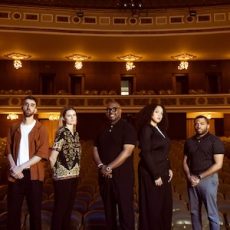
CHRISTIAN MCBRIDE’S URSA MAJOR
Bassist and composer Christian McBride’s most recent project is a quintet showcasing several of the most exciting young players on the scene. Returning to the Miner Auditorium stage for two nights, the cast features tenor saxophonist Nicole Glover, who has toured with Wynton Marsalis and Jazz at Lincoln Center Orchestra, performed with veteran masters such as drummer Al Foster, vocalist Dee Dee Bridgewater, and bassist Reggie Workman, and recorded with pianist Aaron Diehl’s Grammy-nominated 2023 Mary Lou Williams project Zodiac Suite.
Ely Perlman is an exciting young guitarist who has collaborated with Terreon Gully and Braxton Cook, and Chicago pianist Mike King has been touring with Dee Dee Bridgewater, and trumpeters Marquis Hill, Theo Croker, and Marcus Printup. Powering the band is Oakland native Savannah Harris, a remarkably poised young drummer who has made a major impact with the likes of vocalist Cécile McLorin Salvant, Kenny Barron, and Immanuel Wilkins.
Tickets: $40.00 ~ $125.00
More Posts: adventure,bandleader,bass,drums,genius,guitar,jazz,music,piano,preserving,saxophone,travel
Daily Dose Of Jazz…
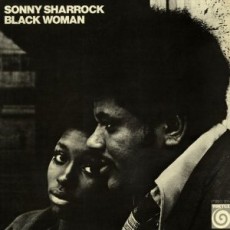
Sonny Sharrock was born Warren Harding Sharrock on August 27, 1940 in Ossining, New York. He began his musical career singing doo-wop in his teen years. One of few guitarists in the first wave of free jazz in the 1960s, Sonny was known for his incisive, heavily chorded attack, his highly-amplified bursts of wild feedback, and for his use of saxophone-like lines played loudly on guitar.
He collaborated with Pharoah Sanders and Alexander Solla in the late 1960s, appearing first on Sanders’s 1966 effort, “Tauhid”, made several appearances with flautist Herbie Mann and also made an un-credited guest appearance on Miles Davis’s “A Tribute to Jack Johnson”, perhaps his most famous cameo.
Sharrock released three albums as a leader in the late ’60s through the mid-’70s: Black Woman, Monkey-Pockie-Boo and Paradise. Following the last release he went into semi-retirement for much of the 1970s until bassist and producer Bill Laswell coaxed him out to play on a 1981 effort, Memory Serves. He would go on to join punk/jazz band Last Exit, record and perform with the improvisational group Machine Gun and would record another seven albums under his own name, such as, a solo project Guitar, the metal-influenced Seize the Rainbow, and the well-received Ask The Ages featuring Pharoah Sanders and Elvin Jones.
Best known for composing the soundtrack to “Space Ghost: Coast To Coast for the Cartoon Network, with more than thirty-two albums to his credit as a leader and sideman, guitarist Sonny Sharrock passed away of a heart attack on May 26, 1994 at age 53.
More Posts: guitar
Daily Dose Of Jazz…
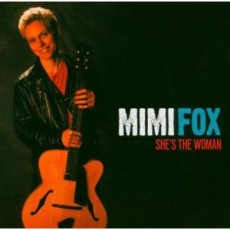
Mimi Fox was born on August 24, 1956 in New York City and started playing drums at nine and guitar when she was ten. She was inspired by the wide variety of music enjoyed by her family – show tunes, classical, Dixieland, Motown – and her own youthful inclination towards pop, folk, and R&B. By the time she was fourteen, she bought her first jazz album, John Coltrane’s classic Giant Steps, changing the course of her musical life. She began touring right out of high school and eventually settled in the San Francisco Bay area where she became a sought after player.
Mimi has released seven albums but her “Perpetually Hip” released in 2006 reached #23 on the Billboard “Top Jazz Albums” chart. This two-disc set contains standards and new tunes written by Fox, with one disc featuring solo recordings while the other is with a band composed of bassist Harvie S, drummer Billy Hart and pianist Xavier Davis.
As a composer, Mimi has received numerous grants, writing and performing original scores for orchestras, documentary films and dance projects. A dedicated educator and clinician, she is Chair of the Guitar Department, a faculty advisor and instructor at The Jazzschool for Musical Study and Performance in Berkeley, California and an Adjunct Professor at New York University. Guitarist Mimi Fox continues to compose, perform and tour.
More Posts: guitar
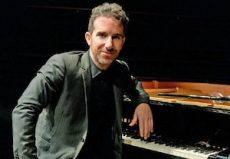
AARON GOLDBERG TRIO
The New York Times has called Aaron Goldberg a “post-bop pianist of exemplary taste and range”, and over a career spanning three decades he has more than earned that distinction. Born in Boston, Goldberg discovered jazz in high school under the guidance of bassist Bob Sinicrope, and later studied with saxophonist Jerry Bergonzi before moving to New York at seventeen to attend the New School for Jazz and Contemporary Music. DownBeat magazine has praised his “quick witted harmonic reflexes, fluid command of line, and cut-to-the-chase sense of narrative logic.”
Goldberg’s career has placed him at the center of some of jazz’s most important collaborations. He toured extensively with Joshua Redman, joined the bands of Kurt Rosenwinkel and Wynton Marsalis, and performed worldwide with the Lincoln Center Jazz Orchestra. He has also collaborated with Charles Lloyd, Madeleine Peyroux, Betty Carter, Freddie Hubbard, and Guillermo Klein, among many others, and somehow found time to earn a master’s degree in philosophy from Tufts along the way. He is a Steinway artist and a member of the celebrated collaborative trio Yes! with Omer Avital and Ali Jackson Jr.
Aaron Goldberg – Piano
Matt Brewer – Bass
Kendrick Scott – Drums
Cover: $27.98
More Posts: adventure,bandleader,club,genius,guitar,instrumental,jazz,music,piano,preserving,travel
MIKE STERN BAND
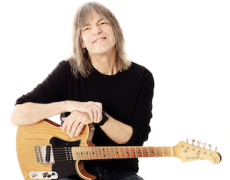
Mike Stern is one of the true guitar greats of his generation. There, he plays with remarkable facility, and his searing lines draw mainly on bebop and the blues. Additionally, he carries a rock-tinged intensity. He uniquely combines the finesse and lyricism of Jim Hall, the driving swing of Wes Montgomery and the turbulent, overdriven attack of Jimi Hendrix.
Stern made his mark with Miles Davis in the early ‘80s before launching his solo career in 1985. Since then, he has released seventeen recordings as a leader, six of which received Grammy nominations. Moreover, his latest recording, 2024’s Echoes and Other Songs, features an all-star cast.
Musicians, critics and fans hail drummer Dennis Chambers for his technique and speed. Furthermore, they particularly praise his ability to play “in the pocket”. Thus, he has worked with John Scofield, George Duke, Brecker Brothers, Steely Dan, Santana, Parliament/Funkadelic, John McLaughlin, and more.
Bassist Noam Tanzer moves among a diverse world of styles. There, these vary from improvised music to hardcore metal, from indie rock in Spanish to the music of Billy Strayhorn. Noam has worked with Paquito D’Rivera, Miguel Zenon, Julieta Rada and others.
Regarded as the First Lady of jazz guitar, Leni Stern has become a respected force on the global music scene. Also, she has led her own groups for over three decades. Additionally, Guitar Player once described her work as “a case study in the interactive properties of composition and improvisation.”
Saxophonist Bob Franceschini ranks among the most in-demand players in New York. There, he has worked with George Benson, Eddie Palmieri, Woody Shaw, Kenny Kirkland, Chris Botti, Chaka Khan and many others.
Cover: $41.95 ~ $47.10
More Posts: adventure,bandleader,club,genius,guitar,jazz,music,preserving,travel