


Daily Dose Of Jazz…
Lorraine Feather was born Billie Lorraine Feather in Manhattan on September 10, 1948 to jazz writer Leonard and Jane, a big band singer. Named after her godmother Billie Holiday, she began using her middle name in grade school.
Lorraine began working in television as a lyricist in 1992 and has received seven Emmy nominations. Her lyrics for children include work for ABC, PBS, Disney and MGM films; with composer Mark Watters wrote for Jessye Norman’s 1996 Olympic performance, and with Larry Grossman composed for Julie Andrews.
Feather’s work has been heard on numerous records covered extensively by artists such as Phyllis Hyman, Kenny Rankin, Patti Austin, Diane Schuur and Cleo Laine. Many of her own solo projects have featured contemporary lyrics to formerly instrumental pieces written by Duke Ellington, Fats Waller and other pre-bop composers. Feather’s recordings have received glowing reviews in every major jazz magazine including Down Beat and Jazz Times.
Loraine has gone on to lyric theatrical work, musical and the American Opera Projects presented excerpts of her work. Her latest release, titled “Attachments” has her penning twelve new sets of lyrics with musicians such as Dave Grusin, Joey Calderazzo, Russell Ferrante, Shelly Berg and Eddie Arkin composing the music. She continues to write, record and perform.

Daily Dose Of Jazz…
Elvin Ray Jones was born on September 9, 1927 in Pontiac, Michigan. By age two he said he knew he held a fascination for drums watching the drummers in circus marching band parades go by his home. Elvin joined his high school’s black marching band, where he developed his rudimentary foundation. Upon discharge from the Army in 1949 he borrowed thirty-five dollars from his sister to buy his first drum set.
In Detroit, Jones played with Billy Mitchell’s house band at Detroit’s Grand River Street Club before moving to New York in 1955 where he worked as a sideman for Charles Mingus, Teddy Charles, Charlie Parker, Bud Powell, Wardell Gray and Miles Davis. By 1960 he was working with John Coltrane on his seminal work “A Love Supreme” and the relationship lasted until 1966.
Remaining active after leaving Coltrane, Elvin led several bands in the late sixties and seventies that are considered highly influential groups, notably a trio with saxophonist Joe Farrell and bassist Jimmy Garrison. He recorded extensively for Blue Note under his own name during this period with groups featuring prominent as well as up and coming greats like George Coleman, Lee Morgan, Frank Foster, Steve Grossman, Dave Liebman and Pepper Adams to name a few.
Elvin Jones’ sense of timing, polyrhythms, dynamics, timbre, and legato phrasing brought the drums to the foreground and his free-flowing style was a major influence on many leading rock drummers, including Mitch Mitchell and Ginger Baker. He performed and recorded with his own group, the Elvin Jones Jazz Machine, whose line up changed through the years, and recorded with both his brothers Hank and Thad over the course of his career.
He taught regularly, often taking part in clinics, playing in schools and giving free concerts in prisons. His lessons emphasized music history as well as drumming technique. Elvin Jones died of heart failure in Englewood, New Jersey on May 18, 2004.
More Posts: drums


Daily Dose Of Jazz…
Wilbur Ware was born in Chicago, Illinois on September 8, 1923. He taught himself to play banjo and bass. In the 1940s, he worked with Stuff Smith, Sonny Stitt and Roy Eldridge. In the ‘50s, Ware played with Eddie Vinson, Art Blakey, Johnny Griffin and Buddy DeFranco.
Ware played simply, strongly, and melodically, with a big, hard-bop percussive sound. His best known for his hard bop percussive style and his most important Wilbur Ware records are three dates with the Thelonious Monk Quartet in 1957-58. The best Monk sides are the three perfect quartet tracks with John Coltrane and Shadow Wilson, followed by the uneven all-star “Monk’s Music” date, where one can hear Ware’s great harmonic insight on “Well You Needn’t”. These dates along with the Sonny Rollins Village Vanguard sets with Elvin Jones are examples of his finest recorded work.
Ware and fellow bassist Israel Crosby were leading examples of the more laid-back “Chicago Sound” approach to the bass during the 1950’s. By 1969, Ware had played with Clifford Jordan, Elvin Jones and Sonny Rollins. He later moved to Philadelphia, where the double-bassist died from emphysema on September 9,1979. He was 56 years old.

More Posts: bass
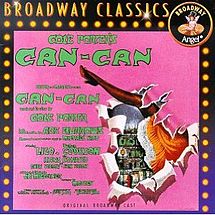
From Broadway To 52nd Street
Can-Can was first seen on the stage of the Shubert Theatre on May 7, 1953 and the audience heard music composed by Cole Porter. The show ran for 892 performances. The original Broadway production ran for over two years starring Gwen Verdon in only her second Broadway role. Both she and and choreographer Michael Kidd won Tony Awards and were praised, the score and book received tepid reviews. However, three songs that rose to become jazz standards were I Love Paris, Just One Of Those Things and It’s All Right With Me.
The Story: In 1893 Paris, the dance hall Bal du Paradis in Montmartre owned by La Môme Pistache, is being threatened with closing by a self-righteous judge, Aristide Forestier. Offended by the scandalous but popular dance that the attractive dancers perform, the “Can-Can”, the judge sends the police to harass the owner and dancers, but the police like the dancers so much that they are reluctant to testify against them in court. Deciding to gather evidence, the judge takes a trip to the club. Once there, he and the owner, La Môme, fall in love but he gets the evidence to send the owner and girls to jail.
One of the dancers, Claudine, a laundry girl by day, has been pursued by art critic Hilaire, however, Claudine is in love with sculptor Boris but still arranges to have dinner with Hilaire to get a favorable review for her love. Conflicted between love and right and wrong, the judge conceded, “obscenity is in the eye of the beholder”. And gets caught in a scandalous kiss with the proprietress. Eventually, Hilaire writes a gushing review of Boris’s work. Judge Aristide loses his judgeship and is disbarred, but La Môme and the girls all go to court with him and all win their cases.
Jazz History: Live jazz was recorded, as early as 1935, but for some reason it was not considered feasible to reproduce it on 78 rpms for public consumption. This precedent was first broken in 1945 by Norman Granz, who, as one of jazz’s liveliest aficionados, originated in the early forties the notion of taking on tour for concert appearances a select group of musicians. It was an arrangement he called “Jazz at the Philharmonic”. In 1944, unbeknownst to the participating musicians, he recorded sections of a concert he was producing in Los Angeles. He then released them soon afterwards in a 12-inch 78 rpm album of three records, and there were just two tunes, “Lady Be Good” and “How High the Moon”, each of which covered three sides, or approximately fifteen minutes of playing time. His experiment proved a huge success and he released fifteen albums since then, the last an entire concert on three 12-inch LPs, amounting to about two hours of music. Other record companies followed suit, using the advantageous expanded playing time of the LP, and the record stores were stocked with live performances of all varieties and qualities, ranging from nightclub stints to private jam sessions.
Sponsored By

www.whatissuitetabu.com