

From Broadway To 52nd Street
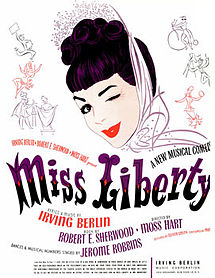
Miss Liberty brought to the stage its star Eddie Albert at the Imperial Theatre on July 15, 1949. The show ran for three hundred and eight performances with music composed by Irving Berlin. The song “You Can Have Him” became a jazz standard.
The Story: In 1885, New York Herald publisher James Gordon Bennett assigns novice reporter Horace Miller to find the woman who served as Frédéric Auguste Bartholdi’s model for the Statue of Liberty. In the artist’s Paris studio, Miller sees a photograph of Monique DuPont and mistakenly believes she was the one. Bennett arranges for her and her grandmother to accompany Horace back to New York City, where she becomes a media darling. When rival publisher Joseph Pulitzer discovers it was Bartholdi’s mother who actually posed for him, he exposes Monique as a fraud in his New York World. She faces deportation until a sympathetic Pulitzer comes to her rescue, paving the way for her to plan a future with Horace, who jilts his American girlfriend Maisie Doll in favor of the French beauty.
Jazz History: As the widely performed bebop or hot jazz began to wane in some sectors of the country, cool jazz began to emerge by the early 1950s. “Cool” was used to describe a kind of toned-down jazz. Later the term became associated with a number of white musicians who relocated to California where they could get day gigs at movie studios, unlike black musicians, while playing jazz at night. In this form it was called West Coast jazz. For white players to represent a kind of cool jazz is ironic since the idea of coolness has its roots in Black culture. Cool jazz contrasts with hot jazz in that it has limited vibrato, restrained timbre, stable dynamics, melodic calm, sophisticated harmonies that tempered the blues idiom.
Sponsored By

www.whatissuitetabu.com
Daily Dose Of Jazz…
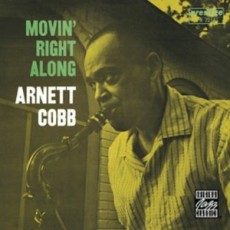
Arnett Cobb was born on August 10, 1918 in Houston, Texas. Taught to play piano by his grandmother, he went on to study violin before taking up the saxophone in high school. At fifteen he joined Louisiana bandleader Frank Davis, performing around Houston and throughout Louisiana during the summers. He continued his career in the mid-Thirties with the local bands of Chester Boone and Milt Larkin; the latter home to Illinois Jacquet, Wild Bill Davis and Eddie “Cleanhead” Vinson.
Arnett went on to replace Illinois in Lionel Hampton’s band in 1942 and is credited with the words and the music to “Smooth Sailing” which became a jazz standard in 1951, and sung by Ella Fitzgerald on her Lullabies of Birdland. After departing from Hampton’s band, Cobb formed his own seven-piece band, but suffering a serious illness in 1950, which necessitated spinal surgery, the group was disbanded.
Reforming the band upon recovery, in 1956 its success was again interrupted, this time by a car crash. This accident had long-term effects on his health, involving long hospital stays and making him permanently reliant on crutches. Nevertheless, Cobb worked as a soloist through the 1970s and 1980s in the U.S. and abroad, working with Jimmy Heath and Joe Henderson in Europe during the late Eighties.
Arnett Cobb, tenor saxophonist, passed away in his hometown in March 24, 1989 at the age of 70.
More Posts: saxophone
Daily Dose Of Jazz…
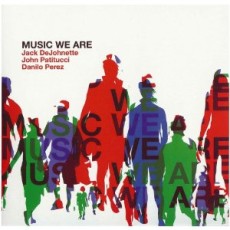
Jack DeJohnette was born August 9, 1942 in Chicago, Illinois and studied drums and piano. He first became known as a member of Charles Lloyd’s band, along with pianist Keith Jarrett. He played with Bill Evans in 1968 on the acclaimed Bill Evans at the Montreux Jazz Festival and from 1969 to 1972 played with Miles Davis.
The 70s saw Jack recording for Milestone/Prestige and ECM appearing widely on ECM also as a sideman. Since then he has recorded for MCA, Blue Note and Kindred Rhythm. He led several groups since the early-1970s, including Compost, a jazz-rock group that produced two albums; then went on to lead sessions that produced the albums “Directions”, “New Directions” and “Special Edition”.
He has worked with a host of jazz lions to numerous to list but suffice it say they range from Eddie Gomez to Dave Holland to Arthur Blythe, David Murray and Chico Freeman. He is a dazzling improviser and a clear stylistic successor of Roy Haynes, and two of the greatest drummers of the 1960s, Tony Williams and Elvin Jones.
Since 2003, Jack has been part of Trio Beyond with organist Larry Goldings and guitarist John Scofield that paid tribute to The Tony Williams Lifetime Trio and he also appears as a member of the Bruce Hornsby Trio. He has been nominated for several Grammy Awards and in 2009 DeJohnette received the Grammy for Best New Age Album “Peace Time”. He has been awarded an NEA Jazz Masters Fellowship for his significant lifetime contributions to the enrichment of jazz and the further growth of the art form.
Jack DeJohnette successfully incorporates elements of free jazz and world music while maintaining the deep grooves of jazz and R&B drummers. His exceptional experience of time and style, combined with astounding improvisational ingenuity, make him one of the most highly regarded and in-demand drummers. He also occasionally appears on piano, on his own recordings and has built a catalogue too immense to cite as he continues to perform, record and tour.
More Posts: drums
Daily Dose Of Jazz…
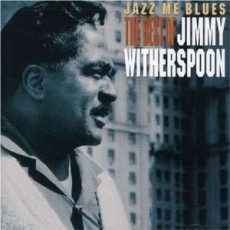
Jimmy Witherspoon was born on August 8, 1920 in Gurdon, Arkansas. He first attracted attention singing with Teddy Weatherford’s band in Calcutta, India, which made regular radio broadcasts over the U. S. Armed Forces Radio Service during World War II. Witherspoon made his first recordings with Jay McShann’s band in 1945.
By 1949 Jimmy was recording under his own name with the McShann band and had his first hit and signature tune with “Ain’t Nobody’s Business”. In 1950 he had several more with “No Rollin’ Blues” and “Big Fine Girl”, as well as “Failing By Degrees” and “New Orleans Woman” recorded with the Gene Gilbeaux Orchestra. These Gilbeaux recordings are from a live performance on May 10, 1949 at a “Just Jazz” concert in Pasadena, CA sponsored by Gene Norman.
Witherspoon’s style of the “blues shouter” became unfashionable in the mid-1950s, but he returned to popularity with his 1959 album, “Jimmy Witherspoon at the Monterey Jazz Festival” featuring Roy Eldridge, Woody Herman, Ben Webster, Coleman Hawkins, Earl Hines and Mel Lewis among others.
The early 60s saw Witherspoon touring Europe with Buck Clayton, recording in the UK, the 70s recording with Brother Jack McDuff in London, with Eric Burdon, toured with his own band with a host of players such as Joe Sample, Cornell Dupree, Thad Jones and others. He continued to record and perform well into the Nineties with Gerry Mulligan, Leroy Vinnegar, Teddy Wilson, Pepper Adams, Junior Mance and the list jazz luminaries goes on and on.
Vocalist Jimmy Witherspoon died of throat cancer in Los Angeles, California on September 18, 1997.
More Posts: vocal
Daily Dose Of Jazz…
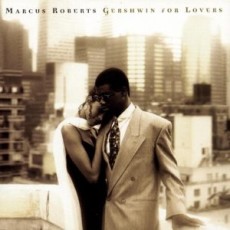
Marcus Roberts, born on August 7, 1963 in Jacksonville, Florida achieved fame as a stride pianist committed to celebrating classic standards and jazz traditions. Blind since his youth, he attended the Florida School for the Deaf and the Blind in St. Augustine, also the alma mater of Ray Charles.
Playing piano at an early age, he studied the instrument with world-renown pianist Leonidas Lipovetsky while attending Florida State University. In 1985, he got his big break when Wynton Marsalis chose him as his new sideman. He became a close friend and disciple of Marsalis, and collaborated with him on many projects during the ensuing years.
With Marsalis’ support and soon after joining him, Roberts began cutting his own records. His albums tend to be homage to past jazz giants. However, his ability and technique as a pianist have always been highly regarded and his music has added to the vocabulary of modern jazz piano and the piano trio.
Roberts has provided the soundtrack to the 1999 film Guinevere serves as Assistant Professor of Jazz Studies in the music program at Florida State University and is a Steinway Artist. He has amassed a catalogue of nearly two-dozen albums as a leader with several more as a sideman.
He excels as an improviser and interpreter in his solo performances and creates interesting and daring arrangements as a large band leader, but his chamber work will endure as his true contribution to American music.
More Posts: piano