

Daily Dose Of Jazz…
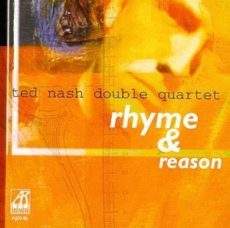
Ted Nash was born December 28, 1960 in Los Angeles, California. His trombonist father, Dick, and reedman uncle Ted, were both well-known jazz and studio musicians and both exposed and encouraged the young man. He started playing the piano at seven, by 12 the clarinet, and a year later he picked up the alto saxophone. In high school he studied jazz improvisation with vibraphonist Charlie Shoemake and had his first gig when he was This was followed by a week with Lionel Hampton in Hawaii.
Ted went on to win an audition to play lead alto with the Quincy Jones band, and by the time he turned 17 he had toured Europe, appeared on three records, and was performing regularly with the likes of Don Ellis, Louie Bellson and Toshiko Akiyoshi, as well as leading his own quintet. The following year he moved to New York City, recorded Conception, his debut album as a leader for the Concord label and became a regular member of a variety of ensembles. He worked with the Gerry Mulligan Big Band, the National Jazz Ensemble and for ten years would be a part of the Mel Lewis Jazz Orchestra.
An accomplished composer his first composition, Tristemente, was recorded by Louie Bellson, he has been commissioned by the Davos Musik Festival in Switzerland to compose works featuring a string quartet in a jazz setting, and commissioned by the Jazz at Lincoln Center Orchestra to compose the well-received Portrait in Seven Shades. It is dedicated to the representation of seven different artists, each in their own movement and was nominated for a Grammy in 2010. The artists were Claude Monet, Salvador Dalí, Henri Matisse, Pablo Picasso, Vincent van Gogh, Marc Chagall, and Jackson Pollock.
Composer and alto saxophonist Ted Nash leads an eclectic group called Odeon, and is a member of the Jazz Composers Collective along with Ben Allison, Frank Kimbrough, and Michael Blake.
Sponsored By


More Posts: saxophone
Daily Dose Of Jazz…
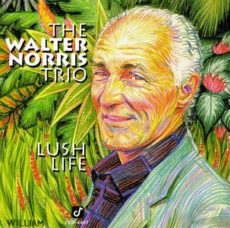
Walter Norris was born in Little Rock, Arkansas on December 27, 1931 and first studied piano at home with his mother. Lessons with John Summers, a local church organist followed. During his junior high and high school years his first professional performances were with the Howard Williams Band in and around Little Rock.
After graduating from high school, Norris went on to briefly play with Mose Allison, then did a two-year tour in the US Air Force. After the military he played with Jimmy Ford in Houston, Texas, then moved to Los Angeles, California and became an integral part of the West Coast Jazz scene. He was enlisted to play on Jack Sheldon’s first album as well as on the 1958 Ornette Coleman’s first album, Something Else! The Music of Ornette Coleman on the Contemporary Records label.
1960 saw Walter relocating to New York City and forming a trio with guitarist Billy Bean and bassist Hal Gaylor. The group made one album before he took a job at the New York City Playboy Club in 1963 and in time became the club’s Director of Entertainment, remaining there until 1970. After Playboy, for the next four years he became a freelance performer and taught in the New York area.
In 1974, he replaced Roland Hanna in the Thad Jones-Mel Lewis Band and after a tour of Scandinavia, he remained in Europe to record a duo album with double bassist George Mraz, titled Drifting.
Returning to the states, he joined the Charles Mingus Quintet in 1976, however, he left the band after an unintentional calling him Charlie instead of Charles with Mingus narrowly escaped confrontation in the dressing room prior to a performance, Norris quit the band. He accepted a job in Berlin, Germany, as pianist with the Sender Freies Berlin-Orchestra, insisting it was his fear of Mingus that was the primary reason for the move to Europe.
Signing a five-album contract with Concord Records in 1990, Walter released three significant albums, Sunburst with saxophonist Joe Henderson, Hues of Blues with George Mraz, and the solo piano album Live at Maybeck Recital Hall. In 1998, he self-financed the album From Another Star, recorded in New York with bassist Mike Richmond, pressing 1,000 copies. He also recorded with Ronnie Bedford, Aladár Pege, Larry Grenadier, Mike Heyman, Larance Marable, Leszek Możdżer.
His autobiography, In Search of Musical Perfection and a method book Essentials for Pianist Improvisers were released in 2005. In July 2006, Norris recorded at his Berlin home with bassist Putter Smith and in 2010 he had a documentary film produced titled Walter Norris, a documentary. Pianist and composer Walter Norris passed away on October 29, 2011 at his home in Berlin, Germany.

Take A Dose On The Road
More Posts: piano
Daily Dose Of Jazz…
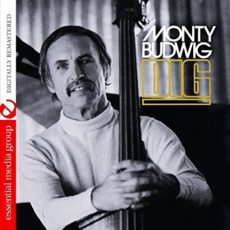
Monty Rex Budwig was born on December 26, 1926 in Pender, Nebraska and began playing bass while in high school. He continued after enlisting in the Air Force as a member of the military band.
In 1954 he moved to Los Angeles, California and went on to record and perform with Carmen McRae, Barney Kessel, Woody Herman, Red Norvo, Scott Hamilton, Toshiko Akiyoshi, Chet Baker, Bud Shank, Gary Burton, Frank Butler, Conte Candoli, Betty Carter, June Christy, Rosemary Clooney, Sonny Criss, Herb Ellis, Bill Evans, Stan Getz, Stan Kenton, Junior Mance, Charles McPherson, Art Pepper, Shorty Rogers, Bola Sete and Sarah Vaughan, to name a few.
Monty spent a decade with Shelly Manne from 1957 to 1967 and recorded fifteen albums with him, including the live Blackhawk sessions. He is most notably known for his playing and recording with the Vince Guaraldi Trio tour in the1960’s along with drummer Don Joham, and on the seminal work Jazz Impressions of Black Orpheus that contained the classic version of Cast Your Fate To The Wind. However, controversy surrounds whether it was bassist Fred Marshall or Budwig heard on the Charlie Brown Christmas Album.
His only release as a leader during his career is the recording Dig on the Concord label. Double bassist Monty Budwig, who mainly performed in the West Coast jazz genre, passed away on March 9, 1992 at the age of 65.
Sponsored By

More Posts: bass
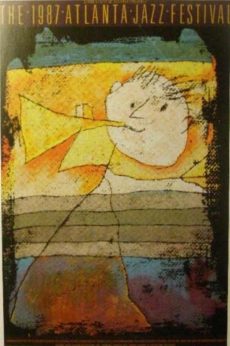
Atlanta Jazz Festival… 1987
More Posts: festival,forty,free,history,jazz,music,tradition,years

Daily Dose Of Jazz…
Charles “Don” Alias was born on December 25, 1939 in Harlem, New York City, the son of Caribbean immigrants. Absorbing the lessons of neighborhood Cuban and Puerto Rican hand drummers, while in high school he played conga with the Eartha Kitt Dance Foundation, and in 1957 accompanied the singer at the Newport Jazz Festival.
Mothballing his musical career to study biology at Erie, Pennsylvania’s Cannon College, he followed those studies with a stint at Boston’s Carnegie Institute for Biochemistry. While there Alias regularly moonlighted at local clubs in the company of students of the nearby Berklee School of Music, among them conguero Bill Fitch and bassist Gene Perla, and played bass in a short-lived trio featuring Chick Corea on guitar and Tony Williams on drums.
When Perla landed a gig with Nina Simone, he convinced the singer to hire Alias to assume drumming duties. By the end of his three-year residency he was serving as musical director, and eventually captured the attention of Miles Davis, with whom Simone regularly shared festival bills. He would go on to record four albums with Miles Davis including sitting in to play the drums on the recording of Miles Runs the Voodoo Down on the album Bitches Brew in 1969, when neither Lenny White nor Jack DeJohnette were able to play the marching band-inspired rhythm.
Settling back in New York City in the late Seventies he along with Gene Perla formed the Afro-Cuban fusion group Stone Alliance, which would be resurrected in 1980 with pianist Kenny Kirkland and tenor saxophonist Bob Mintzer. Performing on hundreds of recording sessions, he can be heard playing with Carla Bley, Uri Caine, Jack DeJohnette, Roberta Flack, Joe Farrell, Dan Fogelberg, Bill Frisell, Hal Galper, Kenny Garrett, Herbie Hancock, Elvin Jones, Joe Lovano, David Sanborn, Philip Bailey, Joni Mitchell, Jaco Pastorius, Carlos Santana, John McLaughlin, Lalo Schifrin, Nina Simone, Steve Swallow, the Brecker Brothers, James Taylor, Weather Report, Lou Reed, Blood Sweat & Tears, Pat Metheny, Don Grolnick Group and Jaco Pastorius, on the short list.
Percussionist Don Alias, best known for playing congas and other hand drums, but was also a capable drum kit performer, passed away suddenly in his Manhattan home on March 29, 2006 in New York City.
Give The Gift Of Knowledge
More Posts: drums,percussion