

Daily Dose Of Jazz…
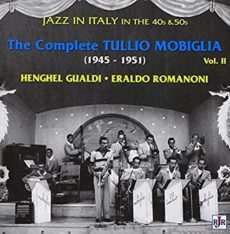
Tullio Mobiglia was born in Carezzano, Italy on April 12, 1911. In the early 1930s, after his studies at the conservatory in Genova and his first local engagements, he made several trips to the United States as a member of an on-board ship’s orchestra. Once in America, he made the acquaintance of the leading tenor saxophonists, including Coleman Hawkins.
In 1940 he visited Berlin, Germany as a member of the Italian Orchestra Mirador and in 1941 Tullio was with the Heinz Wehner Orchestra, and from April to November, he formed his own sextet played in the Patria Bar and was also in the Komiker Cafe’s musical revue Dreams About Me.
In the early Forties, Mobiglia’s orchestra played in the Rosita Bar and he also did some Film and Recordings during this period. Kramer combined musicians from two different generations to form his orchestra utilizing trumpeter Alfredo Marzaroli and saxophonist and clarinetist Francesco Paolo Ricci from the Twenties along with the younger members, Tullio Mobiglia, Eraldo Romanoni, Carlo Pecori, and the Triestino Angelo Bartole that performed during the Second World War II in Berlin.
After the war, he operated mainly in Italy, but also performed in Dortmund and Frankfurt Germany. From 1967 into the ’80s, he was active as a violin teacher at the Sibelius Conservatory in Helsinki, Finland.
Tullio directed a band without interruption in Berlin between 1941 and 1943, along with the Kramer’s Orchestra during the second half of the Thirties, the only stable group in the history of Italian Jazz between the years 1935 and ’43. He enlisted the brilliant and inventive guitarist Alfio Grasso to take part in the recordings.
Tenor saxophonist, violinist and bandleader Tullio Mobiglia passed away on July 24, 1991, aged 80, in Helsinki, Finland.

More Posts: bandleader,history,instrumental,jazz,music,saxophone,violin

Daily Dose Of Jazz…
Ian Armit was born on April 11, 1929 in Fife, Scotland. He played in Sandy Brown’s band in 1957, and that same year he released the solo EP Jazz Club Piano on Decca Records. The late 1950s saw him as part of the band by Humphrey Lyttelton and was part of the recording sessions by Al Fairweather, Cy Laurie, and Wally Fawkes.
In the 1960s Armit worked in the British blues scene with Alexis Korners Blues Incorporated, with Rod Stewart and toured the United States with the singer Long John Baldry in 1971. As a session musician, he worked with Sandy Denny, Bob Wallis, and went on a European tour.
Moving to Switzerland, he led his own quartet, recorded his Ian’s Boogie Woogie with the Old Rivertown Jazz Band and performed with Piccadilly Six, the Harlem Rambler and other local blues bands. Pianist Ian Armit, who recorded five albums as a leader from 1954 to 1976, passed away on February 18, 1992, in Zurich, Switzerland.
More Posts: bandleader,history,instrumental,jazz,music,piano
Daily Dose Of Jazz…
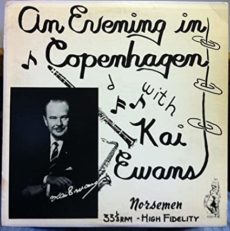
Kai Ewans was born Kai Peter Anthon Nielsen on April 10, 1906 in Hørsholm, Denmark. He initially played the banjo but switched to saxophone in 1923 when he formed the Blues Jazz Band. Disbanded in 1924, he joined Valdemar Eiberg’s ensemble from 1924–26.
Adopting the name Kai Ewans in 1927, he led Denmark’s first big band in 1927–28 and then led bands in Belgium and Germany through 1931. Following this, he played with Bernard Etté, Kai Julian, and Eric Tuxen through the mid-thirties.
He founded a new big band including mostly musicians from Tuxen’s ensemble in 1936, performed with Adelaide Hall, and recorded copiously with Benny Carter in the 1940s until the ensemble dissolved in 1947. Kai then emigrated to the United States, working in business before moving to California in 1956. From 1960 to 1964 he ran a restaurant with Carter in Beverly Hills. He later in the decade returned to Copenhagen to play again.
Retiring late in life to Connecticut, saxophonist Kai Ewans passed away on April 3, 1988.
More Posts: bandleader,history,instrumental,jazz,music,saxophone
Daily Dose Of Jazz…
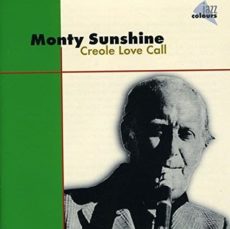
Monty Sunshine was born on April 9, 1928 in Stepney, London, England. Along with Lonnie Donegan, Jim Bray, and Ron Bowden, formed the backline of what was the embryo Chris Barber Band. A few personnel changes between 1953 and ‘54 with the departure of Ken Colyer whose name headed the band for a time until they adopted Baber’s name permanently.
The band quickly gained an international reputation following their inaugural tour of Denmark, before their professional debut in the United Kingdom. Sunshine stayed with the band for several years, until leaving in 1960 and forming his own band, staying true to the original six-man lineup.
In January 1963, the British music magazine NME reported that the biggest trad jazz event to be staged in Britain had taken place at Alexandra Palace. The event included Sunshine, George Melly, Diz Disley, Acker Bilk, Chris Barber, Kenny Ball, Ken Colyer, Alex Welsh, Bob Wallis, Bruce Turner, and Mick Mulligan.
Sunshine returned to play a reunion concert with the original Chris Barber Band at the Fairfield Halls, Croydon in June 1975. This was well-received, and the band reformed once again for an international reunion tour in 1994. Sunshine retired from music around 2001. His discography is extensive, and compact discs have been issued of recordings with Colyer and Barber, as well as with his own band. He has also worked with Beryl Bryden, Johnny Parker, the Crane River Jazz Band, and Donegan’s Dancing Sunshine Band.
Clarinetist Monty Sunshine, who is known for his clarinet solo on the track Petite Fleur, a million-seller for the Chris Barber Jazz Band in 1959, passed away on November 30, 2010, at the age of 82.
More Posts: bandleader,clarinet,history,instrumental,jazz,music
Daily Dose Of Jazz…
Phillip Robert Lee was born on April 8, 1943 in London, England and studied guitar with Ike Isaacs as a teenager. He was a member of the National Youth Jazz Orchestra, including their performance in the 1960 Antibes Jazz Festival. By the 1960s he was playing with John Williams and Graham Collier, was resident at Ronnie Scott’s Old Place, and in a band that included Bob Stuckey, Dudu Pukwana, and John Marshall.
During the 1970s, he played in jazz-rock bands such as Gilgamesh and Axel with Tony Coe and with Michael Garrick, Henry Lowther, and John Stevens. He recorded Twice Upon a Time in 1987 with Jeff Clyne.
Later in his career, he worked with Gordon Beck, Andres Boiarsky, Benny Goodman, Lena Horne, Marian Montgomery, Annie Ross, Dardanelle, Harry Edison, Ken Peplowski, Eddie Daniels, Jimmy Smith and the London Jazz Orchestra.
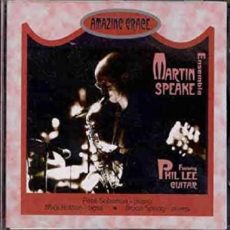
Phil Lee began playing jazz in the 1960s and. Since then he has recorded and appeared live with a vast range of musicians. including Pat Smythe, Duncan Lamont, Norma Winstone, Michael Garrick, Jimmy Hastings and Martin Speake. Phil has toured with Charles Aznavour, Michel Legrand, Gordon Beck and recently Jessye Norman.
In the 1970s he was a member of the fusion band Gilgamesh. His musicianship is held in high regard not only by fellow jazz players but also by musicians in other genres. His film credits include brief appearances in Eyes Wide Shut and Alan Plater’s TV film Misterioso and his playing featured in The Last of the Blonde Bombshells. Guitarist Phil Lee continues to perform, record and tour.
More Posts: guitar,history,instrumental,jazz,music