

Daily Dose Of Jazz…
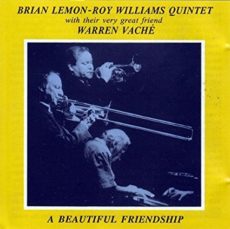
Roy Williams was born on March 7, 1937 in Bolton, Lancashire, England and began his career as a trombonist during the British trad jazz movement of the 1950s. He played with trumpeter Mike Peters and clarinetist Terry Lightfoot in the early Sixties, then joined trumpeter Alex Welsh’s Dixieland outfit in 1965, replacing Roy Crimmins. While with Welsh, he played with visiting American jazz players as Wild Bill Davison, Bud Freeman, and Ruby Braff.
Williams left Welsh in 1978 and joined Humphrey Lyttlelton’s band, staying with the latter for four years. In the ’80s he began working freelance and soon became a first call trombone playing with clarinetist Peanuts Hucko, tenor saxophonist Scott Hamilton, trumpeter Bent Persson and clarinetist John Barnes. He performed with The World’s Greatest Jazz Band.
Among Roy’s recordings are Gruesome Twosome on the Black Lion label, and Interplay for Sine Records, both with Barnes. In 1998 he co-led a swing-oriented quintet date with saxophonist Danny Moss titled Steamers! on the Nagel-Heyer label. Though not as active as he was up through the Nineties, trombonist Roy Williams won numerous jazz polls, toured Europe and the United States and remains a popular presence when he’s on the British mainstream jazz scene.


#preserving genius
More Posts: trombone
Daily Dose Of Jazz…
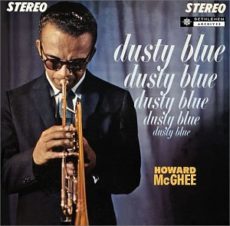
Howard McGhee was born on March 6, 1918 in Detroit, Michigan and originally played clarinet and tenor saxophone before taking up trumpet when he was 17. By 1941 he was playing in the territory bands led by Lionel Hampton, Andy Kirk being featured on McGhee Special, then with Count Basie and landing with Charlie Barnet from 1942-43. Participating in the fabled bop sessions at Minton’s Playhouse and Monroe’s Uptown House, he modernized his style away from Roy Eldridge, moving towards Dizzy Gillespie. However, it was in a club listening to the radio when he first heard Charlie Parker and became one of the early adopters of the new style, to the disapproval by older musicians like Kid Ory.
In 1946 a new label, Dial Records, organized some record sessions in Hollywood with Charlie Parker and the Howard McGhee combo. Joining these two were pianist Jimmy Bunn, bassist Bob Kesterson and Roy Porter on drums. He continued to work as a sideman for Parker playing on titles like Relaxin’ at Camarillo, Cheers, Carvin the Bird and Stupendous. Racial prejudice cut his California stay short when it became particularly vicious towards McGhee as half of a mixed-race couple.
Back in New York Howard he recorded for Savoy Records and had a historic meeting on record with Fats Navarro in 1948 on the Blue Note label. For much of the Fifties drug problems sidelined Howard but he resurfaced in the 1960s, appearing in many George Wein productions. His career sputtered again in the mid-1960s and he did not record again until 1976. He led one of three big jazz bands trying to find success in New York in the late 1960s. While the band did not survive, a recording was released in the mid-1970s.
He taught music through the 1970s, both in classrooms and at his Manhattan apartment. He was as much an accomplished composer and arranger as he was a performer. He recorded fifteen albums as a leader and held down sessions as a sideman with Dexter Gordon, Johnny Hartman, James Moody, Don Patterson, Joe Williams. Over the course of his career he would record for Felsted, Bethlehem, Contemporary, Hep, Black Lion, Sonet, SteepleChase, Jazzcraft, Zim, and Storyville record labels. Trumpeter Howard McGhee, known for his fast fingers and very high notes, passed away on July 17, 1987.
Sponsored By

Voices From The Community
#preserving genius
More Posts: trumpet

Daily Dose Of Jazz…
Dave Green was born on March 5, 1942 in Edgware, London, England. His first public performances were with his childhood friend Charlie Watts in the late 1950s while in their teens. He went on to perform with Humphrey Lyttelton from 1963 to 1983, while also playing with the Don Rendell–Ian Carr band in the early 1960s, and went on to play with Stan Tracey.
After his departure from Lyttelton in the early Eighties, he led his own group, Fingers, featuring Lol Coxhill, Bruce Turner and Michael Garrick. He regularly backed visiting musicians from the United States at Ronnie Scott’s, including Coleman Hawkins, Ben Webster, Roland Kirk and Sonny Rollins.
He performed and recorded with Dave Newton, Didier Lockwood and Spike Robinson. In 1991, he was a founding member of Charlie Watts’s quintet, together with Gerard Presencer, Peter King and Brian Lemon. Since 1998, he has led a trio featuring Iain Dixon and Gene Calderazzo, and became a member of The ABC&D of Boogie Woogie, with Ben Waters, Axel Zwingenberger and Charlie Watts, performing at the Lincoln Center with Bob Seeley and Lila Ammons.
Continuing to perform and record, bassist Dave Green has released for albums as a leader and working with Ruby Braff, Tony Coe, Captain John Handy, Ben Webster, Buddy Tate, Peter King, Spike Robinson, Stan Tracey, Ken Peplowski, Acker Bilk, Scott Hamilton, Bob Wilber, Roy Williams, Brian Lemon, John Critchinson, Dave Cliff, Joe Temperley, Lol Coxhill, John Bunch, Dick Morrissey and the Michael Garrick Trio has released twenty-four albums as a sideman.
Sponsored By

www.whatissuitetabu.com
#preserving genius
More Posts: bass
Daily Dose Of Jazz…
Jan Garbarek was born March 4, 1947 in Mysen, Norway and grew up in Oslo, the only child of a former Polish prisoner of war and a Norwegian farmer’s daughter. He began his recording career in the late 1960s featured on recordings by jazz composer George Russell. Initially influenced by Albert Ayler and Peter Brötzmann, by 1973 he left avant-garde jazz, and gained wider recognition working with pianist Keith Jarrett’s European Quartet, recording on six Jarrett albums between 1974 and 1979.
As a composer, he draws from Scandinavian folk melodies and his Ayler influence, as well as being a pioneer of ambient jazz composition, exhibited on his Dis album with guitarist Ralph Towner. Jan has ventured into new-age music, set a collection of Olav H. Hauge poems to music, solo saxophone complemented a full mixed choir and incorporated synthesizers and elements of world music.
Garbarek has recorded more than two-dozen albums as a leader and another 45 to date as a sideman with Karin Krog, Terje Rypdal, George Russell, Art Lande, Ralph Towner, Bill Connors, David Darling, Keith Jarrett, Egberto Gismonti, Charlie Haden, Zakir Hussain, Trilok Gurtu, Manu Katché, Eleni Karaindrou, Kim Kashkashian, Marilyn Mazur, Gary Peacock, L. Shankar, Paul Giger, Giya Kancheli, Miroslav Vitous, Eberhard Weber and Kenny Wheeler
His album Officium, a collaboration with early music vocal performers the Hilliard Ensemble, became one of ECM’s biggest-selling albums of all time. Saxophonist Jan Garbarek, who received a Grammy nomination in 2005 for his album In Praise of Dreams, He is also active in classical and world music and continues to perform, record and tour.
Sponsored By

#preserving genius
More Posts: saxophone
Daily Dose Of Jazz…
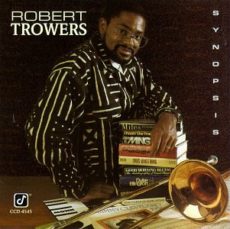
Robert Trowers was born on March 3, 1957 in Brooklyn, New York into a family of musicians that fostered a love for music at an early age. After the mandatory piano lessons during early childhood, he developed an interest in the trombone from listening to the music of the Swing Era. Among the bands that sparked his interest in jazz were those of Count Basie, Duke Ellington, Glenn Miller, and Artie Shaw. The trombonists that influenced Robert were Laurence Brown, “Tricky Sam” Nanton, Tyree Glenn, Tommy Dorsey, Glenn Miller and Jack Teagarden, J.J. Johnson, Jimmy Cleveland, Curtis Fuller, and Frank Rosolino.
During his college years Trowers played around New York City with Jaki Byard’s Apollo Stompers, Ray Abrams/Hank Doughty Big Band, Charles Byrd, Ray Draper, Cecil Payne, Harold Cumberbatch, Bill Hardman, Junior Cook, and Mario Escalera. His first European tour and Carnegie Hall date were with Abdullah Ibrahim’s band Ujammah in 1979.
In 1982, he joined Lionel Hampton for three and a half years, then a year freelancing in New York and teaching in the Public School system, before another European tour with Illinois Jacquet. Upon returning he joined the Count Basie Orchestra, under the direction of Frank Foster, playing the trombone in this band for the next eight years, leaving in 1995 to pursue other opportunities. The years with those stellar bands put him onstage with some of the greatest names in jazz, including Sarah Vaughan, Dizzy Gillespie, Billy Eckstine, Nancy Wilson, Cab Calloway, Jay McShann, Sonny Stitt, Benny Carter, Al Grey, Frank Sinatra, Joe Williams, Tony Bennett, Randy Weston, George Gee and many others.
He went on to record two albums as a leader, Synopsis and Point of View in the Eighties, toured with Lincoln Center Jazz Orchestra led by Wynton Marsalis, and later became a member of the Carnegie Hall Jazz Band under Jon Faddis. Robert worked a short tour with T.S. Monk, did a European tour with a traveling theatre production of the Broadway show Black and Blue, and gained membership into the Vanguard Jazz Orchestra.
Along with Derrick Gardner and Frank Foster, he started a nonprofit arts organization named Progressive Artistry that promoted jazz in all its various forms in concerts and lecture/demonstrations in inner city neighborhoods until 2004. Most recently, trombonist Robert Trowers has been on the faculty of North Carolina Central University.
Sponsored By

#preserving genius
More Posts: trombone