

Daily Dose Of Jazz…
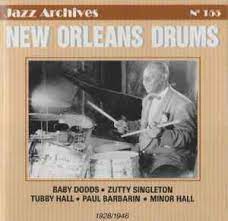
Alfred “Tubby” Hall was born October 12, 1895 in Sellers, Louisiana and his family moved to New Orleans, Louisiana in his childhood. His younger brother Minor “Ram” Hall also became a professional drummer. He played in many marching bands in New Orleans, including with Buddie Petit. His drumming style was forceful and sober, generally maintaining constant tempo on the snare.
By 1917 Hall had moved to Chicago, Illinois where he played with Sugar Johnny Smith. After two years in the United States Army, he returned to playing in Chicago mostly with New Orleans bands, joining Carroll Dickerson’s Orchestra and recording in 1927. He later played with the groups of King Oliver, Jimmie Noone, Tiny Parham, and Johnny Dodds.
He is seen in Armstrong’s Paramount movies of the early 1930s, including the live action and Betty Boop cartoon I’ll Be Glad When You’re Dead, You Rascal You and A Rhapsody in Black and Blue in 1932. Only Armstrong and Hall got closeups in the two films, and both get their faces transposed with those of racially stereotyped jungle natives in the cartoon. Hall morphs from a jazz drummer to a cannibal stirring a cooking pot with two wooden sticks.
Drummer Tubby Hall, considered one of the three greatest jazz drummers of his generation by jazz critic Hugues Panassié, along with Zutty Singleton and Baby Dodds, transitioned in Chicago, Illinois on May 13, 1945.

More Posts: drums,history,instrumental,jazz,music
Daily Dose Of Jazz…
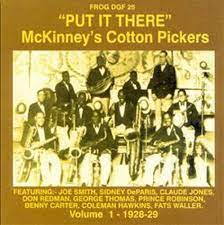
Bill McKinney was born William McKinney on September 17, 1895 in Cynthiana, Kentucky. Early in his career he worked as a drummer in a circus band until he was inducted into the Army in World War I. After service, he settled in Springfield, Ohio where he took over leadership of the Synco Jazz Band.
After hiring drummer Cuba Austin, McKinney worked as leader and business manager. After touring the U.S. Midwest, they got a residency at the Arcadia Ballroom in Detroit, Michigan in 1926. While there, they were heard by bandleader and music promoter Jean Goldkette, who arranged a more lucrative home base for the band in Detroit’s Graystone Ballroom. The band was renamed McKinney’s Cotton Pickers.
During the Great Depression the band broke up in 1934 and Bill led and played with a dance band in Boston, Massachusetts for a time. From 1937 on McKinney managed a Detroit Cafe with a dance floor and live bands who McKinney booked, while booking bands for other locations on the side.
Drummer Bill McKinney retired in the 1950s and spent his last years in his childhood hometown of Cynthiana, where he transitioned on October 14, 1969 at 74.

More Posts: bandleader,drums,history,instrumental,jazz,manager,music
Daily Dose Of Jazz…
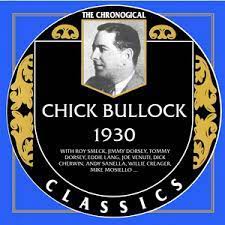
Charles Bullock, known in the industry as Chick, was born on September 16, 1898 in Montana to immigrants from England.. He belonged to a select group of mostly freelance vocalists who sang the vocal refrains on hundreds of New York sessions, which included Smith Ballew, Scrappy Lambert, Irving Kaufman, Arthur Fields, and Dick Robertson. Some of these vocalists were also musicians leading bands, but their singing was more often featured.
Though he began his career in vaudeville and sang in movie palaces, he rarely performed live because his face was disfigured due to an eye disease. His career as a studio musician took off in the late 1920s, and in the 1930s he sang with musicians such as Duke Ellington, Luis Russell, Cab Calloway, Bunny Berigan, Bill Coleman, Jack Teagarden, Tommy Dorsey, Jimmy Dorsey, Joe Venuti, and Eddie Lang.
Bullock’s recordings proved so popular that he used pseudonyms for some recordings, including the name Sleepy Hall. However, in the 1940s the World War II recording ban essentially ended Bullock’s career and he quit the music business in 1942. He moved to California in 1946 and took up real estate, opening his own company.
Chick was mostly associated with the ARC group of labels including Melotone, Perfect, Banner, Oriole, and Romeo. Many of his records were issued under the name Chick Bullock and his Levee Loungers.
Jazz and dance band vocalist Chick Bullock, who recorded some 500 tunes over the course of his career, transitioned on September 15, 1981, in California at the age of 82.
More Posts: bandleader,history,instrumental,jazz,music,vocal
Daily Dose Of Jazz…
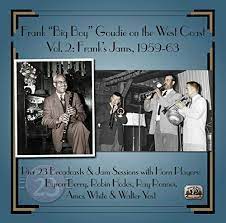
Frank “Big Boy” Goudie was born on September 13, 1899 in Youngsville, Louisiana, 150 miles west of New Orleans, Louisiana in the area of the state known as Cajun country, where he lived until the age of eight. His family then moved to New Orleans, where he began playing cornet, and became proficient enough to find work with local bands such as Papa Celestin’s Original Tuxedo Band and the Magnolia Band, two of the top New Orleans bands at that time. He began studying clarinet and tenor saxophone, which would eventually become his primary instruments.
Arriving in New Orleans around 1907 meant Frank had a front-row seat to the blossoming of early jazz with King Oliver, Kid Ory, Johnny Dodds, Freddie Keppard, Jimmie Noone and a host of others, were in their prime and working at many venues throughout the city.
With the 1918 closure of Storyville and the early 1920s, New Orleans experienced a diaspora of musicians, one of whom was Goudie. In 1921 he joined a band accompanying a traveling minstrel show, and for the next four years he performed in Louisiana, Texas, New Mexico and California. He joined another traveling group, Frank Matthews and the Louisiana High Browns, ending up in Tampico, Mexico in 1925.
That same year he sailed to France, making Paris his home base for the next 14 years. Work was plentiful for expat Black musicians in Paris prior to World War II. He would go on to work with bands led by Benny Peyton, Louis Mitchell, Sam Wooding, Noble Sissle, Freddy Johnson, Bill Coleman, and Willie Lewis during the Thirties. He worked at “Bricktop’s,” owned and operated by Ada “Bricktop” Smith, who was a supporter of American jazz musicians. Frank played often and recorded with Django Reinhardt.
While living in Europe, Goudie carried a wicker suitcase full of upholstery tools with which to augment his income – a trade he learned as a young man in New Orleans. He left Paris in late 1939, moving to South America, where he worked in Brazil and Argentina with guitarist Oscar Aleman, and fronted his own groups.
In 1946, Frank moved back to Paris, playing there with Arthur Briggs, Harry Cooper, and Bill Coleman. In 1951, he moved to Berlin, led his own band and recorded there in 1952 and 1953 and in Yugoslavia in 1955.
Returning to the States in 1957 to run his uncle’s business in San Francisco, California, his presence became known to the close-knit Bay Area jazz community. It didn’t take long before he again was in demand and playing with trumpeter Marty Marsala, pianists Earl Hines, Bill Erickson and Burt Bales, trombonist Bob Mielke and other local groups.
Trumpeter, alto and tenor saxophonist and clarinetist Frank Goudie, who as a young man, his great height earned him the nickname “Tree,” and he became known as “Big Boy” during his years in Paris, transitioned from cancer at age 64, in San Francisco on January 9, 1964.
More Posts: bandleader,clarinet,history,instrumental,jazz,music,saxophone,trumpet

Daily Dose Of Jazz…
Elmer Schoebel was born in East St. Louis, Illinois on September 8, 1896. Early in his career he played along to silent films in Champaign, Illinois. After moving on to vaudeville late in the 1910s, he played with the 20th Century Jazz Band in Chicago, Illinois in 1920.
1922-23 saw him as a member of the New Orleans Rhythm Kings, then led his own band, known variously as the Midway Gardens Orchestra, the Original Memphis Melody Boys and the Chicago Blues Dance Orchestra, before joining Isham Jones in 1925. After returning to Chicago, Elmer played with Louis Panico and Art Kassel, and arranged for the Melrose Publishing House.
By the 1930s, Schoebel was writing and arranging, working as the chief arranger for the Warner Brothers publishing division. From the 1940s onward he did some performing with Conrad Janis, Blue Steele’s Rhythm Rebels (1958), and with his own ensembles in St. Petersburg, Florida. He continued to play up until his death.
Schoebel wrote a number of standards, including Bugle Call Rag, Stomp Off- Let’s Go, Nobody’s Sweetheart Now, Farewell Blues, and Prince of Wails. While a member of the New Orleans Rhythm Kings he wrote I Never Knew What A Girl Could Do, Oriental, and Discontented Blues.
Pianist, composer and arranger Elmer Schoebel, who as a leader only recorded one of his own compositions in 1929 titled Prince of Wails, transitioned on December 14, 1970.
More Posts: arranger,bandleader,composer,history,instrumental,jazz,music,piano