

Daily Dose Of Jazz…
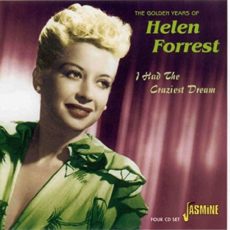
Helen Forrest was born Helen Fogel in Atlantic City, New Jersey on April 12, 1917. Raised in a single parent household with three older brothers, the family relocated to Brooklyn while she was in her teens. Her mother remarried and with the new husband turned the family home into a brothel, which nearly saw her raped by her stepfather. This resulted in her living with her piano teacher who recognized her singing potential. Soon she dropped out of high school and pursued a singing career.
Returning to Atlantic City she began singing with her brother Ed’s band, soon after returning to New York City. By the age of 17 she was singing for WNEW and WCBS where she was known as Bonnie Blue and The Blue Lady of Song. Eventually she found a two year gig singing at the Madrillon Club, in Washington, D.C. This led to her joining Artie Shaw in 1938 and shared vocal duties with Billie Holiday. Two of Helen’s biggest hits with Shaw were They Say and All the Things You Are. With Shaw she became a national favorite until the band broke up in 1939
Forrest then joined Benny Goodman in December 1939 and recorded, among other hit songs The Man I Love, just one of 55 studio recordings with Goodman. But being a difficult man to work with in August 1941, she quit the orchestra to avoid having a nervous breakdown. Her departure led her to briefly recorded with Nat King Cole and Lionel Hampton.
In 1941, she approached Harry James, auditioned and was voted in by the band. It was with this band that she got the opportunity to sing verses as opposed to choruses in the middle of an instrumental. Her most popular numbers, 1941’s I Don’t Want to Walk Without You and I Had the Craziest Dream in 1942, preceded her appearance with the James Band in the Hollywood film Springtime in the Rockies, starring Betty Grable. In 1942 and 1943, Helen Forrest was voted the best female vocalist in the United States in the Down Beat poll.
Forrest left Harry James in late 1943 and embarked on a solo career, signed a recording contract with Decca and co-starred with Dick Haymes on a CBS radio show from 1944 to 1947. She recorded with Haymes and 10 songs reached the Top Ten including Long Ago and Far Away, It Had To Be You and I’m Always Chasing Rainbows. By the end of the Forties she was headlining theaters and clubs.
The Fifties saw Helen rejoining Harry james and recording a new swing album titled Harry James in Hi-Fi, which became a bestseller. By the end of the 1950s, her solo career waned as rock’n’roll became increasingly popular. She would go on to have a stint with the startup Bell Records, sang with Tommy Dorsey’s orchestra, in the early 1960s and continue to make occasional records and perform in concerts. By the 1970s and 1980s, she was performing in supper clubs on big band nostalgia tours, doing a television reunion of herself, James, and Haymes on The Merv Griffin Show.
In 1980 she suffered a stroke, but recovered to resume performing and recording. She wrote an autobiography, I Had the Craziest Dream, and in 1983, Helen released her final album, entitled Now and Forever. She continued singing until the early 1990s when rheumatoid arthritis began to affect her vocal chords and forced her into retirement. Swing vocalist Helen Forrest, who sang with three of the most popular bands of the era and earned the reputation as the voice of the name bands, passed away on July 11, 1999, from congestive heart failure in Los Angeles, California at the age of 82.
Sponsored By


#preserving genius
More Posts: vocal
Daily Dose OF Jazz…
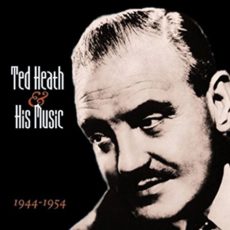
George Edward “Ted” Heath was born March 30, 1902 in Wandsworth, England. After playing tenor saxophone at the age of six, encouraged by his father and leader of the Wandsworth Town Brass Band, he later switched to trombone.
Earning a living for his family in the post-war years Ted formed a band along with his brother Harold and three other musicians, played to commuters outside London Bridge Station and outside the Queen’s Hall Gardens venue. It was here that he was spotted and asked to play with the Jack Hylton Band who had a residence there. Though not having the experience required he did not last long, his professional career began and he went on to pursue a career as a professional musician.
His first real band gig was in the 1920s touring Europe with the American band called the Southern Syncopation Orchestra, followed by the Metro-Gnomes, a small band fronted by Ennis Parkes, then again joined Hylton’s theatre band. Heath played with the Kit Cat Club band led by American Al Starita, and heard Bunny Berrigan, Tommy and Jimmy Dorsey, and Paul Whiteman when they toured Europe.
By 1928 he joined Bert Ambrose’s orchestra at London’s Mayfair Hotel and stayed until 1935 when he moved on to Sydney Lipton’s orchestra at the Grosvenor House. But it was Ambrose who taught Heath how to be a bandleader during a time that Heath became the most prominent trombone player in Britain, renowned for his perfect tone. He played on numerous recordings. During the late ’30s and early ’40s, he played as a sideman on several Benny Carter sessions.
In 1940, Heath joined Geraldo’s orchestra and played numerous concerts and broadcasts and became one of the “boys” in Geraldo’s vocal group, ‘Three Boys and a Girl’. His composition That Lovely Weekend with Dorothy Carless on vocal became an immediate wartime hit. The royalties from this song and another composition Gonna Love That Guy allowed Heath to form his own band.
On D-Day 1944, the Ted Heath & His Music band was officially formed and played on the BBC radio. He went on to provide music for film, performed dates with Lena Horne and Ella Fitzgerald, toured Scandinavia, were regular Poll Winners in the Melody Maker and the New Musical Express and performed twice for King George VI. He held Sunday Night Swing Sessions at the London Palladium from 1947 to 1955.
During the Fifties he toured the U.S. that contracted to play Nat King Cole, June Christy and the Four Freshmen and consisted of 43 concerts in 30 cities in 31 days climaxing in a Carnegie Hall. So successful was the tour that after so many encore calls at the Carnegie Hall performance that Nat King Cole had to come out on stage and ask people to leave. Ted would later successfully tour the US again and also toured Australia and Europe.
In addition to Cole, Heath established close personal and professional relationships with Woody Herman, Count Basie, Marlene Dietrich, Johnny Mathis and Tony Bennett. He worked with Sarah Vaughan, Mel Torme, Donna Hightower and others. His band members included Ronnie Scott, Stan Tracey, Kenny Baker, Duncan Campbell, Don Rendell, Tommy Whittle, Don Lusher, Wally Smith, Jack Parnell, Ronnie Verrell, Johnny Hawksworth and singers Dickie Valentine, Lita Roza and Dennis Lotis. in the ’50s gave the band more teenage appeal.
He commissioned over 800 original scores and arrangements from Tadd Dameron, George Shearing, Reg Owen, John Keating, Kenny Graham, Ken Moule, Robert Farnon, Woolf Phillips, Ron Roullier, Bill Russo, Johnny Douglas, Ron Goodwin and Ralph Dollimore.
Trombonist, composer and bandleader Ted Heath, who led the greatest post-war big band and recording over 100 albums, passed away on November 18, 1969 at the age of 67.
Sponsored By

#preserving genius
More Posts: trombone
Daily Dose Of Jazz…
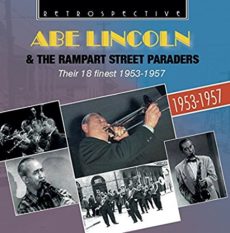
Abram Lincoln was born March 29, 1907 in Lancaster, Pennsylvania, one of six brothers, and began playing trombone at age five, instructed by his cornet playing father John. His older brother Bud, would also become a professional musician, as would brothers Roy and Chet.
He began working professionally in the early 1920s and 1930s spending time playing with Adrian Rollini’s California Ramblers, replacing Tommy Dorsey. Lincoln also performed with Arthur Lange, Ace Brigode, Roger Wolfe Kahn, Paul Whiteman, and Ozzie Nelson.
As a studio musician, Abe most prominently performed occasional solos and dixieland-stylings during the musical portions on the Old Time Radio show on NBC. In the 1930s and into the 1940s he work primarily in Los Angeles, California studios as a sideman. He played on Fibber McGee and Molly from the mid-40s until 1953 with the Billy Mills Orchestra.
During the Dixieland revival of the 1950s Abe’s career saw a resurgence, playing with Wingy Manone, the Rampart Street Paraders, Red Nichols, Bob Scobey, Pete Fountain, Jack Teagarden, and Matty Matlock.
Lincoln played his trombone for music and sound effects for Walter Lantz Woody Woodpecker cartoons and some Buster Keaton comedies. He recorded with Wild Bill Davison and did freelance work into the 1970s, though he went into semi-retirement by the 1980s. Trombonist Abe Lincoln, who played weddings and special occasions, passed on June 8, 2000 in Van Nuys, California.
Sponsored By
#preserving genius
More Posts: trombone
Daily Dose Of Jazz…
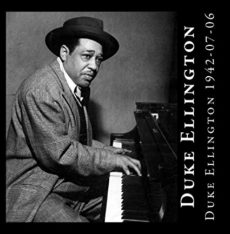
Junior Raglin was born Alvin Raglin on March 16, 1917 in Omaha, Nebraska. He started out on guitar but had picked up bass by the mid-1930s. He played with Eugene Coy from 1938 to 1941 in Oregon, and then joined Duke Ellington’s Orchestra, when Ellington returned to using two basses, then replaced Jimmy Blanton after his departure from the orchestra. He remained with Duke from 1941 to 1945.
After leaving Ellington, Raglin led his own quartet, and also played with Dave Rivera, Ella Fitzgerald, and Al Hibbler. He returned to play with Ellington again briefly in 1946 and 1955. Falling ill in the late 1940s, he quit performing;
Double-bassist Junior Raglin, who performed mainly during the swing era and never recorded as a leader, passed away on November 10, 1955 at age 38.
Sponsored By
#preserving genius
More Posts: bass
Daily Dose Of Jazz…
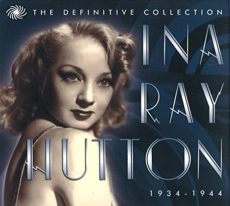
Ina Ray Hutton was born Odessa Cowan on March 13, 1916 in Chicago, Illinois. She began dancing and singing in stage revues at the age of eight and by the age of 13, Odessa was considered so advanced that she skipped eighth grade and went straight to high school at Hyde Park High School.
By the time she was 18 years old, Odessa became Ina Ray Hutton for the stage and was already a seasoned performer, having starred in Gus Edwards’ revue Future Stars Troupe at the Palace Theater, Lew Leslie’s Clowns in Clover. On Broadway she performed in George White’s revues: Melody, Never Had An Education, and “Scandals”, and then went onto The Ziegfeld Follies.
In 1934, she was approached by Irving Mills and vaudeville agent Alex Hyde to lead an all-girl orchestra, The Melodears, featuring trumpeters Frances Klein and Mardell “Owen” Winstead, pianist Ruth Lowe Sandler, saxophonist Jane Cullum, guitarist Marian Gange,and trombonist Alyse Wells during its existence. Hutton and her Melodears were one of the first all-girl bands to be filmed for Paramount shorts, including Accent on Girls and Swing Hutton Swing, as well as Hollywood feature films.
The group disbanded in 1939 and the following year she led an all-male orchestra that was featured in the 1944 film Ever Since Venus. This group disbanded in 1949. During the 1950s, she returned to the all-girl format for a variety television program, The Ina Ray Hutton Show, which ran from 1951 to 1956 on Paramount Television Network’s flagship station KTLA in Los Angeles, California.
Vocalist and bandleader Ina Ray Hutton retired from music in 1968 and passed away in Ventura, California on February 19, 1984 of complications from diabetes, at the age of 67.
Sponsored By

Voices From The Community
#preserving genius
More Posts: vocal