

Daily Dose Of Jazz…
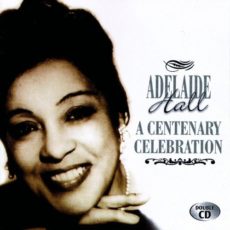
Adelaide Louise Hall was born on October 20. 1901 in Brooklyn, New York and began her stage career in 1921 on Broadway in the chorus line of the Noble Sissle and Eubie Blake hit musical Shuffle Along. She went onto appear in a number of similar black musical shows including Runnin’ Wild on Broadway in 1923, in which she sang James P. Johnson’s hit song Old-Fashioned Love.
In 1925, Hall toured Europe with the Chocolate Kiddies revue that included songs written by Duke Ellington, backed by the Sam Wooding Orchestra. The following year appeared in the short-lived Broadway musical My Magnolia after which she appeared in Tan Town Topics with songs written by Fats Waller and had a short road tour on the TOBA circuit. She then starred in Desires of 1927, with a score written by Andy Razaf and J. C. Johnson, that toured America for a year between 1926 and 1927.
In 1927 Adelaide recorded her wordless vocals on Creole Love Call, The Blues I Love To Sing and Chicago Stomp Down with Duke Ellington and his Orchestra. The recordings were worldwide hits and catapulted both careers into the mainstream. She and Duke Ellington went on to record I Must Have That Man and Baby. She starred on Broadway with Bill “Bojangles” Robinson, Tim Moore and Aida Ward in Blackbirds of 1928. The show became the most successful all-black show ever staged on Broadway at that time and made Hall and Bojangles into household names. It was this musical that not only secured her success at home and abroad in Europe when the production was taken in 1929 to Paris, France, where it ran for four months at the Moulin Rouge. In Europe she rivaled Josephine Baker for popularity on the European stage.
With Blackbirds′ music score written by Jimmy McHugh and lyrics by Dorothy Fields, Hall’s performances of the songs I Can’t Give You Anything but Love, Baby, Diga Diga Do, Bandanna Babies and I Must Have That Man made them into household hits, and they continued to be audience favourites throughout her long career. Through the 1930s she would perform on Broadway again with Bojangles in Brown Buddies, toured worldwide, discovered and hired blind pianist Art Tatum and recorded with him Strange as it Seems, I’ll Never Be The Same, This Time it’s Love and You Gave Me Everything but Love. She would continue to tour America, Canada and South America before turning to Europe once again and settling in Paris, France. Her husband, Bert Hicks, opened a nightclub for her called La Grosse Pomme where she entertained often. The Quintette du Hot Club de France featuring Django Reinhardt and Stephane Grappelli were one of the house bands at the club.
Leaving Paris for London, England in 1938, she lived out the rest of her days there, becoming one of the most popular singers of her time. Hall recorded I Can’t Give You Anything But Love and That Old Feeling at London’s Abbey Road Studios with Fats Waller. Throughout her career she made more than 70 records for Decca, had her own BBC Radio series Wrapped in Velvet, making her the first black artist to have a long-term contract with the BBC, became one of the highest paid entertainers in the United Kingdom and appeared on the stage, in films, and in nightclubs, of which she owned her own in New York, London and Paris.
Adelaide would go on to record with Humphrey Lyttleton, and perform alongside Lena Horne, Spike Milligan, John Betjeman, Ethel Waters, Josephine Baker, Louis Armstrong, Cab Calloway, Fela Sowande, Rudy Vallee, Jools Holland, Tony Bennett, Phyllis Hyman, Jacques Loussier, Alan Downey, Wayne Sleep, Ronnie Scott, Stan Tracey, the New Swingle Singers, Elisabeth Welch, Gregory Hines, Bobby Short, Honi Coles, Edith Wilson, Nell Carter, John W. Bubbles, Dizzy Gillespie, Herbie Hancock, Stephane Grappelli, Mel Torme, Zoot Sims, Carmen McRae and Chick Corea, among a list too vast to mention.
She pioneered scat singing along with Louis Armstrong and is widely acknowledged as one of the world’s first jazz singers, holds the accolade of being the 20th century’s most enduring female recording artist, her recording career having spanned eight decades, In the 100 Great Records of the 1920s she is at number 26 with Duke Ellington’s Orchestra, singing The Blues I Love To Sing, and her recording of the Dorothy Fields/Jimmy McHugh tune I Can’t give You Anything But Love represent 1928 in the American Society of Composers, Authors and Publishers (ASCAP) celebration of its centenary timeline of songs chosen to represent the past hundred years.
Singer, dancer, actress and nightclub chanteuse Adelaide Hall, who entered the Guinness Book of World Records in 2003 as the world’s most enduring recording artist having released material over eight consecutive decades, passed away on November 7, 1993, aged 92, at London’s Charing Cross Hospital.
Sponsored By


More Posts: vocal
Daily Dose Of Jazz…
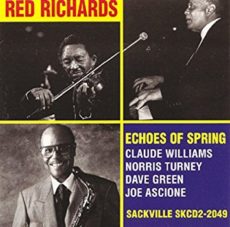
Red Richards was born Charles Coleridge Richards on October 19, 1912 in New York City. He began playing classical piano at age ten, and from the age of 16 concentrated on jazz after hearing Fats Waller. His first major professional gig was with Tab Smith at New York’s Savoy Ballroom from 1945 to 1949.
Following his stint with Smith, in the early Fifties Red played with Bob Wilber and Sidney Bechet. He toured Italy and France in 1953 with Mezz Mezzrow’s band alongside Buck Clayton and Big Chief Moore, and also accompanied Frank Sinatra during his time in Italy. He went on to work with Muggsy Spanier on and off from 1953 through the end of the decade, and then with Fletcher Henderson in 1957-58. During 1958 he did some time as a solo performer in Columbus, Ohio, then played with Wild Bill Davison in 1958-59 and again in 1962.
1960 saw Richards formed Saints & Sinners with Vic Dickenson, playing with this ensemble until 1970. He joined drummer Chuck Slate and his band in 1971 and stayed with him most of the year. He recorded an album with Chuck called Bix ‘N All That Jazz and following this he worked with Eddie Condon from 1975 to 1977. In 1977 he played with his own trio through the following year. He played and toured worldwide with Panama Francis’s group, the Savoy Sultans from 1979 through the 1980s and recorded with Bill Coleman in 1980.
Pianist Red Richards continued to tour almost up until the time of his death and passed away on March 12, 1998 in Scarsdale, New York.

Take A Dose On The Road
More Posts: piano
Daily Dose Of Jazz…
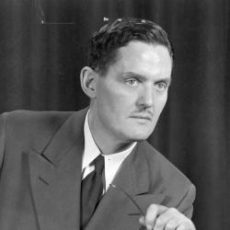
Marshall Winslow Stearns was born on October 18, 1908 in Cambridge, Massachusetts. He played drums in his teens, and attended Harvard University both for undergraduate and for law school. Following this he studied medieval English at Yale University, where he took his Ph.D. in 1942.
Stearns went on to teach English at several U.S. colleges and during this time wrote often about jazz music for magazines such as Variety, Saturday Review, Down Beat, Record Changer, Esquire, Harper’s, Life, and Musical America. Receiving a Guggenheim Fellowship in 1950, he used the proceeds to finish his 1956 work The Story of Jazz, which became a widely used text, as well as a popular introduction to jazz.
He began teaching jazz at New York University in 1950 and then at Hunter College from 1951. In 1952, Marshall founded the Institute of Jazz Studies, which he directed. He became a consultant in the 1950s to the United States State Department, and accompanied Dizzy Gillespie on a tour of the Middle East in 1956 sponsored by the office. He taught at the New School for Social Research from 1954 to 1956 and the School of Jazz in Lenox, Massachusetts.
Jazz critic and musicologist Marshall Stearns, who along with his second wife, Jean, wrote a second book, Jazz Dance, which was published posthumously in 1968, passed away on December 18, 1966 in Key West, Florida.
Sponsored By

More Posts: author,critic,musicologist
Daily Dose Of Jazz…
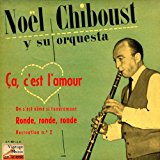
Noël Chiboust was born on October 14, 1909 in Thorigny-sur-Marne , Département Seine-et-Marne, France. He began his career as a violinist with Ray Ventura and during the early Thirties played trumpet in the Michel Warlop Orchestra. By 1936 he was involved in the concert series la semaine à Paris, by the Hot Club de France. At this time in his career he also joined the André Ekyan Orchestra until 1938, then played in the Swing Band of Philippe Brun followed by an early 1940s stint with Alix Combelle.
Around the mid 1930s he recorded with Django Reinhardt , Stéphane Grappelli , Bill Coleman and Coleman Hawkins, joined Eddie Brunner in 1938 at Cabaret Bagatelle. The late 1930s saw him giving up the trumpet and joining the tenor saxophone and clarinet sections when he joined the Marcel Bianchi Orchestra.
From 1940 he recorded under his own name for the French label Swing releasing a few 78s. Starting in 1944 he performed with an orchestral cast including Hubert Rostaing, and with Jack Diéval and Lucien Simoen at Club Schubert. From 1947 to 1950 he had an engagement at Cabaret le Drap d’Or.
He turned his attention to popular music as well as the rock and roll to and by 1959 released several EPs and singles for Polydor Records with songs like Telstar, Dynamite Charleston and Yes Sir That’s My Baby.
Trumpeter, tenor saxophonist, clarinetist, arranger, composer and band leader in the field the swing and popular music era Noël Chiboust passed away on January 17, 1994.

Miami
Daily Dose Of Jazz…
Jack Fallon was born on October 13, 1915 in London, Ontario, Canada and played violin before making double-bass his primary instrument at age 20. During World War II he played in a dance band in the Royal Canadian Air Force, and settled in Britain after his discharge. He joined Ted Heath’s band in 1946 and played bebop in London clubs in his spare time.
1947 saw Fallon playing with Ronnie Scott and Tommy Whittle at the Melody Maker/Columbia Jazz Rally, followed by his working with Jack Jackson, George Shearing and Django Reinhardt. Soon after playing with Reinhardt, he played in a Count Basie ensemble which also included Malcolm Mitchell and Tony Crombie, playing with both of them after leaving Basie. He went on to work together with Hoagy Carmichael and Maxine Sullivan and tour Sweden together with Reinhardt and Stéphane Grappelli.
In the 1950s he accompanied Mary Lou Williams, Sarah Vaughan, and Lena Horne. He was a sideman in the ensembles of Humphrey Lyttelton, Kenny Baker and Ralph Sharon, and was the house bassist at Lansdowne Studios. Working outside of jazz with blues musicians such as Big Bill Broonzy and Josh White, and played with Johnny Duncan’s Blue Grass Boys. As the bass guitar became more popular, Jack became a champion and played both instruments in the latter part of his career.
He became a booker/promoter establishing the booking agency Cana Variety in 1952. Cana booked primarily jazz artists in its early stages but expanded to rock acts by the 1960s, including The Beatles and The Rolling Stones and was requested by the Beatles to play violin on the song Don’t Pass Me By. Bassist Jack Fallon continued to play jazz locally in London, England and in the studios into the 1990s. He published a memoir titled From the Top in 2005, and passed away on May 22, 2006 at age 90 in London, England.
Uplift Someone’s World
#preserving genius
More Posts: bass