

Daily Dose Of Jazz…
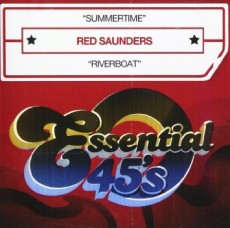
Red Saunders was born Theodore Dudley Saunders on March 2, 1912 in Memphis, Tennessee. Early in his career he played in Milwaukee, Wisconsin and Chicago, Illinois playing with Stomp King. For a time, he worked with Tiny Parham at the Savoy Ballroom in Chicago.
In 1937, the Club DeLisa gave Saunders control of the house band, where he remained almost uninterrupted until the club’s closure in 1958. Among his sidemen were Leon Washington, Porter Kilbert, Earl Washington, Sonny Cohn, Ike Perkins, Riley Hampton, singer Joe Williams and Mac Easton.
Among the arrangers he employed were Johnny Pate and Sun Ra. Despite his regular gig and disinclination to go on the road, Red played with Duke Ellington, Louis Armstrong and Woody Herman, and recorded with Big Joe Turner.
He continued to lead a band at Chicago’s Regal Theater into the Sixties, and played with Little Brother Montgomery and Art Hodes at the New Orleans Jazz Festival in the 1970s. Drummer and bandleader Red Saunders, who also played vibraphone and timpani, passed away on March 5, 1981 in Chicago.

Inspire A Young Mind
More Posts: drums
Daily Dose Of Jazz…
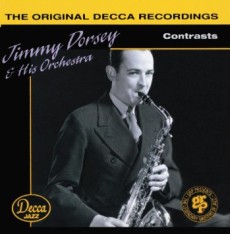
James Dorsey was born on February 29, 1904 in Shenandoah, Pennsylvania. Known as “JD”, he played trumpet in his youth and appeared on stage with J. Carson McGee’s King Trumpeters in 1913 at age nine. He switched to alto saxophone two years later, then learning to double on the clarinet.
With his brother Tommy playing trombone, he formed Dorsey’s Novelty Six, one of the first jazz bands to broadcast. In 1924 he joined the New York City based California Ramblers with Paul Whiteman and Red Nichols, did freelance radio and recording work throughout the 1920s and joined the Ted Lewis band, with whom he toured Europe.
He went on to work with Rudy Vallee and other bandleaders, continued with the Dorsey Brothers Orchestra, appeared on seventy-five radio broadcasts, breaking with his brother changed the band to the Jimmy Dorsey Orchestra with Bobby Byrne, Ray McKinley, Donald Matteson, Skeets Herfurt, and vocalists Bob Eberly and Kay Weber, later hiring Helen O’Connell.
In the fifties he rejoined his brother under the auspices of Tommy Dorsey and His Orchestra featuring Jimmy Dorsey, appeared on Jackie Gleason’s show and got their own weekly variety program Stage Show, produced by Gleason.
Jimmy took over leadership of the orchestra after Tommy’s death but only survived a few months passing away from throat cancer at age 53 in New York City on June 12, 1957.
Jimmy received a gold record for the Herst/Sharpe composition So Rare, made Latin flavored records that topped the charts in 1941, appeared in several movies including their own bio-pic The Fabulous Dorseys, composed the classic tune I’m Glad There Is You, as well as a host of others collaborating with Jimmy Van Heusen, Sonny Burke, Frankie Trumbauer and Babe Russin to name a few.
Saxophonist Jimmy Dorsey is considered one of the most important and influential alto saxophone players of the Big Band and Swing era, had several #1 hits, honored with a U.S. postal stamp, had his recording of Brazil (Aquarela do Brasil) into the Grammy Hall of Fame, and was inducted into the Big Band and Swing Hall of Fame.
Daily Dose Of Jazz…
William Russell was born Russell William Wagner on February 26, 1905 in Canton, Missouri. He learned to play the violin and throughout his career contributed to many a performance. When he decided to become a classical music composer he changed his name, transposing first and second and dropping his last.
He was a leading figure in percussion music composition, influenced by his acquaintances John Cage and Henry Cowell. In turn, he also influenced Cage, in his emphasis of percussion. During the 1930s, predating Cage’s main work, Russell’s percussion works called for vernacular textures such as Jack Daniels bottles, suitcases, and Haitian drums, and pianos.
One notable performance of his Fugue For Eight Percussion Instruments took place in 1933 at Carnegie Hall, with the ubiquitous and influential critic-writer-performer Nicholas Slonimsky conducting. These performances took place under the auspices of the Pan-American Association of Composers, an organization that was composed of Cowell, Slonimsky Ruth Crawford Seeger, Edgard Varese and other luminaries of American ultra-modernism.
Bill was also one of the leading authorities on early New Orleans jazz, authoring articles and books, including three essays in the milestone book, Jazzmen and the voluminous 720-page Jelly Roll Morton scrapbook, Oh, Mr. Jelly. He made many recordings of historical interest, founded American Music Records, helping bring many forgotten New Orleans performers, including Bunk Johnson back to public attention and became an important force in the New Orleans jazz revival of the early 1940s.
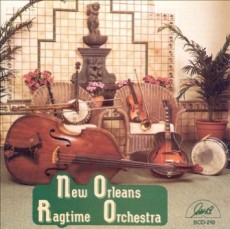
Moving to the French Quarter of New Orleans in 1956, he opened a small record shop from which he also repaired violins. Russell played violin with the New Orleans Ragtime Orchestra, co-founded and became the first curator of The Hogan Jazz Archive at Tulane University in 1958,
Russell collected a large quantity of material related to the history of New Orleans, early jazz, ragtime, blues, and gospel music, all of which he kept in his French Quarter apartment. During his lifetime he always was willing to share access to the material with serious researchers.
At his death on August 9, 1992, Bill Russell, the single most influential figure in the revival of New Orleans jazz that began in the 1940s, bequeathed his collection to the Historic New Orleans Collection, where it continues to be a valuable resource for researchers in the city that became his last home.
Jazz Is Global – Share
Daily Dose Of Jazz…
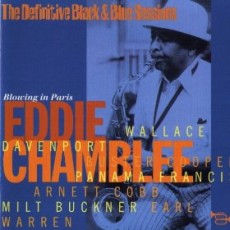
Edwin Leon Chamblee was born in Atlanta, Georgia on February 24, 1920 and grew up in Chicago, Illinois where he began learning the saxophone at the age of 12. After leaving Wendell Phillips High School he studied law at Chicago State University, playing in clubs in the evenings and on weekends.
Chamblee played in U.S. Army bands between 1941 and 1946 and after leaving the service joined Miracle Records. He played on Sonny Thompson’s hit record Long Gone in 1948, and on its follow-up Late Freight credited to the Sonny Thompson Quintet featuring Eddie Chamblee. Both records reached no. 1 on the national Billboard R&B chart and two following records also charted in 1949.
From 1947, Eddie led his own band in Chicago clubs, as well as continuing to record with Thompson, work on other sessions in Chicago, including The Four Blazes hit Mary Jo in 1952. By 1954 he switched gears joining Lionel Hampton’s band for two years, touring in Europe, before returning to lead his own group again in Chicago. He accompanied Amos Milburn, Lowell Fulson and Dinah Washington during the late 50s to early 60s. The two performed vocal duets in a style similar to that later adopted by Washington with Brook Benton.
Known also by his nickname Lone Gone, he recorded for the Mercury and EmArcy labels and with his own group in the early 1960s for Roulette and Prestige Records. In the 1970s he rejoined Hampton for tours of Europe, where he also played with Milt Buckner, recorded for the French Black & Blue label, and performed with the Count Basie Orchestra in 1982. From the 1980s until his passing at age 79 on May 1, 1999, tenor and alto saxophonist Eddie Chamblee performed with the Harlem Blues and Jazz Band.
Inspire A Young Mind
More Posts: saxophone
Daily Dose Of Jazz…
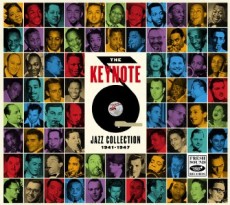
Harry Lim was born on February 23, 1919 in Batavia, Jakarta, Indonesia. He grew up in the Netherlands where he became very fond of jazz, moving to the U.S. in 1939. After working as a freelance record producer, he was the Keystone label’s jazz producer from 1943-46, putting together scores of classic sessions. His emphasis was on small-group jazz that ranged from Dixieland to bop but mostly focused on top swing all-stars.
Although he was a lifelong fan of jazz, he was primarily active in jazz during two different periods. The quality of the music under Harry’s guidance was very high but unfortunately, however, in 1946 John Hammond replaced him and Keynote subsequently declined and became defunct. Lim had his own short-lived HL label in 1949, produced a few obscure sessions for Seeco, and tried reviving Keynote in 1955, but ended up working at Sam Goody’s New York record store from 1956-73.
During his years at Keystone he was able to produce sessions by Count Basie, Roy Eldridge, Cozy Cole, Barney Bigard, George Barnes, Paul Gonsalves, Bud Freeman, Ann Hathaway, Coleman Hawkins, J.C. Heard, Neal Hefti, Earl Hines, Milt Hinton, Chubby Jackson, Ted Nash, Jonah Jones, Paul Robeson, Red Rodney, Charlie Shavers, Wilie Smith, Rex Stewart, Juan Tizol, Dinah Washington, Lennie Tristano, George Wetting, Lester Young, and the list just goes on.
Harry didn’t return to producing until 1972 when he formed the Famous Door label, a top mainstream record company that recorded a variety of valuable and now hard-to-find sessions with Bill Watrous, Red Norvo, Zoot Sims, and others up until his death.
Record producer Harry Lim passed away on July 27, 1990 in New York City. He was most active on the jazz scene between 1940s to through the 1950s, and happily was still living when Polygram reissued all of the Keynote jazz sessions on a huge LP box set in 1986.
Dose A Day – Blues Away
More Posts: record producer