

Daily Dose Of Jazz…
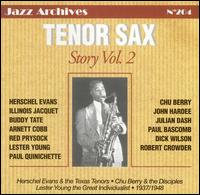
Herschel “Tex” Evans was born March 9, 1909 in Denton, Texas but spent much of his childhood in Kansas City, Kansas learning to play alto saxophone. It was his trombone and guitar-playing cousin, Eddie Dunham who convince him to switch to the tenor, which ultimately established his reputation.
After perfecting his craft in the famous jam sessions held in the jazz district between 12th and 18th streets in Kansas City, Evans returned to Texas in the 1920s and joined the Troy Floyd orchestra in San Antonio in 1929. He stayed with the band until it dispersed in 1932. Evans performed for a time with Lionel Hampton and Buck Clayton in Los Angeles, and in the mid-1930s returned to Kansas City to become a featured soloist in Count Basie’s big band.
For the next three years Herschel’s reputation as a tenor saxophonist was at its peak. His musical duels with fellow band member Lester Young are considered jazz classics. Count Basie’s popular “One O’Clock Jump” featured the contrasting styles of the two musicians and brought to each the praise of both critics and the general public. Evans’s greatest single success was his featured solo on Basie’s hit “Blue and Sentimental”.
Evans also made records with such notable jazz figures as Harry James, Teddy Wilson and Lionel Hampton. Evans has been credited with influencing fellow tenorists Buddy Tate, Illinois Jacquet, and Arnett Cobb. Although not a prolific composer, Evans wrote a number of popular works including the hits “Texas Shuffle” and “Doggin’ Around”. On February 9, 1939, at the age of 29, he died of heart disease in New York City.
More Posts: saxophone
Daily Dose Of Jazz…
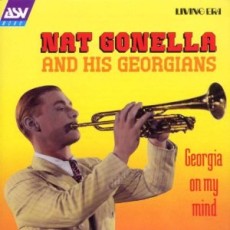
Nathaniel Charles Gonella was born March 7, 1908 in East London, England and took up cornet as a child while at St. Mary’s Guardian School, an institution for underprivileged children. His first professional job interrupted his stint as a furrier’s apprentice when he joined Archie Pitt’s Busby Boy’s Band in 1924. He remained with the band until 1928, and it was during this period that he became acquainted with the early recordings of Louis Armstrong and the New Orleans jazz style.
Nat played and recorded with many prominent jazz musicians, including Billy Cotton, Archie Alexander, Digby Fairweather, Lew Stone, Bob Bryden and Roy Fox. His distinctive vocal style was reminiscent of his idol, Louis Armstrong, though his voice was often eclipsed by his achievements as a bandleader and trumpeter.
Gonella’s standing grew even more quickly after the formation of his own band, “The Georgians”, in 1935, taking the name from his highly popular recording of “Georgia On My Mind” in 1932. He later formed a big band and quickly became a headliner on the variety circuit.
Nat flirted briefly with bebop but returned to the variety stage until a revival of tradition jazz came in the late Fifties. His performing and recording success lasted until the advent of The Beatles in the Sixties, however he toured the northern club circuit and over the next thirty years he continued to sing occasionally with various bands until his death in Gosport on August 6, 1998 at age 90.
More Posts: bandleader,mellophone,trumpet,vocal
Daily Dose Of Jazz…
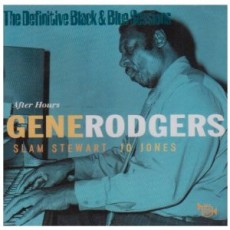
Gene Rodgers was born on March 5, 1910 in New York City. He worked professionally as a pianist from the mid-1920s and over the next few years made recordings with Clarence Williams and King Oliver while also playing with Chick Webb and Teddy Hill.
Rodgers started his own variety show in the 1930s, doing tours of Australia and England recording with Benny Carter in 1936 while in the latter. Upon his return to the States in ‘39 he played with Coleman Hawkins, Zutty Singleton and Erskine Hawkins into the early 40s. During the Forties he worked in Hollywood appearing in the film Sensations of 1945 with Cab Calloway and Dorothy Donegan. After this he worked mainly in New York, leading a trio for many years.
Rodgers appears, with opening title credits, in the 1947 film “Shoot To Kill”, and appearing in the film are two of his compositions “Ballad of the Bayou” and later is “Rajah’s Blues”.
Rodgers recorded sparingly as a leader; he did two sides for Vocalion in 1936, four in a session for Joe Davis in 1945, and albums as a trio leader for EmArcy, Black & Blue Records and 88 Up Right. He played with the Harlem Blues and Jazz Band in 1981-82.
Gene Rodgers, pianist and arranger, best known for his contributions on Coleman Hawkins’ 1939 recording of “Body and Soul”, passed away on October 23, 1987 in New York City.
More Posts: piano
Daily Dose Of Jazz…
George Dorman “Scoops” Carry was born on January 23, 1915 in Chicago, Illinois. His mother a music teacher, his brother Ed a Chicago based bandleader and guitarist put Scoops in good company during his childhood. Starting on horn at the age of eight, he later went on to study at the Chicago College of Music and Iowa University.
He worked with Cassino Simpson, the Midnight Revellers and Boyd Atkin’s Firecrackers in the late 1920s and 30s while still a teenager. In 1931 Carry played with Lucky Millinder in RKO theater palaces. Reuniting with his brother in 1932, the pair co-led an orchestra through the middle of the 1930s. Following this, Scoops played with Zutty Singleton, Fletcher Henderson and Roy Eldridge. By 1938 he was with Art Tatum, a year later with Horace Henderson and at the end of the decade he worked briefly with Darnell Howard before joining Earl Hines’s band in 1940.
Carry remained in Hines’s employ until 1946, working with him in both large and small ensemble settings. After his tenure with Hines, Carry left music and entered law school in 1947, eventually working in the office of the Illinois state attorney.
Scoops Carry, alto saxophonist and clarinetist during the swing era, passed away on August 4, 1970.
Daily Dose Of Jazz…
Wallace Bishop was born February 17, 1906 in Chicago, Illinois and started on drums as a teenager, studying under Jimmy Bertrand. His first professional gig was with Art Sims and his Creole Roof Orchestra in Milwaukee in 1926. Around this time he also played with Jelly Roll Morton, Bernie Young, Hughie Swift, Richard M. Jones and Tommy Dorsey.
Often addressed as “Bish”, from 1928 to 1930 he played with Erskine Tate followed with the Earl Hines Orchestra from 1931-1937. By the 1940s he was playing with Jimmie Noone, Coleman Hawkins, Don Redman, Phil Moore, Foots Thomas, John Kirby and Sy Oliver among others.
While touring Europe with Buck Clayton in 1949, Wallace elected to remain there, and found work both with noted European jazz musicians and with touring or expatriate Americans, including Bill Coleman, Don Byas, Ben Webster, Kid Ory, Milt Buckner, Buddy Tate and T-Bone Walker. Bishop recorded only two pieces as a bandleader in 1950, with a trio, but he continued to record regularly into the 1970s.
Wallace Bishop, a subtle and supportive jazz drummer who was one of the finest drummers of the swing era, passed away on May 2, 1986 in Hilversum, Holland.