

Daily Dose Of Jazz…
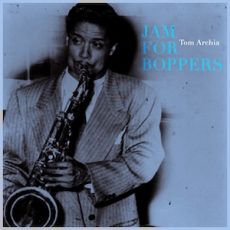
Tom Archia was born Ernest Alvin Archia, Jr. on November 26, 1919 in Groveton, Texas, and moved with his family as a child to Rockdale and then Baytown, near Houston, Texas. He played saxophone in the Wheatley High School orchestra. Known during childhood as Sonny, but took the name Tom when he decided that neither his first or middle names were appropriate for a musician.
After graduating from Prairie View A&M University in 1939, he joined Milt Larkin’s band which included Eddie Vinson, Arnett Cobb, and Illinois Jacquet in the reed section and Cedric Haywood as pianist and arranger. 1942 saw Archia arrived in Chicago, Illinois with Larkin for a nine-month residency backing T-Bone Walker at the Rhumboogie Club.
The following year he joined the Roy Eldridge orchestra alongside Ike Quebec, Ted Sturgis, and Doc West that recorded in Chicago for the Brunswick label. He moved to the Rhumboogie Dream Band until mid 1944. Unfortunately he frequently disrupted band discipline and was fired by Marl Young who took over as bandleader.
In 1945 Tom went to Los Angeles, California and joined Howard McGhee’s combo, with Teddy Edwards, among others. Shortly afterwards, he was recording with the brothers Illinois and Russell Jacquet, as well as Helen Humes.
Returning to Chicago in 1946, Archia became a headliner at the Macomba Lounge, recorded extensively for Aristocrat Records during the late Forties, and recorded with Wynonie Harris and Hot Lips Page. He would go on to participate in tenor saxophone duels with Buster Bennett, Gene Ammons, Claude McLin, Hal Singer, Harold Ashby, Porter Kilbert and Lucius Washington.
By the Sixties he was struggling to find gigs and he retired to Houston in 1967, after being temporarily disabled by a broken jaw. After recovering, he played the Houston club circuit for the rest of his life. Tenor saxophonist Tom Archia died on January 16, 1977 at the age of 57.

More Posts: history,instrumental,jazz,music,saxophone
Daily Dose Of Jazz…
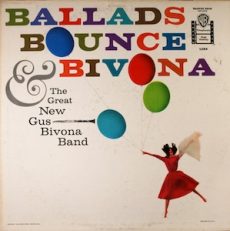
Gus Bivona was born on November 25, 1915 in New London, Connecticut. He got his musical start under the close eye of his musician parents, his mother was a pianist, and his father was a guitarist. His first instrument was violin, but he switched to a combination of alto saxophone and clarinet at the age of 16.
He began his professional debut in the Spider Johnson Band, followed by performing around New England in Leo Scalzi’s Brunswick Orchestra. 1935 saw Gus begin a lengthy stint with the Jimmy Monaco Orchestra and worked with the Hudson-DeLange Orchestra, He went on to spend several months with Bunny Berigan in 1938. Through the end of the decade he worked with bandleaders Will Hudson and Teddy Powell.
In 1940 he put his name on his first band but work as a sideman in more established bands appeared to be what he was after. He spent a period with Benny Goodman in 1940 through the spring of 1941 alongside Charlie Christian. Prior to joining the Naval Air Force Band, Bivona gigged with Jan Savitt and Les Brown & His Band of Renown. He went on to have a series of gigs with Tommy Dorsey and Bob Crosby post World War II.
Signing on with MGM In 1947 he performed numerous studio sessions and on freelance recordings into the 1950s. He connected with Steve Allen, the two would occasionally hit the concert trail, including a lengthy club residency at the Roundtable in New York City. Their collaboration rendered Music for Swingers: Gus Bivona Plays the Music of Steve Allen in 1958 followed by many other West Coast jazz recordings. They were in the company of top studio players and arrangers, such as Skip Martin, Henry Mancini and Pete Rugolo.
Clarinetist Gus Bivona, who also palys saxophone and flute, died on January 5, 1996 in Los Angeles, California.
More Posts: bandleader,clarinet,flute,history,instrumental,jazz,music,saxophone
Daily Dose Of Jazz…
William Henry Bauer was born in New York City on November 14, 1915 and as a child he played ukulele and banjo before switching to guitar. He played with the Jerry Wald band and recorded with Carl Hoff and His Orchestra in 1941, before joining Woody Herman in 1944 as a member of the First Herd. In 1946, he played with Benny Goodman and Jack Teagarden.
Working in small groups led by bassist Chubby Jackson and trombonist Bill Harris, Bauer established himself as a soloist in the bebop movement. In 1946, he began working with Lennie Tristano, enjoying a natural synergy in their style and approach. Their development of intuitive music led to the 1949 session Crosscurrents. He would go on to become a member of the NBC Tonight Show band in New York City and played in the Today Show band at the start of early television.
Continuing his pioneering guitar work in a partnership with Lee Konitz, whose avant-garde saxophone work was a perfect match for Billy’s guitar. The dialogue between the musicians crossed styles from bop and cool to the avant-garde. Their recordings have been described as “some of the most beautiful duet recordings in jazz. Duet For Saxophone and Guitar was an unusual instrument pairing which has been described as redefining the role of jazz guitar.
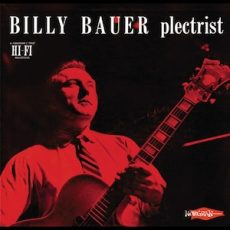
Bauer made one album under his own name, Plectrist, in 1956. Later, he arranged the song No One that appeared on the album Henry Golis Presents Good Music with Friends in 2007.
Guitarist Billy Bauer died of pneumonia in New York at the age of 89 on June 17, 2005.
More Posts: bandleader,guitar,history,instrumental,jazz,music
Daily Dose Of Jazz…
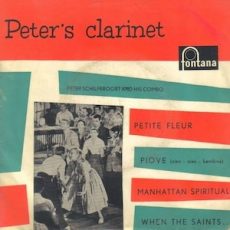
Anne Peter Schilperoort was born on November 4, 1919 in The Hague, Netherlands. Famous for his work with the Dutch Swing College Band, and projects with other well-known musicians.
He is most recognized as a saxophone and clarinet player, but also played the guitar and the banjo. Leading the Dutch Swing College Band from 1946 to 1955, then from 1960 to 1990, his style was Dixieland, a style popular at the start of the twentieth century. His band became widely popular across Europe, Australia, Asia and South America in 1960, known as a Dixieland revival band.
Peter Schilperoort, also known as Pat Bronx, died in Leiderdorp, Netherlands on November 17, 1990 at the age of 71.
More Posts: banjo,clarinet,guitar,history,instrumental,jazz,music,saxophone
Daily Dose Of Jazz…
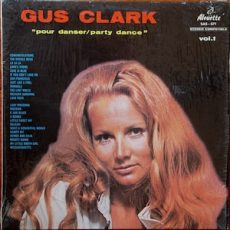
Gus Clark was born Gustave De Clercq on October 21, 1913 in Antwerp, Belgium. While still in his teens he led local dance bands and also played in the groups of musicians such as Harry Pohl, Maurice Pinto, and Jack Hoedemaeker.
In the 1930s Gus played with his own group in Brussels, Belgium, and Coleman Hawkins performed with this ensemble. He later set up a new ensemble of all-Black musicians in Belgium, which included Lauderic Caton as a sideman.
Clark performed with Jean Omer, Jean Robert, and Gus Deloof as a sideman, and continued recording as a leader in the 1940s and 1950s.
Pianist Gus Clark died in his native city on April 10, 1979.

More Posts: history,instrumental,jazz,music,piano