

Daily Dose Of Jazz…
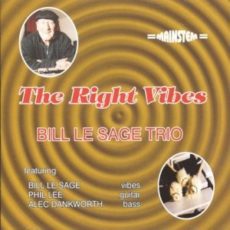
Bill Le Sage was born William A. Le Sage in London, England on January 20, 1927. His father and two uncles were musicians and he started playing the ukulele at the age of eight, drums at fifteen and taught himself to play the piano.
His career began in 1945 when he led his first sextet. He was then a member of army bands while serving with the Royal Signals. He played piano for the Johnny Dankworth Seven in 1950 but decided to switch to the vibraphone. Leaving in 1954 Bill joined the various small groups led by the drummer Tony Kinsey, until 1961 when he started playing with baritone saxophonist Ronnie Ross, with whom he co-led various line-ups until 1966. During this period, he also played with Kenny Baker’s Dozen and wrote music for television and films.
The 1960s gave Le Sage the opportunity to work with the Jack Parnell Orchestra, the Chris Barber Band, and led his group, Directions In Jazz. His composer credits included scores for the films The Tell-Tale Heart, Tarnished Heroes, The Silent Invasion, Strip Tease Murder and The Court Martial of Major Keller.
He accompanied numerous visiting American musicians, including guitarist Tal Farlow on an annual basis. In 1969, he formed the Bebop Preservation Society Quintet, which he continued for more than two decades and also worked with Barbara Thompson’s Jubiaba and others. Vibraphonist Bill Le Sage passed away in London on October 31, 2001.

More Posts: bandleader,composer,history,instrumental,jazz,music,piano,vibraphone
Three Wishes
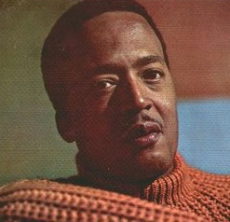
Earl Coleman’s response to Nica’s question of three wishes reflected his feelings on the state of jazz in America was:
- “To work with conscientiousness…”
- “Preferably in Europe.”
*Excerpt from Three Wishes: An Intimate Look at Jazz Greats – Compiled and Photographed by Pannonica de Koenigswarter

More Posts: baroness,history,instrumental,jazz,music,pannonica,three,vocal,wishes
Daily Dose Of Jazz…
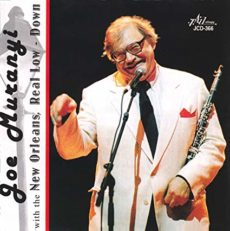
Joseph P. Muranyi was born in Martins Ferry, Ohio on January 14, 1928 and studied with Lennie Tristano, however, he was primarily interested in early jazz styles such as Dixieland and swing. After playing in a United States Army Air Forces band, he moved to New York City in the 1950s and attended the Manhattan School of Music and Columbia University.
During the 1950s he played under Eddie Condon, collaborating with Jimmy McPartland, Max Kaminsky, Yank Lawson, Bobby Hackett, and Red Allen. During that decade he also played with the Red Onion Jazz Band, Danny Barker, and Wingy Manone.
1963 saw him playing with The Village Stompers, a Dixieland band that reached the pop charts with its song Washington Square. From 1967 to 1971 he was the clarinetist with the Louis Armstrong All-Stars. After initially struggling to pronounce Muranyi’s Hungarian family name, Armstrong introduced him on stage as “Joe Ma Rainey”, to Muranyi’s own amusement. Following this stint, he played with Roy Eldridge, World’s Greatest Jazz Band, Cozy Cole, Lionel Hampton, Herman Autrey, Wild Bill Davison, Zutty Singleton, and others.
He worked extensively as a record producer and wrote liner notes for hundreds of albums. Clarinetist, producer, writer and critic Joe Muranyi, who was also an enthusiastic vocalist and played both soprano and tenor saxophone, passed away in Manhattan, New York on April 20, 2012.
Daily Dose Of Jazz…
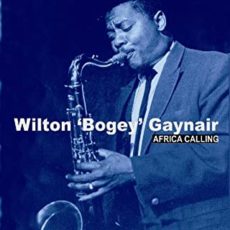
Wilton “Bogey” Gaynair was born on January 11, 1927 in Kingston, Jamaica, Gaynair was raised at Kingston’s Alpha Boys School, where fellow Jamaican musicians Joe Harriott, Harold McNair and Don Drummond were also pupils of a similar age.
Beginning his professional career playing in Kingston’s clubs backing such performers as George Shearing and Carmen McRae, he traveled to Europe in 1955, basing himself in Germany because of the plentiful live work that was offered. Bogey recorded only three times as a bandleader and two of those recordings came during visits to England, 1959’s Blue Bogey and Africa Calling in 1960, on Tempo Records but the latter went unreleased until 2005 due to the label’s demise.
Gaynair returned to Germany shortly after recording these sessions where he remained based for the rest of his life. He concentrated on live performance with such bands as the Kurt Edelhagen Radio Orchestra and played at the opening ceremony of the 1972 Summer Olympics in Munich. He was involved in extensive session work and was a guest artist on Ali Haurand’s Third Eye in 1977 but only recorded one more jazz album under his own name, Alpharian 1982. Among the numerous artists he performed with included Gil Evans, Freddie Hubbard, Shirley Bassey, Manhattan Transfer, Horace Parlan, Bob Brookmeyer, and Mel Lewis.
In September 1983, he suffered a stroke during a concert, and from then until his death, he was unable to play the instrument. Tenor saxophonist Wilton Bogey Gaynair passed away on February 13, 1995 in Cologne, Germany, aged 68.
More Posts: bandleader,composer,history,instrumental,jazz,music,saxophone
Daily Dose Of Jazz…
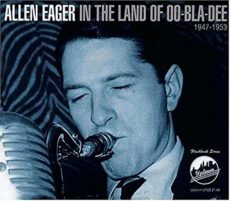
Allen Eager was born in New York City on January 10, 1927 and grew up in the Bronx. He could read at the age of three, learned to drive at the age of 9 with the help of his mother after she caught him driving a garbage truck near the hotels that his parents owned in the Catskill Mountains. He took clarinet lessons with David Weber of the New York Philharmonic at the age of 13. He briefly played with Woody Herman at the age of 15, and at the same age, he took heroin for the first time.
By sixteen he was playing in Bobby Sherwood band, then went on to play with Sonny Dunham, Shorty Sherock, and Hal McIntyre. Eager was then with Herman again for a year in 1943, Tommy Dorsey, and Johnny Bothwell in 1945. After World War II he became a regular on the 52nd Street in New York City leading his own ensemble from 1945–47. His recording debut as a leader was for Savoy Records in 1946 with pianist Ed Finckel, bassist Bob Carter, and drummer Max Roach.
Influenced by Lester Young, his playing style on tenor saxophone was, along with contemporary saxophonists Zoot Sims, Stan Getz, Al Cohn and others. Adopting the musical forms pioneered in bebop, he also adopted the drug dependency of a lot of the bebop players in the 1940s. Allen was a member of several bands led by black musicians including Coleman Hawkins, Fats Navarro, Tadd Dameron and Charlie Parker and recorded with trumpeter Red Rodney for Keynote Records in 1947.
He would go on to play with Gerry Mulligan, Terry Gibbs in 1952, and shortly after with Buddy Rich. He then briefly abandoned music and drugs, becoming a ski and horse riding instructor. In the Fifties, he returned to again led his own ensemble as a saxophonist, frequently playing with Howard McGhee. He lived in Paris for a couple of years, then returned to the U.S. in 1957, Eager recorded The Gerry Mulligan Songbook under Mulligan’s leadership, which was his last recording for 25 years.
After this, he essentially retired from jazz, pursuing skiing, competitive auto racing, and LSD experiments with Timothy Leary. In the late Sixties he settled in Florida with his family, played with Frank Zappa in the 1970s, and in 1982 Eager made a comeback with an album for Uptown Records, entitled Renaissance. He toured with Dizzy Gillespie in 1983, and with Chet Baker. Tenor and alto saxophonist Allen Eager passed away from liver cancer on April 13, 2003 in Daytona Beach, Florida.
More Posts: history,instrumental,jazz,music,saxophone