

Daily Dose Of Jazz…
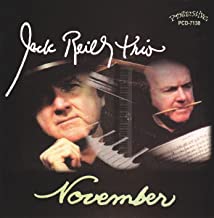
Jack Reilly, also known as Sean Petrahn was born on January 1, 1932, in Staten Island, New York. At age 7, he began classical piano and gave his first recital while still in grammar school. In high school, during his teen years, he formed a jazz band that proved to be pivotal in his choice of jazz as the major musical force in his life.
From 1951 to 1953 he played in a U.S. Navy band while stationed in Puerto Rico and it was there that he met Bill Evans. After military duty, Jack received a four-year scholarship to the Manhattan School of Music majoring in piano and composition. There he met Bill Russo, Phil Woods, Zoot Sims, John Lewis, John LaPorta, and Hall Overton. The year he graduated from MSMJohn LaPorta hired Jack to perform at the Newport Jazz Festival in 1958.
The critics gave high praise for the quartet’s performance and raves for Jack’s playing. During this time he also worked with Warren Covington, George Russell, Lennie Tristano, and Jerry Wald. He moved to California briefly in the mid-1960s to study Indian classical music with Ali Akbar Khan, and returned to Manhattan where he composed the large-scale piece Requiem Mass for Chorus and Jazz Quartet. This work was performed in New York with Sheila Jordan, Jack Six, Norman Marnell, Joe Cocuzzo, and the contemporary chorale with Carol Lian conducting.
In 1967, Jack presented an entire evening of his solo and trio works at Carnegie Recital Hall. His Liturgical Jazz ~ The Psalms, sung by Sheila Jordan was a true synthesis of the blues and classical music. A second choral work, commissioned by the National Endowment for the Arts, was titled The Light of The Soul. The jazz musicians included Jimmy Giuffre~flute and tenor sax, Jack Six~bass, and Joe Cocuzzo~drums.
Reilly served on the faculties of New York University, Berklee College of Music, The Mannes College of Music, and the New School for Social Research. He was chairman of the Department of Jazz Studies at the New England Conservatory of Music as well as the Jazz Program at La Musica A Villa Scarsella in Diano Marina, Italy. He presented lecture/recitals at numerous universities in Europe and in North America including a presentation at the prestigious International Piano Festival and Competition at the University of Maryland.
Pianist Jack Reilly released nine albums during his career and passed away on May 18, 2018, at the age of 86.

More Posts: bandleader,composer,history,instrumental,jazz,music,piano

Daily Dose Of Jazz…
Joe Harris was born on December 23, 1926 in Pittsburgh, Pennsylvania, growing up in the Manchester neighborhood. He learned to play the drums by taking lessons at an early age from Pittsburgh’s Bill Hammond, who taught his the rudiments of drumming. His musical education included symphonic percussion such as tympani and xylophone and by age 18 he was playing in big bands and touring the country.
As a young man in 1946 he moved to New York City, where he played with Dizzy Gillespie over the next two years, helped pioneer Latin jazz, and anchored the house band at the famed Apollo Theater. Balancing jazz with the heavier R&B sounds of tenor saxophonist Arnett Cobb in the late ’40s, Harris gigged with singer Billy Eckstine in 1950, and worked with Erroll Garner, Jimmy Heath, Ella Fitzgerald, Sarah Vaughan, Sonny Rollins, Stan Getz, Billie Holiday and James Moody.
Following a decade as one of the early bebop drummers, Joe took off for Sweden with his first tour in the summer of 1956 with trumpeter Rolf Ericson. His subsequent expatriate status put him in the company of other transplanted instrumentalists including trumpeter Benny Bailey, with whom he recorded from 1957 – 59, and pianist Freddie Redd. He taught himself to speak Swedish fluently and learned a fair amount of German and Japanese, eventually moved to Sweden, married and had a daughter before living in Germany and Japan for a time.
Harris eventually returned to the States for TV work in Los Angeles, California among other things. The drummer would later study music in the Far East, Egypt, Africa and Latin America prior to settling back in his native Manchester, scaling back his performance schedule with local musicians. He continued to practice daily, mentor students and teaching jazz history and drums for years at the University of Pittsburgh until his death on January 27, 2016 at age 89.

More Posts: drums
Daily Dose Of Jazz…
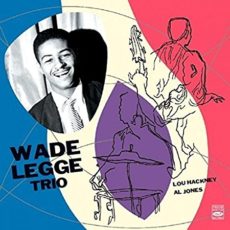
Wade Legge was born on February 4, 1934 in Huntington, West Virginia. He played more bass than piano in his early years, and it was with the bass that Milt Jackson first noticed him, recommending Wade to Dizzy Gillespie. After hiring him, Gillespie moved him to piano and he remained a member of Gillespie’s ensemble until 1954. During his Dizzy years, Legge recorded a date in France as a trio session leader.
Following his tenure with Gillespie, Wade moved to New York City and freelanced there, playing in Johnny Richards’s orchestra, and sessions with Charles Mingus, Sonny Rollins, Milt Jackson, Joe Roland, Bill Hardman, Pepper Adams, Jimmy Knepper and Jimmy Cleveland.
Legge was one of three pianists recording as a member of the variously staffed Gryce/Byrd Jazz Lab Quintets in 1957 and appeared on more than 50 recordings before retiring to Buffalo in 1959. Jazz bassist and pianist Wade Legge died on August 15, 1963 in Buffalo, New York at the age of 29.


Daily Dose Of Jazz…
Peter Herbolzheimer was born on December 31, 1935 in Bucharest, Romania and migrated from communist Romania to West Germany in 1951.Two years later he moved to the United States, settling in Michigan and enrolled in Highland Park High School in the graduating class of 1954. There, he was a staple in the musical choral groups and orchestra, and accompanied several groups on guitar who often performed for various organisations and corporate functions around the Detroit area.
Returning to Germany in 1957 he took up the valve trombone, playing in numerous jazz cellar open mic groups. Peter attempted to return to Michigan, but his visa was denied, so for one year he studied at the Nuremberg Conservatory. In the Sixties he played with the Nuremberg radio dance orchestra and with Bert Kämpfert’s orchestra. He went on to play in the pit orchestra of Hamburg theater, then formed his Rhythm Combination and Brass for which he wrote most of the arrangements.
This big band had an international lineup of eight brass with saxophonist Herb Geller, Allan Botschinsky, Art Farmer, Dusko Goykovich, Palle Mikkelborg, Ack van Rooyen and Jiggs Whigham. The rhythm section had Dieter Reith, Philip Catherine, Niels-Henning Ørsted Pedersen, Bo Stief, Alex Riel, Grady Tate, and Nippy Noya. In the late 1970s the band toured successfully with a “jazz gala” program featuring guest stars such as Esther Phillips, Stan Getz, Nat Adderley, Gerry Mulligan, Toots Thielemans, Clark Terry, Albert Mangelsdorff, Dianne Reeves and Chaka Khan.
The Seventies and Eighties had Herbolzheimer writing music for the opening of the 1972 Olympic Games in Munich, won the International Jazz Composers Competition 1974 in Monaco and was the arranger and conductor and led his orchestra for virtually every major German television network and accompanied visiting American musicians such as Ella Fitzgerald, Benny Goodman, Sammy Davis, Jr., Dizzy Gillespie and Al Jarreau.
Between 1987 and 2006 he was the musical director of Germany’s national youth jazz orchestra, the Bundes Jazz Orchester, conducted regular workshops and clinics for big band jazz and was chosen as the music director, arranger and conductor of the European Jazz Band, which toured throughout Europe until 2009. Trombonist and bandleader Peter Herbolzheimer passed away at age 74 in Cologne, Germany on March 27, 2010.

More Posts: trombone
Daily Dose Of Jazz…
Joseph Alison Harris was born on December 23, 1926 in Pittsburgh, Pennsylvania and took lessons at an early age from Pittsburgh native Bill Hammond, an acclaimed master of traditional rudimental drumming. The training gave him the ability to sit in with a band or orchestra and quickly sight-read almost any style of music. While still in his teens he hit the road playing in big-band ensembles for a globe-trotting career as one of the most versatile jazz drummers of his time, one of the last survivors of the golden era of bebop.
A former Pittsburgh band mate, bassist Ray Brown who had joined Dizzy Gillespie’s pioneering bebop band, arranged for Joe to audition for the drum chair, leading to be a member of the group. Fired for demanding overtime pay for a rehearsal, they later reconciled.
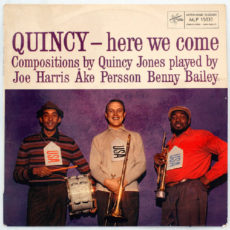
Remaining in high demand throughout his career, he married, lived and played in Sweden for five years during the Fifties, welcoming the contrast from the racial prejudices of the United States. Harris toured Europe with a band led by Quincy Jones, joined a state-run band at Radio Free Berlin and accompanied Charlie Parker, Ella Fitzgerald, Sarah Vaughan, Sonny Rollins, Stan Getz, Billie Holiday and many other greats.
He spent his last decades at his Manchester home, teaching jazz history and drums for years at the University of Pittsburgh, tapered back his performing schedule and mentored younger jazz musicians. Drummer and educator Joe Harris passed away on January 27, 2016 at age of 89.
More Posts: drums