

Daily Dose Of Jazz…
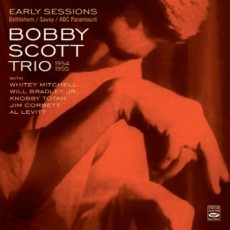
Bobby Scott was born Robert William Scott on January 29, 1937 in Mount Pleasant, New York and began his studies at the La Follette School of Music under Edvard Moritz at age 8, and by 11 was working professionally. He became a pianist, vibraphonist and singer, but could also play the accordion, cello, clarinet and double bass.
In 1952 he began touring with Louis Prima, and also performed with Gene Krupa and Tony Scott in the 1950s. In 1956 he hit the U.S. Billboard Hot 100 with the song “Chain Gang”, peaking at #13. (not the same Sam Cooke song) It sold over one million copies, and was awarded a gold disc.
As a bandleader, he recorded sessions for Verve, ABC-Paramount, Bethlehem and Musicmasters. Booby won a Grammy Award for Best Instrumental Composition for the song “A Taste of Honey”, and co-wrote the song “He Ain’t Heavy, He’s My Brother”.
In the 1960s he became a music teacher and studied again under Moritz, but occasionally recorded as well, including a Nat King Cole tribute album released in the 1980s. He also arranged for jazz and easy listening musicians.
Musician, songwriter and record producer Bobby Scott died of lung cancer on November 5, 1990, at the age of 53. He left a catalogue of twenty-seven recordings from 1953 to 1990 that include performing on soundtracks such as The Pawnbroker, Joe, Slaves, In The Heat of the Night and The Color Purple.

Take A Dose On The Road
More Posts: piano,vibraphone,vocal
Daily Dose Of Jazz…
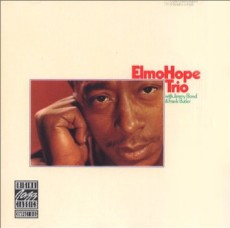
Jimmy Bond was born on January 27, 1933 in Philadelphia Pennsylvania. He started playing bass in junior high school in Philadelphia. While only so much interest can be generated with accounts of a player’s high school days, in this case the details include jamming with the likes of Gene Ammons and Charlie Parker.
Starting in the summer of 1955, the bassist was working with the extremely popular trumpeter and vocalist Chet Baker, a connection that resulted in dozens of record releases. He went on to backup Ella Fitzgerald from 1956 to 1957, but in the ’60s he began to break away from what had seemed to be his genre of choice.
The Bond studio recordings of the ’60s and ’70s involved sessions with Randy Newman, the Jazz Crusaders, Phil Spector and Fred Neil among others. As one of a few studio players who shunned the electric bass and his studio involvements included stints with Tim Buckley, Frank Zappa and Lightnin’ Hopkins as well as Jimmy Witherspoon and Nina Simone.
Adolescent boys couldn’t help noticing the name of this dependable bassist in the wake of James Bond becoming a superhero in the ’60s. When he attended a conference, it was no doubt to get a recording session started. The talk would have been about what key a song is in or how quickly it should move, hardly the stuff of international intrigue. But the main reason these aforementioned lads were noticing the Bond name in the first place was because this was a bassist who shifted his talents from the jazz bandstand to the recording studio, perhaps out of necessity but with great skill and subtlety nonetheless.
Inspire A Young Mind
More Posts: bass
Daily Dose Of Jazz…
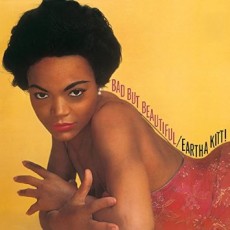
Eartha Mae Kitt was born Eartha Mae Keith on January 17, 1927 to a Cherokee/Black mother and German father on a cotton plantation in North, a small town in Orangeburg County near Columbia, South Carolina.
Raised by Anna Mae Riley, a Black woman whom she believed to be her mother, at age 8 she was sent to live with another family until Anna Mae death due to her man’s refusal to accept the child’s light complexion. She was ultimately sent to live with her biological mother Mamie Kitt in New York City.
Eartha began her career in 1943 with the Katherine Dunham Company, a relationship that lasted until 1948. As a member she appeared in the 1945 original Broadway production of the musical Carib Song. Orson Welles signed her 1950 to her first starring Broadway role as Helen of Troy in his staging of Dr. Faustus, followed by Shinbone Alley. During this decade she starred in films such as Mark of the Hawk, St. Louis Blues and Anna Lucasta.
A talented singer with a distinctive voice and unique style that became enhanced as she became fluent in French, by the early 1950s, she had six US Top 30 hits and a UK Top 10 hit “under The Bridges of Paris” with two more in 1963 and 1983. Kitt recorded such hits as Let’s Do It”, “Champagne Taste”, C’est Si Bon”, “Just An Old Fashioned Girl”, “Monotonous”, “Je Cherche Un Homme”, “Love For Sale” and “Santa Baby” among others.
Success found her way into television taking over the role of Catwoman in 1967 for the 3rd and final season of Batman. But in 1968, her career in America suffered due to President Lyndon B. Johnson after she made anti-war statements at a White House luncheon. It wasn’t until ten years later that she made a successful return to Broadway in the 1978 original production of the musical Timbuktu, receiving the first of her two Tony Award nominations; the second was for the 2000 original production of the musical The Wild Party.
Eartha toured and performed in Europe for many years and her English-speaking performances always seemed to be enriched by a soft French feel. She spoke four languages and sang in seven, which she effortlessly demonstrated in many of the live recordings of her cabaret performances. Over the course of her career from the Seventies until her death, Kitt voiced television commercials, wrote three autobiographies, had disco hits, was embraced by the gay community, continued making movies, making appearances on popular television shows, returned to Broadway and touring companies, and became a darling of the cabaret scene.
Eartha Kitt, actress, jazz singer, cabaret star, dancer, stand-up comedienne, activist and voice artist, winner of three Emmy Awards, and recipient of a Hollywood Walk of Fame Star was a true renaissance woman who screamed her way out of this world, passed away in her home on Christmas Day, December 25, 2008.
Put A Dose In Your Pocket
More Posts: vocal
Hollywood On 52nd Street
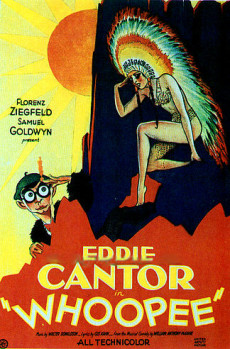
Makin’ Whoopee! and My Baby Just Cares for Me are jazz classics. The former, a jazz/blues song with lyrics written by Gus Kahn and music by Walter Donaldson was first popularized by Eddie Cantor in the 1928 musical Whoopee!, and then reprised the role in the 1930 movie. Kahn and Donaldson also wrote the latter for the musical comedy film in 1930.
The title is a euphemism for sexual intimacy and the song itself has been called a “dire warning”, largely to men, about the “trap” of marriage. Makin’ Whoopee begins with the celebration of a wedding honeymoon and marital bliss, but moves on to babies and responsibilities, and ultimately on to affairs and possible divorce, ending with a judge’s advice.
The Story: In California Sheriff Bob Wells and the daughter of a rancher Sally Morgan are getting married. She, however is in love with Wanenis, whose part-Indian heritage presents difficulties. Sally abandons Sheriff Bob and their wedding, catching a ride with Henry Williams. Henry has problems of his own, being a hypochondriac, but Sally adds to his problems when she leaves a note saying they have eloped. A chase ensues, with the jilted Bob; Mary, who is Henry’s nurse and is in love with him; and a cast of others. Along the way they arrive at the Indian Reservation where Wanenis lives.
Sponsored By

www.whatissuitetabu.com
Daily Dose Of Jazz…
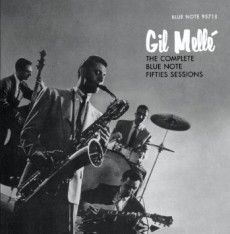
Gil Mellé was born December 31, 1931 in New York City and began his career in jazz as a post-bop baritone and tenor saxophonist, signed with Blue Note at the age of 19, becoming the first Caucasian on the label. Between 1953 and ’57 he recorded five 10” records and his debut 12” LP, Patterns in Jazz for Blue Note. Leaving the label he then went to Prestige releasing three albums.
In the 1950s, Mellé’s paintings and sculptures were shown in New York galleries and he created the cover art for albums by Miles Davis, Thelonious Monk and Sonny Rollins. During this period Gil played the tenor and baritone saxophone with George Wallington, Max Roach, Tal Farlow, Oscar Pettiford, Ed Thigpen, Kenny Dorham and Zoot Sims.
It was Mellé who introduced engineer Rudy Van Gelder to Alfred Lion, Blue Note’s founder, in 1952 after Lion was impressed with the sound of Mellé’s recordings. Abandoning jazz and moving to Los Angeles in the 60s his road led to composing for film and television, and experimenting with electronic music.
As a film and television composer, Mellé was one of the first to use electronic instruments that he built himself, was first to compose a main theme for Rod Serling’s Night Gallery series arranged entirely for electronic instruments as well as The Six Million Dollar Man. Gil composed more than 125 motion picture scores including That Certain Summer, The Andromeda Strain, The Judge and Jake Wyler.
Gil Mellé died of a heart attack on October 28, 2004 in Malibu, California.
Give The Gift Of Knowledge
More Posts: saxophone