

Daily Dose Of Jazz…
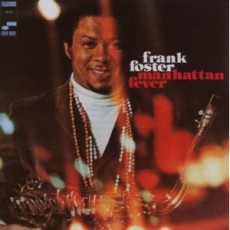
Frank Benjamin Foster III was born September 23, 1928 in Cincinnati, Ohio and began his musical career when he took up the clarinet at 11. Two years later he was playing the alto saxophone, quickly advanced and played with local bands by 14. He began composing and arranging at 15, leading his own 12-piece band while still in high school. He received his continued musical education at Wilberforce University but left with Snooky Young, moved to Detroit, playing the local jazz scene with Wardell Gray.
From 51-53 he served in Korea followed by joining Count Basie’s Big Band, contributed both arrangements and original compositions to Count Basie’s band including the standard, “Shiny Stockings” and other popular songs such as “Down for the Count,” “Blues Backstage,” “Back to the Apple,” “Discommotion,” and “Blues in Hoss Flat” as well as arrangements for the entire “Easin’ It” album.
From 1970 to 1972 he played with Elvin Jones, and in 1972 and 1975 with the Thad Jones-Mel Lewis big band. Frank went on to form and lead several groups, most notably Living Color and The Loud Minority while also co-leading a quintet with Frank Wess in 1983, and toured Europe with Jimmy Smith’s quintet in 1985.
By June 1986 Foster succeeded Thad Jones as leader of the Count Basie Orchestra and during his tenure Dr. Foster received two Grammy Awards for his big band arrangement of the Diane Schuur composition “Deedles’ Blues” and for his arrangement of the renowned guitarist/vocalist George Benson’s composition “Basie’s Bag”.
Over his career he was never far from education spending time teaching at the New England Conservatory of Music, New York City Public School System in Harlem, and State University of New York, Buffalo. Suffering a stroke in 2001, Frank Foster discontinued his playing but continued to lead The Loud Minority on limited engagements but soon passed the helm to trumpeter Cecil Bridgewater.
The tenor and soprano saxophonist and flautist amassed throughout his career twenty-six albums as a leader, thirty-four as a sideman and arranged five albums for Sarah Vaughan, Diane Schuur, Frank Sinatra, George Benson and Count Basie. Saxophonist Frank Foster continued to compose and arrange until his passage on July 26, 2011 at the age of 82.
Daily Dose Of Jazz…
Eric J. Gale was born in Brooklyn, New York on September 20, 1938 and began playing the double bass when he was 12 years old, also playing tenor saxophone, trombone and tuba before settling on the guitar. The basis of his style was formed on the 50s and 60s R&B circuit.
He majored in chemistry at Niagara University but was determined to pursue a musical career, and began contributing to accompaniments for such stars as Maxine Brown, Jackie Wilson, The Flamingoes, The Drifters and Jesse Belvin in the 50s.
Eric began to attract rather quickly the attention of King Curtis and Jimmy Smith, who began recommending him for studio work. His reputation as a first call studio musician in the Sixties became widely recognized and he eventually appeared on an estimated 500 albums.
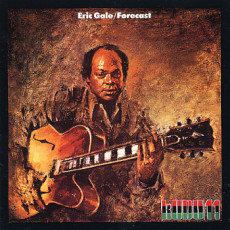
By the 70s he had teamed up with the AM/CTI label eventually working with Creed Taylor exclusively on CTI and its subsidiary label KUDU as a session musician. He finally got his break as a leader in 1973 with his well received “Forecast” LP that showcased his skill as a front man. He was a co-founder of the mid-70s funk band “Stuff” which garnered wide acclaim.
Among the list of Who’s Who musicians and vocalists he recorded with over the course of his career were David “Fathead Newman, Mongo Santamaria, Bob James, Paul Simon, Lena Horne, Johnny Hodges, Quincy Jones, Bob Marley, Nina Simone, Peter Tosh, Grover Washington Jr., Herbie Mann, Esther Phillips, Joe Cocker, Carly Simon, Van Morrison, Billy Joel and Aretha Franklin, along with a stint in her stage band.
Shortly after recording on Al Jarreau’s Tenderness album, guitarist Eric Gale died of lung cancer on May 25, 1994, at the age of 55 in Baja, California.
More Posts: guitar
Daily Dose Of Jazz…
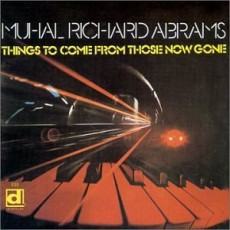
Muhal Richard Abrams was born on September 19, 1930, in Chicago, Illinois. He didn’t start his musical training until his enrollment in Roosevelt University but not hearing what he heard in the streets caused him to study piano on his own. His natural ability to study and analyze things allowed him to read, identify the key the music was in, then the notes and how to play the piano. Listening to Art Tatum, Charlie Parker, Bud Powell, Thelonious Monk and many others, he concentrated on the composition of Duke Ellington and Fletcher Henderson pieces. Although it took a lot of time and sweat, he was soon playing on the scene.
Abrams’ first gigs were playing the blues, R&B, and hard bop circuit in Chicago and working as a sideman with everyone from Dexter Gordon and Max Roach to Ruth Brown and Woody Shaw. In 1950 he began writing arrangements for the King Fletcher Band, and in 1955 played in the hard-bop band Modern Jazz Two + Three, with tenor saxophonist Eddie Harris.
After this group folded he kept a low profile until he organized the Experimental Band in 1962, a contrast to his earlier hard bop venture in its use of free jazz concepts. This band, with its fluctuating lineup, evolved into the Association for the Advancement of Creative Musicians (AACM), emerging in May 1965 with Abrams as its president. Opting not to play in smoky nightclubs they often rented out theatres and lofts where they could perform for attentive and open-minded audiences.
His landmark album “Levels and Degrees of Light” in 1967 saxophonists Anthony Braxton and Maurice McIntyre, vibraphonist Gordon Emmanuel, violinist Leroy Jenkins, bassist Leonard Jones and vocalist Penelope Taylor. However, he never strayed too far from hard bop during this period playing with Eddie Harris, Dexter Gordon and other hard boppers.
Moving to New York in 1975, Abrams became a part of the local Loft Jazz scene and in 1983 he established the New York chapter of the AACM. Over the course of his career he composed for symphony orchestras, classical works, string quartets, solo piano, voice, and big bands in addition to making a series of larger ensemble recordings that include harp and accordion. He has recorded extensively under his own name frequently on the Black Saint label and as a sideman on others’ records, working with the likes of Marion Brown, Chico Freeman, Eddie “Lockjaw” Davis, Art Farmer, Sonny Stitt, Art Ensemble of Chicago, and numerous others.
Muhal Richard Abrams, educator, administrator, composer, arranger, cellist, clarinetist and pianist was given a Lifetime Achievement Award by the Vision Festival, New York City’s premier jazz festival and in 2010 was honored as a NEA Jazz Master. He continues to perform and record.

Daily Dose Of Jazz…
“Brother” Jack McDuff was born Eugene McDuffy on September 17, 1926 in Champaign, Illinois. He began his musical career playing bass first with Joe Farrell followed by Willis Jackson who encouraged him to take up the organ. In the late 50’s he moved to his new instrument and began attracting the attention of Prestige Records. He soon became a bandleader, leading groups that featured then, young guitarist George Benson, saxophonist Red Holloway and drummer Joe Dukes.
McDuff’s debut recording “Brother Jack” for Prestige was followed by his sophomore project, The Honeydripper, featuring Jimmy Forrest and Grant Green. After his Prestige tenure he joined the Atlantic Records family for a brief period and then by the 70s was recording for Blue Note.
The decreasing interest in jazz and blues during the late 70s and 1980s meant that many jazz musicians went through a lean time and it wasn’t until the late 1980s, with The Re-Entry, recorded for the Muse label in 1988, and once again began a successful period of recordings, initially for Muse, then on the Concord Jazz label from 1991. George Benson appeared on his mentor’s 1992 Colour Me Blue album.
Despite health problems, Brother Jack continued working and recording throughout the 1980s and 1990s, touring Japan with Atsuko Hashimoto in 2000. “Captain” Jack McDuff, as he later became known, was one of the most prominent jazz organist and organ trio bandleader during the hard bop and soul jazz era of the Sixties. He passed away of heart failure on January 23, 2001 at the age of 74 in Minneapolis, Minnesota.
More Posts: organ
Daily Dose Of Jazz…
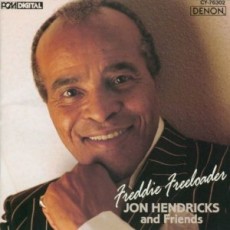
Jon Hendricks was born John Carl Hendricks on September 16, 1921 in Newark, Ohio and along with his 14 siblings moved around a lot until his A.M.E. pastor father settled in Toledo. As a teenager, Jon’s first interest was in the drums, but before long he was singing on the radio regularly with another Toledo native, pianist Art Tatum. Out of high school Jon served in the Army during WWII and after his discharge entered pre-law at the University of Toledo but stop at the graduate level because his G.I. benefits ran out. Charting a new course on the advice and encouragement given him by Charlie Parker, he moved to New York and began his singing career.
In 1957, he teamed with Dave Lambert and Annie Ross to form the legendary vocal trio Lambert, Hendricks & Ross. With Jon as lyricist, the trio perfected the art of vocalese and took it around the world, earning them the designation of the “Number One Vocal Group in the World” for five years in a row from Melody Maker magazine. After six years the trio disbanded for solo careers but not before leaving behind a catalog of legendary recordings, most of which have never gone out of print.
Pursuing a solo career, Hendricks moved his young family to London, England in 1968, toured Europe and Africa, performed frequently on British television, and appeared in British and French films and his sold-out club dates drew fans such as the Rolling Stones and the Beatles. Five years later the Hendricks settled in California, worked as the jazz critic for the San Francisco Chronicle, and taught classes at California State University, Sonoma and the University of California, Berkeley.
Over the course of his career Hendricks wrote a stage piece about the history of jazz, “Evolution of the Blues” that ran an unprecedented five years at the Off-Broadway Theatre in San Francisco and another year in Los Angeles; and his television documentary, “Somewhere to Lay My Weary Head” received an Emmy, Iris and Peabody awards; has recorded several critically-acclaimed albums on his own, collaborated with his wife and daughters, with the Manhattan Transfer on 7 Grammy winning “Vocalese”, has served on the Kennedy Center Honors committee under Presidents Carter, Reagan, and Clinton; has been appointed distinguished Professor of Jazz Studies at the University of Toledo; selected as the first American jazz artist to lecture at the Sorbonne in Paris.
Jon has toured worldwide with the “Four Brothers” comprised of Kurt Elling, Mark Murphy and Kevin Mahogany as well as working with his 15 member vocal group Vocalstra. Countless of singers and critics cite him as the one of the originators of vocalese and he has influenced just as many from Van Morrison and Al Jarreau to Bobby McFerrin and Georgie Fame. Time Magazine dubbed him the “James Joyce of Jive” while Leonard Feather called him the “Poet Laureate of Jazz”.
Vocalist Jon Hendricks endlessly performed, toured and recorded until he transitioned on November 22, 2017 in Manhattan, New York City, at age 96.
More Posts: vocal