

Daily Dose Of Jazz…
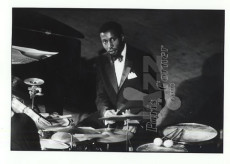
Connie Kay, the drummer for the longstanding Modern Jazz Quartet was born Conrad Henry Kirnon on April 27, 1927, in Tuckahoe, New York. The self-taught drummer played with Sir Charles Thompson in the 40s along with Miles Davis and Cat Anderson.
By the late forties to the mid-fifties he played off and on with Lester Young, Beryl Booker, Stan Getz, Coleman Hawkins, Charlie Parker and others. But it wasn’t until 1955 when replacing Kenny Clarke, that Kay found his home with the Modern Jazz Quartet, an association that would last nearly twenty years.
After the dissolution of the MJQ, Connie played with Chet Baker, Cannonball Adderley, Jimmy Heath, Jim Hall and Paul Desmond. In the 70s he worked with Tommy Flanagan, Soprano Summit, Benny Goodman and became the house drummer at Eddie Condon’s club.
In 1981 the MJQ reorganized to play festivals and later on a permanent six-months-per-year basis. When Kay’s health began to suffer, the drummer was replaced first by Mickey Roker and then by Albert “Tootie” Heath.
Kay was known for his subtle and quietly effortless playing with the MJQ, but beyond that memorable interaction he was an invaluable asset to everyone he came in contact with. He played with great discretion and restraint making his contribution to one of the great aggregations of all time.
Connie Kay died in New York City on 30 November 1994. He was sixty-seven years old.

More Posts: drums
Daily Dose Of Jazz…
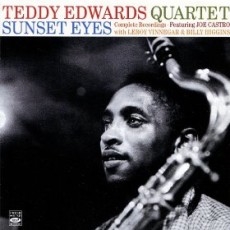
Teddy Edwards was born Theodore Marcus Edwards in Jackson, Mississippi on April 26, 1924. Learning to play at a very early age he began on alto, then clarinet, finally settling on the tenor. His first professional gig was with the Royal Mississippians prior to his uncle sending for him in Detroit where he lived for a short time. Although presented with the chance for greater opportunities family illness took him back to Jackson.
Venturing to Louisiana he met Ernie Fields who persuaded him to join his band and touring through Tampa, Washington, DC thwarted his dream of New York and Edwards ended up in Los Angeles, which would become his permanent residence in 1945. It was during this period in his career when he started playing with Howard McGhee’s band that Teddy switched to the tenor saxophone.
Teddy played with such notables as Charlie Parker, Roy Milton, Wynonie Harris, Vince Guaraldi, Joe Castro, Ernie Andrews among others and recording “The Duel” with Dexter Gordon in 1947 set Edwards up as a dueling legend. As a leader, throughout the 50s and 60s he worked with Max Roach, Clifford Brown, Benny Carter, Benny Goodman, Milt Jackson Sarah Vaughan, Tom Waits and Jimmy Smith, recording on Onyx, Pacific Jazz, Contemporary, Prestige and other labels, writing his best known composition Sunset Eyes.
Teddy Edwards, who became one of the most influential tenor saxophonists passed away on April 20, 2003. His sound exemplified an affinity for the blues and tone-quality that accompanies within a fluent post-bop vocabulary.

More Posts: saxophone
Daily Dose Of Jazz…
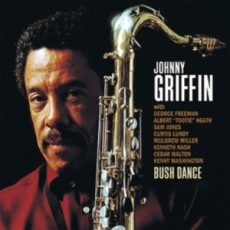
John Arnold Griffin III was born on April 24, 1928 in Chicago, Illinois. Nicknamed the “Little Giant”, he studied music at DuSable High School starting out on clarinet, taking up the oboe and finally the alto saxophone. At fifteen he was playing with T-Bone Walker and three days after graduation joined Lionel Hampton who encouraged the young man to take up the tenor, appearing on a Hamp recording in 1945 at age 17.
In the mid-forties Johnny formed a sextet with Joe Morris and George Freeman, played on R&B records for Atlantic Records and played baritone with Arnett Cobb’s R&B band. After a two-year stint in the Army he returned to Chicago and began establishing his reputation, subsequently signing with Blue Note. By 1957 he gained membership into Art Blakey’s Jazz Messengers, then replaced Coltrane in Monk’s Five Spot Quartet, and recorded Thelonious In Action and Misterioso.
On his first leader outing in 1956 with Blue Note that brought him critical acclaim, Griffin led Wynton Kelly, Curly Russell and Max Roach on “Introducing Johnny Griffin”. This was immediately followed the next year with “A Blowing Session” featuring Coltrane and Hank Mobley. He went on to play with Monk, Blakey and with Clark Terry. During this period he became known as the fastest tenor in the west for the ease with which he could execute fast note runs with excellent intonation.
In 1960 he teamed up with Eddie “Lockjaw” Davis establishing a quintet and recorded several albums over the next two years, then moved to France in ’63 and recorded with Wes Montgomery and Dizzy Gillespie, Nat Adderley, and joined the Kenny Clarke-Francy Boland Big Band and by 1978 he moved to the Netherlands. He became the first choice sax player for touring musicians to the continent. In the seventies he and Davis recorded again, he played with Toots Thielemans, Nat Adderley, Grady Tate, Stan Getz, Art Farmer, Slide Hampton, Gerry Mulligan and arranger Quincy Jones among a host of others.
On July 25, 2008, Johnny Griffin passed away of a heart attack at the age of 80 in Mauprévoir, France, his home for the last 24 years of his life.

More Posts: saxophone
Daily Dose Of Jazz…
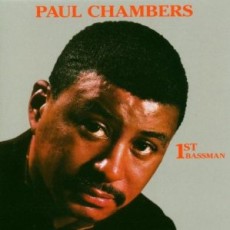
Paul Laurence Dunbar Chambers, Jr. was born in Pittsburgh, Pennsylvania on April 22, 1935 but was raised in Detroit after the death of his mother. He began his music career as a youth playing the baritone horn, then switched to the tuba but by age 14 finally settled on the string bass in 1949. Through high school he trained with a Detroit Symphony Orchestra bassist, played classical music with the Detroit String Band, played with the Cass Technical High School Symphony and various other student groups that often had him playing the baritone saxophone.
Bassist Jimmy Blanton was Paul’s biggest influence but Charlie Parker and Bud Powell were his first influences. He admired Oscar Pettiford and Ray Brown, followed by Percy Heath, Milt Hinton and Wendell Marshall for their rhythm section work. It was Charles Mingus’ and George Duvivier’s technical prowess that gave him an understanding of their broadening of the jazz bass.
Chambers was invited to New York by Paul Quinichette and was soon touring and playing with George Wallington, J.J. Johnson, John Coltrane, Wes Montgomery, Bennie Green, Thad Jones, Barry Harris and Kai Winding. In 1955 he joined the Miles Davis followed by Wynton Kelly and freelanced with many jazz greats throughout his short but impressive career.
Paul Chambers was a prominent figure and one of the most influential jazz bassists of the 1950s and 60s. His importance in the development of jazz bass can be measured by his impeccable time, intonation and virtuosic improvisations. He, along with Slam Stewart was first to perform arco or bowed features.
Over the span of his extremely short career Paul was a member of two of the jazz world’s most famous “rhythm sections”, the first with Red Garland and Philly Jo Jones, the second with Wynton Kelly and Jimmy Cobb. On January 4, 1969 he passed away of tuberculosis at the premature age of 33.

More Posts: bass
Daily Dose Of Jazz…
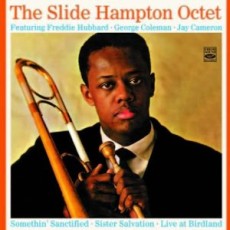
Slide Hampton was born Locksley Wellington Hampton on April 21, 1932 in Jeannette, Pennsylvania, one of twelve children born to Laura and Clarke Hampton, who taught them to play instruments. One of the few left-handed trombonists, not naturally having received a left-handed trombone from his father, by age twelve the Hamptons were living in Indianapolis and Slide was playing in the Duke Hampton Band, led by his father.
Just eight years later Slide was on stage at Carnegie Hall playing with Lionel Hampton in 1952. Throughout the 1950s Slide played with Buddy Johnson, played and arranged for Maynard Ferguson, and recorded with master trombonist Melba Liston. As his reputation grew he began working with Art Blakey, Tadd Dameron, Barry Harris, Thad Jones, Mel Lewis, and Max Roach, contributing both original compositions and arrangements. In the early Sixties he formed an octet with Freddie Hubbard, Booker Little and George Coleman that toured and recorded throughout the U.S. and Europe.
Over the course of fifty plus years Hampton has played with Woody Herman, lived in Europe for ten years, taught at Harvard, University of Massachusetts, DePaul University and Indiana State. He has led a nine trombone 3 rhythm band – World Of Trombones, co-led a quintet with Jimmy Heath called Continuum and freelanced as a writer and player.
This gifted jazz musician has been inducted into the Indianapolis Jazz Hall of Fame, is a two-time Grammy winner, and was honored in 2005 with the NEA Jazz Masters Award. Trombonist, bandleader, educator, master composer, arranger Slide Hampton, who is among the most distinguished assembly of careers in music, passed away on November 18, 2021 in Orange, New Jersey.

More Posts: trombone