

Daily Dose Of Jazz…
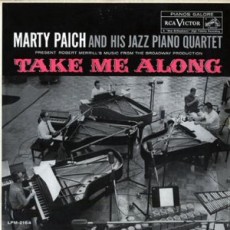
Marty Paich was born Martin Louis Paich on January 23, 1925 in Oakland, California. He started his music career taking lessons on the accordion followed by the piano and by 10 he formed his first of several bands and by 12 was playing regularly at weddings and similar social events. He attended a series of professional schools, served in the Army Air Corps during WWII leading various bands and orchestras until his discharge. Marty went back to school studying composition and graduating magnum cum laude in 1951 from the Los Angeles Conservatory.
Paich had an extraordinary ear for style and an eclectic taste. His early work included arranging and playing the score for Disney’s Lady and The Tramp, accompanist for Peggy Lee, playing piano for Shorty Roger’s Giants and touring with Dorothy Dandridge.
During the 1950s, Paich was active in West Coast jazz performance while also working intensively in the studios. He not only played on, but arranged and produced, numerous West Coast jazz recordings, including albums by Ray Brown, Ella Fitzgerald, Terry Gibbs, Shelly Manne, Anita O’Day, Dave Pell, Buddy Rich but it was his association with Mel Torme and their work with the Marty Paich Dektette, albeit difficult at times, was what many jazz critics consider to be the high point of their respective careers.
The 60’s moved him to the studios and television working for Andy Williams, Al Hirt, Dinah Shore, Glen Campbell, Sonny & Cher, the Smothers Brothers and winning an Emmy for Ironside.
In a career which spanned half a century, he worked as a pianist, composer, arranger, producer, music director and conductor for such artists as Frank Sinatra, Sammy Davis Jr., Sarah Vaughan, Stan Kenton, Jack Jones, Art Pepper, Stan Getz, Barbra Streisand, Ray Charles, Aretha Franklin, Linda Ronstadt, and Michael Jackson and a hundred others. Marty Paich passed away on August 12, 1995, aged 70 from colon cancer, at his home in Santa Ynez, California.

Daily Dose Of Jazz…
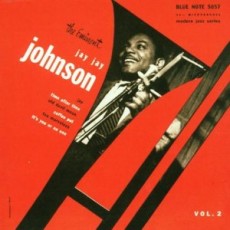
J. J. Johnson was born James Louis Johnson in Indianapolis, Indiana on January 22, 1924. He started studying piano at the age of 9 and at fourteen decided to play the trombone. By 1941 he began his professional career with Clarence Love and followed by Snookie Russell in ’42, then playing through the forties with the Benny Carter Orchestra, participating in the first Jazz At The Philharmonic organized by Norman Granz in Los Angeles.
He would tour and record with the Count Basie band, Illinois Jacquet and then began leading and recording small groups featuring Max Roach, Sonny Stitt and Bud Powell. By 1951 he took a job as a blueprint inspector but never abandoned his love for music as documented by his compositions Enigma and Kelo recorded by Miles Davis, garnering an invitation to play on the 1954 classic Davis Blue Note session, Walkin’.
Johnson went on to lead groups with Kai Winding, arranging for and backing Sarah Vaughan, following with a successful solo career touring the U.S., the U.K. and Scandinavia. He recorded a wide range of albums with notables as Bobby Jaspar, Clifford Jordan, Freddie Hubbard, Tommy Flanagan, Cedar Walton, Andre Previn and the list goes on and on.
In 1958-59 Johnson was one of three plaintiffs in a court case that hastened the abolition of the cabaret card system. By the sixties he was concentrating more on composition, writing a number of large-scale works that incorporated elements of both classical and jazz.
The 70’s saw J.J. in Hollywood scoring for film and television – Across 110th Street, Starsky & Hutch, and the Six Million Dollar Man but racism and other prejudices kept a black jazz musician from securing the amount and quality of work he was qualified to perform. However, his compositions including “Wee Dot”, “Lament” and “Enigma” have become jazz standards.
The trombonist, composer and arranger also authored a book of original exercises and etudes and a biography titled “The Musical World Of J.J. Johnson. He was voted into the Down Beat Hall of Fame in 1995. Diagnosed with prostate cancer, on February 4, 2001, he committed suicide by shooting himself.


Daily Dose Of Jazz…
Jimmy Wilbur Cobb was born January 20, 1929 in Washington, DC. Playing around the nation’s capital with the leading local musicians, by the age of 22, Jimmy left DC to tour with Earl Bostic; and with his wife Dinah Washington, doubling as her musical director until 1955. After freelancing for a while in New York he joined Cannonball Adderley from 1957-58, played briefly with Stan Getz, and Dizzy Gillespie.
In late 1958 Cobb followed Cannonball into the Miles Davis group until 1963. It was during this period of his career that he was a part of what many consider to be the quintessential jazz album Kind Of Blue. He also recorded with Davis on Sketches Of Spain, Someday My Prince Will Come, Live at the Blackhawk and Carnegie Hall, Porgy & Bess and the Sorcerer.
During the 70’s he played with Wynton Kelly, Sarah Vaughan with copious freelance work and a long relationship with Nat Adderley continued well into the nineties. His resume is an impressive testament to his time playing, well-constructed improvisation or slow compelling sounds having worked extensively with a wide range of artists from Pearl Bailey and John Coltrane to Eddie Gomez and Geri Allen.
The drummer has received the Don Redman Heritage award and has been inducted as a NEA Jazz Master. He remained vibrant in the jazz idiom touring and performing regularly with his group, as of 2011, the Jimmy Cobb “So What” Band, as a tribute to 50 years of Kind of Blue and the music of Miles Davis.
Drummer and bandleader Jimmy Cobb, having been suffering from lung cancer, passed away on May 24, 2020 at his Manhattan home at the age of 91.

More Posts: drums
From Broadway To 52nd Street
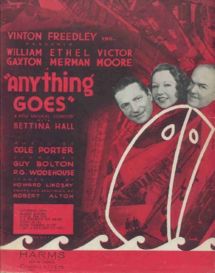
Anything Goes opened at the Alvin Theater on November 21, 1934 and had a run of 420 performances. Cole Porter wrote the music for the show and it featured such stars as Ethel Merman, William Gaxton and Bettina Hall. From the musical I Get A Kick Out Of You is singled out for fame and applause as a jazz standard.
The Story: Reno Sweeney, an evangelist turned bar hostess gets such a kick out of Billy Crocker that she boards a Europe bound liner to dissuade him from pursuing Hope Harcourt. Crocker, aboard without a ticket must adopt several disguises. Hope loves an Englishman of her peer. Rev. Dr. Moon is on J. Edgar Hoover’s public enemy list at #13 and attempting to rise to #1. Reno holds a revival; Hope becomes an heiress, drops her Englishman and consents to marry Crocker. Moon gets dropped from Hoover’s list.
Broadway History: In the 1900-01 season there were seventy plays or musicals being produced on Broadway. It was the beginning of the boom and the decades that followed saw the number of plays produced quadruple. In addition, there were seven vaudeville houses and six burlesque theaters presenting their shows to a theatre thirsty population of just over three and a half million inhabitants.
The first decade of the 20th century was both boring and transformational in the history of Broadway. The seeds of that transformation go back to 1882 with the construction of The Madison Square Theatre at 24th Street. At the time, the theatre district was concentrated between Union Square and 24th Street.
More Posts: broadway
Daily Dose Of Jazz…
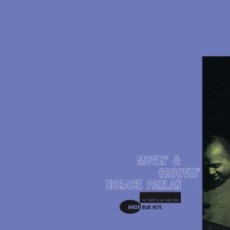
Horace Parlan was born on January 19, 1931 in Pittsburgh, PA who became an influential hard bop and post-bop pianist. Stricken with polio as a child that partially crippled his right hand, Parlan turned this would be handicap into what has been described as a “pungent left hand chord voicing style while complimenting highly rhythmic phrases with this right”.
He began playing in R&B bands in the 50’s until his move to New York where he joined Charles Mingus’ band from 1957 to 1959, a collaboration that greatly influenced Parlan’s career. Time would see him playing with Booker Ervin, Eddie Lockjaw Davis, Johnny Griffin and Rahsaan Roland Kirk; was the house rhythm section for Minton’s Playhouse in Harlem with bassist George Tucker and drummer Al Harewood while recording a strong series of sessions for Blue Note in the 60’s.
By 1973 Horace was on his way to Europe, settling in Copenhagen and gained international recognition through his Steeplechase recordings including exceptional duet dates with Archie Shepp. He also recorded with Dexter Gordon, Red Mitchell and in the 80’s with Frank Foster and Michael Urbaniak.
His later work, notably a series of duos with the tenor saxophonist Archie Shepp, including the album Goin’ Home, is steeped in gospel music. He has recorded nearly two-dozen albums as a leader and more as a sideman. In 2000 he was a recipient of the Ben Webster Prize given by the Ben Webster Foundation. Horace Parlan, the hard bop/post-bop pianist who attributes Ahmad Jamal and Bud Powell as his major influences, resided and performed regularly in Copenhagen, Denmark until his passing on February 23, 2017 in Korsør, Denmark.

More Posts: piano