

Daily Dose Of Jazz…
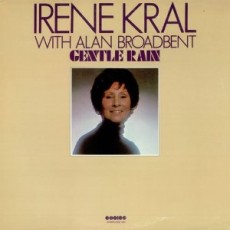
Vocalist Irene Kral was born in Chicago, Illinois on January 18, 1932. The younger sister of Roy Kral, an already a successful musician, she started singing professionally as a teenager making her debut with the Jay Burkhardt Big Band. She went on to work with Woody Herman and Chubby Jackson.
Freelancing around Chicago, Irene gigged with a vocal group called Tattle-Tales, spent nine months singing with Maynard Ferguson’s big band and also performed with groups led by Stan Kenton and Shelly Manne, After an association with the Herb Pomeroy Orchestra, she got married, moved to Los Angeles and stopped performing.
Fortunately for the jazz world by the late 50’s Irene embarked upon a solo career recording two sessions for United Artists, a ’65 date for Mainstream and from 1974 to 1977 recorded three great albums, “Kral Space” and two projects with pianist Alan Broadbent “Where Is Love” and “Gentle Rain”. Her rendition of Spring Can Really Hang You Up The Most is not only considered classic but also definitive.
Irene Kral died at the age of 46 of breast cancer in Encino, California on August 15, 1978. She attributed Carmen McRae as one of her inspirations and was brought back to the attention of the world posthumously by director Clint Eastwood when he used her recording in the Bridges of Madison County.

More Posts: vocal
Daily Dose Of Jazz…
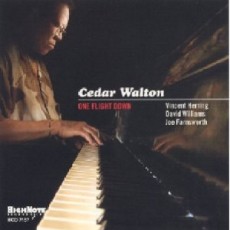
Cedar Walton was born Cedar Anthony Walton Jr. was born January 17, 1934 in Dallas Texas. After attending the University of Denver, he moved to New York in 1955. A two-year stint in the Army saw him performing in a jazz ensemble, whereupon his discharge he joined Kenny Dorham’s band. By the late 1950s Walton was playing with J. J. Johnson, the Art Farmer/Benny Golson Jazztet and Gigi Gryce. In 1959 he recorded as a member of John Coltrane’s group on his seminal work Giant Steps.
In the early 1960s, Cedar joined Art Blakey’s Jazz Messengers and for three years held the position of pianist/arranger, playing with Wayne Shorter and Freddie Hubbard. He left the Messengers in 1964 and by the late Sixties was part of Prestige Records’ house rhythm section, where in addition to releasing his own recordings, he recorded with Sonny Criss, Pat Martino, Eric Kloss, and Charles McPherson.
Although he has been one of the finest interpreters of standards, Walton is considered one of the jazz world’s most underrated composers contributing “Bolivia”, “Fantasy in D”, Mosaic and “Ugetsu”.
During the mid-1970s, Walton led the funk group Mobius. He has recorded with Hank Mobley, Abbey Lincoln, Lee Morgan and led the group Eastern Rebellion with rotating members included Clifford Jordan, George Coleman, Bob Berg, Sam Jones and Billy Higgins.
In January 2010, he was inducted as a member of the National Endowment for the Arts Jazz Masters. Since first recording as a leader he has recorded some four-dozen albums and an equal amount as a sideman. Pianist Cedar Walton continued to lead his own groups and freelance until his death on August 19, 2013.

More Posts: piano

Daily Dose Of Jazz…
Kenny Wheeler was born Kenneth Vincent John Wheeler and came into this world on January 14, 1930, in Toronto, Canada. He began playing the cornet at the age of 12, becoming interested in jazz in his mid-teens. Spending a year at the Royal Conservatory in Toronto, he moved to Britain in 1952 at the age of 22 and found his way into the jazz scene of London playing with Tommy White, Tubby Hayes and Ronnie Scott.
In the 60’s Wheeler worked with John Dankworth, recording “Windmill Tilter” which is now a collector’s item since the master tapes have been lost. He has also enjoyed being active in free improvisation creating orchestral writing with passages of free improvisation infused in the bi band album “Song For Someone” in 1973 named Album of the Year by Melody Maker magazine in 1975.
Kenny’s lists of recordings or performances are too vast but includes Paul Gonsalves, Dave Holland, Anthony Braxton, Keith Jarrett, Steve Coleman, John Taylor, and Lee Konitz among a host of other notables in jazz.
Highly respected among his peers for his beautiful tone and extensive range on the trumpet and flugelhorn, Wheeler has written over one hundred compositions and is a skilled arranger for small groups and larger ensembles. His compositions blend lyrical melodies with a distinctive and ever changing harmonic palette. He has occasionally contributed to rock music recordings, is the patron of the Royal Academy Junior Jazz course, has been based in the UK since 1950 and remained faithful to the jazz genres of avant-garde, post bop, chamber jazz and free improvisation until his passing on September 18, 2014 at age 84 in London, England.

More Posts: flugelhorn,trumpet
Daily Dose Of Jazz…
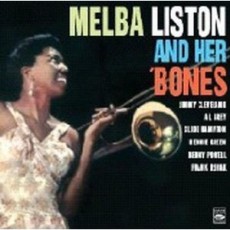
Melba Doretta Liston was born on January 13, 1926. Growing up in Kansas City, MO the young trombonist studied with Alma Hightower and played in youth bands. At 17 the talented trombonist joined Gerald Wilson’s big band and by the mid-1940’s Melba began working with the emerging beboppers like Dexter Gordon, Dizzy Gillespie, Paul Gonsalves, John Coltrane and John Lewis. She toured with Count Basie and Billie Holiday in the late 40’s but was so profoundly affected by audience indifference and the rigors of the road she quit playing.
For the next few years she did clerical work and supplemented her income working as an extra in Hollywood appearing in The Prodigal and The Ten Commandments. By the mid 50’s Melba was back playing, touring with Dizzy Gillespie for the U.S. State Department and recording with Art Blakey’s Jazz Messengers. In 1958 she formed her all-women quintet and with her show “Free and Easy” she toured Europe with Quincy Jones as her musical director.
The 60’s saw Melba collaborating with pianist Randy Weston, arranging primarily her own compositions for mid-size to large ensembles and are widely acknowledged as jazz classics. Melba worked with the likes of Milt Jackson, Clark Terry, and Johnny Griffin as well as arranging for various Motown records. In 1971 she became the musical director for Stax Records, working with Stevie Wonder, Joe Sample, Wilton Felder, Arthur Adams and jazz drummer Paul Humphrey whose uncharted album released in 1972 contains some of Melba’s finest works ever.
Melba Liston was a trombonist, composer and an important jazz arranger whose collaboration with pianist/composer Randy Weston continued until her death on April 23, 1999.
More Posts: trombone
From Broadway To 52nd Street
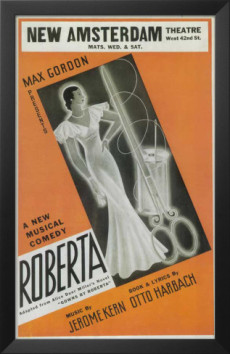
Roberta opened at the New Amsterdam Theater on November 11, 1933. It ran 295 performances with music by Jerome Kern, and lyrics and book by Otto Harbach. The show starred Tamara Drasin, Bob Hope, George Murphy, Ray Middleton, Fay Templeton and Fred MacMurray. The musical comedy was based on the novel Gowns by Roberta by Alice Duer Miller and is set in a fraternity house at Haverhill College. From the play came songs like Yesterdays, Smoke Gets In Your Eyes and The Touch Of Your Hand that have become jazz standards.
The Story: Set in a fraternity house at Haverhill College: A deposed Russian princess has become a famed Parisian couturier. Her partner passes away leaving her half of the business to American football player Randolph Scott–who of course knows next to nothing about the gown business, and couldn’t care less anyway. The former girlfriend of the bandleader poses as a phony Polish countess. Men are chasing women who are chasing men as flirtations involved all.
Jazz History: By the time Roberta premiered on Broadway, the nation was buckling under the devastation of The Great Depression. Twenty-five percent of the workforce was jobless, and up to 60 percent of African American men had no work. Cities became crowded with people searching for work after farms began to whither and rot. Black musicians were not allowed to do studio or radio work. However, jazz music was resilient. While businesses, including the record industry, were failing, dance halls were packed with people dancing the jitterbug to the music of big bands, which would come to be called swing music.
Swing bands attracted throngs with their intensity, playing fast and loud blues riffs and featuring virtuosic soloists. All of a sudden, thanks to musicians such as Coleman Hawkins, Lester Young and Ben Webster, the tenor saxophone became the instrument most strongly identified with jazz.
In Kansas City, pianist Count Basie began building an all-star big band after Benny Moten, a well-known bandleader died in 1935. Basie featured Lester Young, giving rise to the saxophonist’ career as an innovator, and also bringing exposure to an aggressive and bluesy vein of jazz that filled the clubs of the Midwest.
Sponsored By

www.whatissuitetabu.com
More Posts: broadway