

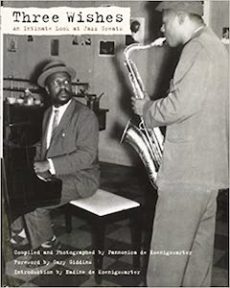
Three Wishes
While at a club or her Cathouse, Pannonica ventured the question to C. Stroman Scoby asking him to give her his three wishes he would want granted and his reply was:
- “Self~realization, by which I mean to realize my connection to the universe.”
- “Harmony among all the creatures in the universe. I wouldn’t need a third wish if those two.”

More Posts: drums,history,instrumental,jazz,music
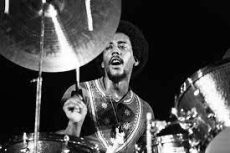
Three Wishes
While hanging out with Roy McCurdy the Baroness had the pleasure of asking him what he would wish for if magically they could be realized and he told her:
- “For my family to be happy and secure.”
- “To play as often as I wanted to, consistently good.”
- “Oh, I don’t know! To be happy. And peace of mind. That’s probably… probably is it.”

Daily Dose Of Jazz…
Pekka Juhani Pöyry was born on December 10, 1939 in Helsinki, Finland and became interested in jazz music at school and began studying the violin and clarinet. However, he was more taken with playing the alto saxophone, having been inspired by Charlie Parker. In addition, he played the flute and soprano saxophone.
After graduating with a Master of Laws in 1966, Pöyry decided to become a professional musician. In the same year he represented YLE, Finland’s national public broadcasting company at EBU’s concert in London, England. By the mid-1960s, he had his own quartet with pianist Eero Ojanen, bassist Teppo Hauta-aho and drummer Reino Laine. Joining the group was Norwegian-Finnish singer Pia Skaar to form a quintet, going on to perform at festivals and gain recognition from the likes of Bill Evans.
Increasingly interested in progressive rock and jazz fusion in the late 1960s and 1970s, with his later groups he attempted an international breakthrough, including the Reading Festival in England in 1973. However, his band Tasavallan Presidentti, broke up in 1974.
By 1975, Pekka was touring northern Europe with the North Jazz Quintet, later joining the orchestra of Heikki Sarmanto, later the UMO Jazz Orchestra, playing in what was then Yugoslavia, as well as, Poland, Czechoslovakia, Cuba, the Soviet Union, Britain and the United States with other bands.
Saxophonist and flutist Pekka Pöyry, was part of the Pekka Pöyry Quartet and Quintet, being a manic depressive committed suicide and transitioned in Helsinki on August 4, 1980. The Pekka Pöyry Award is named in his honor and given to young, talented saxophonists in Finland since the early-1980s.

More Posts: bandleader,flute,history,instrumental,jazz,music,saxophone

Daily Dose Of Jazz…
Sonny Phillips was born on December 7, 1936 in Mobile, Alabama. Phillips began playing jazz organ after hearing Jimmy Smith in his twenties. He studied under Ahmad Jamal, and played in the 1960s and 1970s with Lou Donaldson, Nicky Hill, Eddie Harris, Houston Person, and Gene Ammons.
His debut album Sure ‘Nuff was released on the Prestige Records label in 1969. He released several records as a leader in the Seventies before suffering a long illness in 1980. He also recorded twenty-three albums as a sideman with Harris, Person, Ammons, Rusty Bryant, Billy Butler, Willis Jackson, Etta Jones, Boogaloo Joe Jones and Bernard Purdie.
Electric organist and pianist Sonny Phillips went into semi-retirement after suffering a long illness. He moved to Los Angeles, California and has since performed and taught occasionally.
More Posts: bandleader,history,instrumental,jazz,music,organ,piano

Daily Dose Of Jazz…
Denis Alphonso Charles was born December 4, 1933 in St. Croix, Virgin Islands and first played bongos at age seven with local ensembles. 1945 saw him moving to New York City, and gigging frequently around town. Nine years later he was working with Cecil Taylor and the pair collaborated until 1958. Following this he played with Steve Lacy, Gil Evans, and Jimmy Giuffre. Befriending Ed Blackwell, the two influenced each other.
He went on to record with Sonny Rollins on a calypso-tinged set, and then returned to Lacy, with whom he played until 1964. He worked with Archie Shepp and Don Cherry in 1967, but heroin addiction saw him leave the record industry until 1971. In the 1970s and 1980s, he played regularly on the New York jazz scene with Frank Lowe, David Murray, Charles Tyler, Billy Bang, and others. He also played funk, rock, and traditional Caribbean music. He released three discs as a leader between 1989 and 1992. , and died of pneumonia in his sleep in New York in 1998.
Drummer Denis Charles, who released three albums as a leader, thirty-four as a sideman and several with the BMC Trio, transitioned four days after a five week European tour on March 26, 1998 from pneumonia.
More Posts: bandleader,drums,history,instrumental,jazz,music