

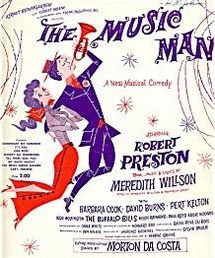
From Broadway To 52nd Street
The Music Man opened at the Majestic Theatre on December 19,1957 and entered the ranks of “Blockbuster” with one thousand three hundred and seventy-five performances. The book, music and lyrics were written and composed by Meredith Wilson for Robert Preston and Barbara Cook, who held the starring roles. The cast album won five Grammy Awards for “Best Original Cast Album”, was on the Billboard charts for 245 weeks and spawned a 1962 film version in which Preston reprised his role with Shirley Jones as the lead love interest. The song “Till There Was You” remains a jazz standard today.
The Story: This is the tale of smooth talking con man Harold Hill who poses as a boys band organizer and leader and sells band instruments and uniforms to naive townsfolk before skipping town with the cash. In River City, Iowa the prim librarian and piano teacher Marian Paroo sees through him, but when Hill helps her younger brother overcome his fear of social interactions due to his lisp, Marian begins to fall in love with Harold. Harold, in turn falling for Marian, risks being caught to win her.
Jazz History: Swing music or simply “Swing” is a form of American music that developed in the early 1930s and became a distinctive style by 1940. Swing uses a strong rhythm section of double bass and drums as the anchor for a lead section of brass instruments such as trumpets and trombones, woodwinds including saxophones and clarinets and sometimes stringed instruments such as violin and guitar, medium to fast tempos, and a “lilting” swing time rhythm. The name swing came from the phrase “swing feel” where the emphasis is on the off–beat or weaker pulse in the music, unlike classical music. Swing bands usually featured soloists who would improvise on the melody over the arrangement.
The danceable swing style of big bands and bandleaders were the dominant form of American popular music from 1935 to 1946, a period known as the Swing Era.
Sponsored By

www.whatissuitetabu.com
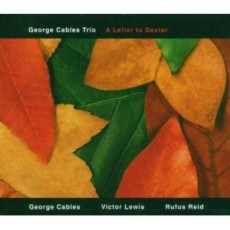
Daily Dose Of Jazz…
George Andrew Cables was born November 14, 1944 in New York City and was classically trained as a youth. He discovered jazz while attending the New York High School for Performing Arts, smitten by the freedom of expression. But unlike most musicians who are influenced by a single pianist, George listened to the whole bands of Miles and Trane and how they held together.
By 1964 he was playing in a band called The Jazz Samaritans that included Billy Cobham, Lenny White and Clint Houston. Playing gigs around New York at the Top of the Gate, Slugs, and other clubs attracted attention to Cables’ versatility and before long he had recorded with tenor saxophonist Paul Jeffrey, played with Max Roach and earned a brief 1969 tenure at the piano bench with Art Blakey and the Jazz Messengers and later with Sarah Vaughan, Tony Williams, Roy Haynes and Dizzy Gillespie.
A 1969 tour with tenor titan Sonny Rollins took Cables to the West Coast and by 1971 he became a significant figure in the jazz scenes of Los Angeles, where he first resided, and San Francisco, where he also lived. Collaborations and recordings with tenor saxophonists Sonny Rollins and Joe Henderson, trumpeters Freddie Hubbard and Woody Shaw, and vibist Bobby Hutcherson made Cables’ wide-ranging keyboard skills, often on electric piano, amply evident. Demand for his sensitive accompaniment increased and by the end of the 1970s, Cables was garnering a reputation as everyone’s favorite sideman.
Perhaps the most pivotal turn came when Dexter Gordon invited Cables into his quartet in 1977. The two years he spent with the tenor giant ignited Cables’ passion for the acoustic piano and immersed him in the bebop vocabulary. But the longest standing relationship Cables developed in the late seventies was with alto saxophonist Art Pepper, becoming his favorite pianist.
George Cables has emerged as a major voice in modern jazz and currently performs and records as a soloist, with trio and larger ensembles, and as a clinician in college jazz programs in addition to composing and arranging for his own albums and others.
More Posts: piano
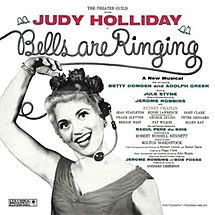
From Broadway To 52nd Street
Bells Are Ringing opened on November 29, 1956 at the Shubert Theatre, starring Judy Holliday, Jean Stapleton, Sydney Chaplin, Jack Weston and John Cleese, running 924 performances. The music and lyrics were composed and written by Jule Styne, Betty Comden and Adolph Green. The original production was directed by Jerome Robbins, choreographed by Robbins and Bob Fosse and ran for 924 total performances after transferring to the Alvin Theatre. The Party’s Over and Just In Time rose to prominence as jazz standards.
The Story: Ella Peterson works in the basement office of “Susanswerphone”, her boss, Sue, telephone answering service. Listening in on others’ lives, adds some interest to her own humdrum existence by adopting different identities and voices for her clients. They include Blake Barton, an out-of-work method actor, Dr. Kitchell, a dentist with musical yearnings but lacking talent, and playwright Jeff Moss, who is suffering from writer’s block and desperately needs a muse. Ella considers the relationships with these clients “perfect” because she can’t see them and they can’t see her.
When Jeff Moss pleads with Ella for help in writing, she responds, and a romance ensues. Complications arise when Ella thinks that she does not fit in with Jeff’s wealthy friends. Adding complications are the police, who are certain the business is a front for an “escort service,” and Sandor, the owner’s shady boyfriend, who unbeknownst to Sue is using the agency as a bookmaking operation.
Broadway History: Off-Off-Broadway theatrical productions in New York City are those in theatres that are smaller than Broadway and Off-Off Broadway theatres. Off-Off-Broadway theatres are often defined as theatres that have fewer than 100 seats,though the term can be used for any show in the New York City area that employs union actors but not under an Off-Broadway, Broadway or Lort contract. It is often used as a term relating to any show with non-union actors. The shows range from professional productions by established artists to small amateur performances.
Sponsored By
www.whatissuitetabu.com
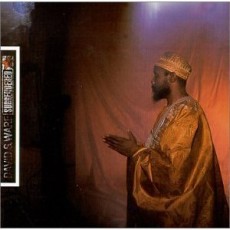
Daily Dose Of Jazz…
David S. Ware was born on November 7, 1949 in Plainfield, New Jersey and began playing at age ten due to his father’s admiration for the saxophone and his large record collection. While in high school he played in the bands and ventured into New York as a teenager to listen to jazz. He had informal practice sessions with Sonny Rollins as a youth in the ’60s; then as part of the fertile NYC Loft Jazz era of the ’70s.
During this decade, he joined the Cecil Taylor Unit and Andrew Cyrille’s Maono. He also worked together with drummers Beaver Harris and Milford Graves. In the early ’80s he toured Europe with both Andrew Cyrille and his own trio. In mid-decade, Ware purposefully engaged himself in a period of extensive woodshedding – in order to further develop both his personal sound and his visionary group concept.
The ’90s saw the full-on actualization of this group, and the recognition of David S. Ware as a true saxophone colossus. A series of groundbreaking albums by the David S. Ware Quartet were released on the Silkheart, DIW, Homestead, AUM Fidelity, and Columbia Jazz labels. Perhaps the most highly acclaimed group of the last decade, David’s efforts were rewarded by being one of the very few jazz musicians whose work was appreciated by an audience outside the narrow confines of the jazz world. In an unprecedented coup, the ‘Cryptology’ album garnered the lead review slot in Rolling Stone Magazine.
Over the course of his career, tenor saxophonist David Ware has recorded for Columbia, Black Saint, DIW, Silkheart, Homestead, AUM Fidelity and Thirsty Ear record labels. He has performed with a host of musicians and was responsible for bringing the young pianist Matthew Shipp to the attention of the jazz environment. David S. Ware, who has played the most prestigious clubs and festivals around the globe passed away on October 18, 2012 ar age 62 in New Brunswick, New Jersey.
More Posts: bandleader,composer,saxophone
Daily Dose Of Jazz…
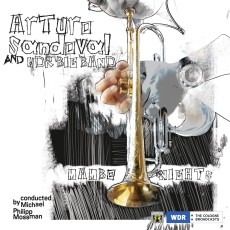
Arturo Sandoval was born in Artemisa, Cuba on November 6, 1949 and began to play music at age 12 in the village band. After playing many instruments, he fell in love with the trumpet. In 1964, he began three years of serious classical trumpet studies at the Cuban National School of Arts. By the age of 16 he had earned a place in Cuba’s all-star national band and was totally immersed in jazz influenced by Charlie Parker, Clifford Brown and with Dizzy Gillespie as his idol and later mentor and colleague.
In 1971 he was drafted into the military. Luckily, Sandoval was still able to play with the Orquesta Cubana de Musica Moderna. In Cuba, Sandoval co-founded the band Irakere with Chucho Valdes and Paquito D’Rivera. They quickly became a worldwide sensation. Their appearance at the 1978 Newport Jazz Festival introduced them to American audiences and garnered them a recording contract with Columbia Records.
Arturo defected to the United States while touring in Spain with Dizzy in 1990, becoming a naturalized citizen in 1999 and has enjoyed a successful career. He has played with Woody Herman, Herbie Hancock, Woody Shaw, Stan Getz, Celine Dion, Tito Puente, Patti LaBelle, Frank Sinatra, Paul Anka, Gordon Goodwin and numerous others.
His life was the subject of the 2000 TV film For Love or Country: The Arturo Sandoval Story, starring Andy Garcia. He currently continues to perform, tour and record around the globe.
More Posts: flugelhorn,piano,trumpet